5 September 2026
10 Best Phonics Classes in India (2026): An Honest Comparison
10 Best Phonics Classes in India (2026): An Honest Comparison
posted on : 22 July 2026
Search for phonics classes in India and every result says the same thing: we're the best, book a demo. Not much help when you're trying to compare ten of them at 11pm.
So here is the comparison we wish existed: the 10 best phonics classes in India in 2026, what each one actually offers, who each is a good fit for, and the questions that cut through the marketing. One honest note before we start: Learn2Read (that's us) runs one of these programs. We've put ourselves at #1, disclosed it openly, and given you the exact criteria to judge us by, so you can disagree with the ranking and still leave with everything you need.
Table of Contents
Why Phonics Matters So Much for Indian Kids
Phonics matters in India because most children learn English as a second or third language, and phonics gives them a system for reading unfamiliar English words instead of memorising spellings by rote.
The national picture shows how much room there is to improve. ASER 2024, the nationwide rural education survey run by Pratham, found that only 23.4% of Class 3 children could read a Class 2-level text, an improvement on 16.3% in 2022 but still leaving roughly three out of four children behind. And the method itself is well proven: the UK's Education Endowment Foundation rates phonics as high impact, worth around five months of extra reading progress on average, when taught explicitly and systematically.
That last phrase, "explicitly and systematically", is the quiet dividing line between the classes below. Keep it in mind as you compare.
How We Picked These 10 (Read This First)
Every program on this list was assessed on five things: the teaching method (systematic synthetic phonics preferred), whether teaching is live with real-time feedback, class format and size options, how visible progress is to parents, and how easy it is to try before paying.
Full transparency: Learn2Read publishes this blog and appears on this list, so treat our #1 spot as a founder's pick and hold us to the same five criteria as everyone else. Details for every provider come from their own public websites as of July 2026; offerings and prices change, so always confirm on a trial call. No provider paid to be here.
The 10 Best Phonics Classes in India, Compared
| # | Program | Format | Known for |
|---|---|---|---|
| 1 | Learn2Read | Live online classes (Zoom) | Systematic synthetic phonics for ages 3-12, structured levels, trusted by parents in 35+ countries |
| 2 | PlanetSpark | Live online, 1:1 and small groups | Big-brand platform; synthetic sequence plus Jolly Phonics courses, app-based practice |
| 3 | Tiny Steps Learning | Live online, 1:1 | One-to-one phonics for ages 3-12 with recordings and free assessment |
| 4 | instrucko | Live online, 1:1 and groups | Teachers from the UK and India; curriculum mapped to global boards |
| 5 | Bambinos.live | Live online groups | Bangalore-based platform for phonics, spoken English and storytelling |
| 6 | iSchooling | Live online | 42-sound phonics with blending and spelling strategies; serves India and the Gulf |
| 7 | Kiddie Expert | Live online | Jolly Phonics in three levels: beginners, basic, advanced |
| 8 | Little Genius Academy | Online and offline (Ahmedabad) | India-first "Pure Phonics" method in a 36-session structure |
| 9 | Phonics Power | Centres (Chennai) and online | Jolly Phonics-inspired courses for ages 5-12 plus teacher training |
| 10 | Katral Elithu | Live online | Phonics classes popular with Tamil-speaking families |
1. Learn2Read
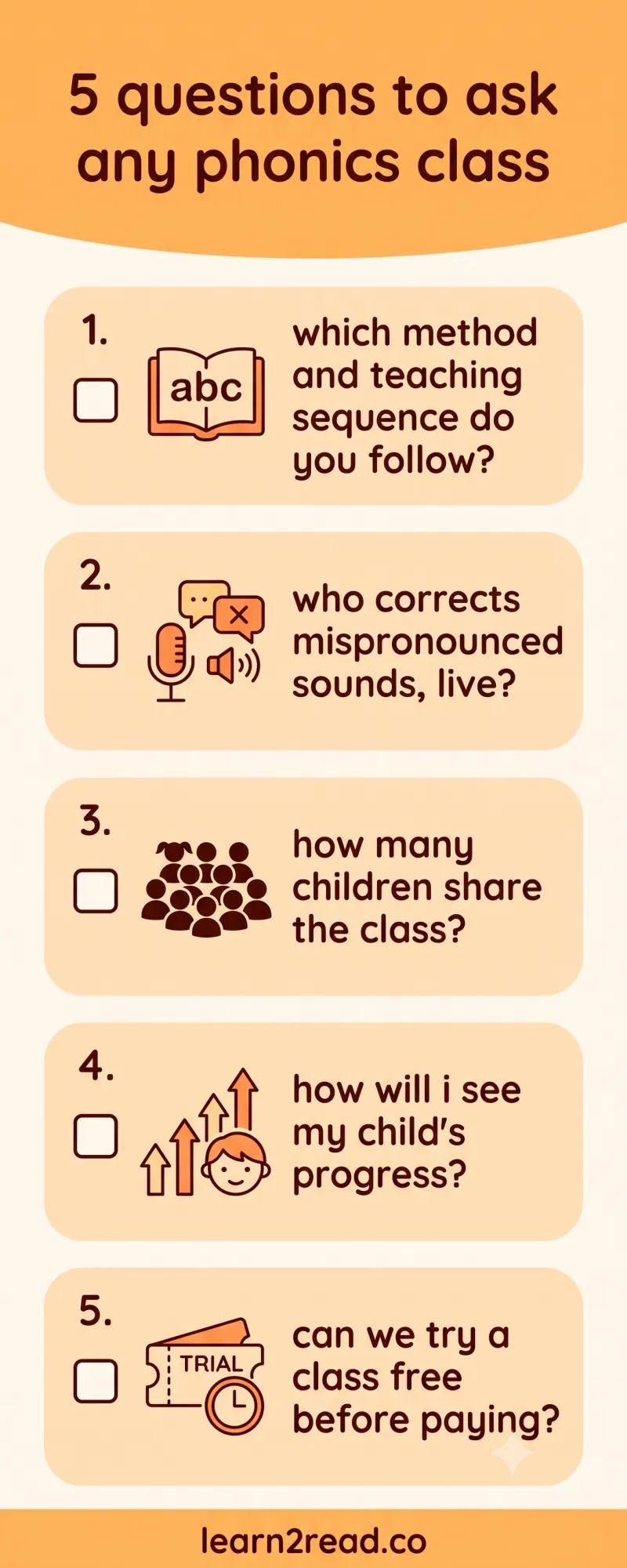
Learn2Read is a live online phonics program for children aged 3-12, teaching systematic synthetic phonics in small classes over Zoom with trained teachers. Children move through structured levels, from first lowercase sounds like s, a and t in Junior Readers (ages 3-3.5) to blending and first sight words in Junior Readers PLUS (ages 3.5-4), with placement based on the child's actual level rather than age alone. Parents across 35+ countries use the program, and the first class is a free trial. Good fit for: parents who want live teaching, a clear written sequence, and a program they can test before paying.
2. PlanetSpark
PlanetSpark is one of India's largest online platforms for children's communication skills, and its phonics offering runs as live 1:1 or small-group video sessions. The teaching follows a systematic synthetic sequence (single sounds like s, a, t, p, i, n, then digraphs and blends), and the company also runs dedicated Jolly Phonics courses. Expect a tech-heavy experience: dashboards, gamified practice and app-based homework. Good fit for: parents who want a large, established brand with 1:1 attention and plenty of digital practice material.
3. Tiny Steps Learning
Tiny Steps Learning offers one-to-one online phonics, grammar and public speaking classes for ages 3-12, built around systematic synthetic phonics. Lessons are recorded for parents to review, home practice is guided, and the starting level comes from a free assessment rather than age. Good fit for: families who specifically want 1:1 teaching and full visibility of every lesson.
4. instrucko
instrucko runs live online English and phonics classes with instructors from both the UK and India, in group or one-to-one formats, with a curriculum mapped to major global examination boards. Good fit for: families who want exposure to UK-trained teachers or plan to move between international school systems.
5. Bambinos.live
Bambinos is a Bangalore-based live classes platform covering phonics, spoken English and storytelling for young children. Classes are taught live in groups, and the company has become one of the more recognisable Indian names in early English learning. Good fit for: parents who want an Indian platform with a broader spoken-English pathway after phonics.
6. iSchooling
iSchooling teaches online phonics built around the 42 English letter sounds, with a clear emphasis on blending for reading and segmenting for spelling, and it makes a point most Indian parents will recognise: children here are usually made to memorise spellings rather than given tools to work them out. It serves families in India, the Gulf and beyond. Good fit for: parents whose main frustration is spelling tests.
7. Kiddie Expert
Kiddie Expert runs online Jolly Phonics courses in three levels (beginners, basic and advanced), teaching the 42 sounds through the classic Jolly Phonics mix of songs, actions and stories, then moving into digraphs, tricky words and spelling rules. Good fit for: parents who specifically want the Jolly Phonics method, level by level.
8. Little Genius Academy
Little Genius Academy grew out of Ahmedabad with a "Pure Phonics" approach it designed for Indian learners, arguing that imported programs don't always fit children for whom English isn't the home language. The program runs as a 36-session structure, online and offline. Good fit for: families who want an India-first method and a fixed, finite course length.
9. Phonics Power
Phonics Power is a Chennai institution offering Jolly Phonics-inspired courses for children aged roughly 5-12 through physical centres and online classes, along with teacher training programs. Good fit for: Chennai families who prefer in-person classes at a centre with a long local track record.
10. Katral Elithu
Katral Elithu runs online phonics classes that have built a loyal following among Tamil-speaking families, with parent reviews on its site repeatedly praising the patience of its teachers. Good fit for: Tamil-medium homes adding English reading, especially parents who found their child stuck at rote word-learning.
How to Choose Between Them: 5 Questions That Cut Through the Marketing
The right phonics class for your child is the one that answers five questions well: which method and teaching sequence they follow, who corrects mispronounced sounds live, how many children share the class, how parents see progress, and whether you can try a class free before paying.
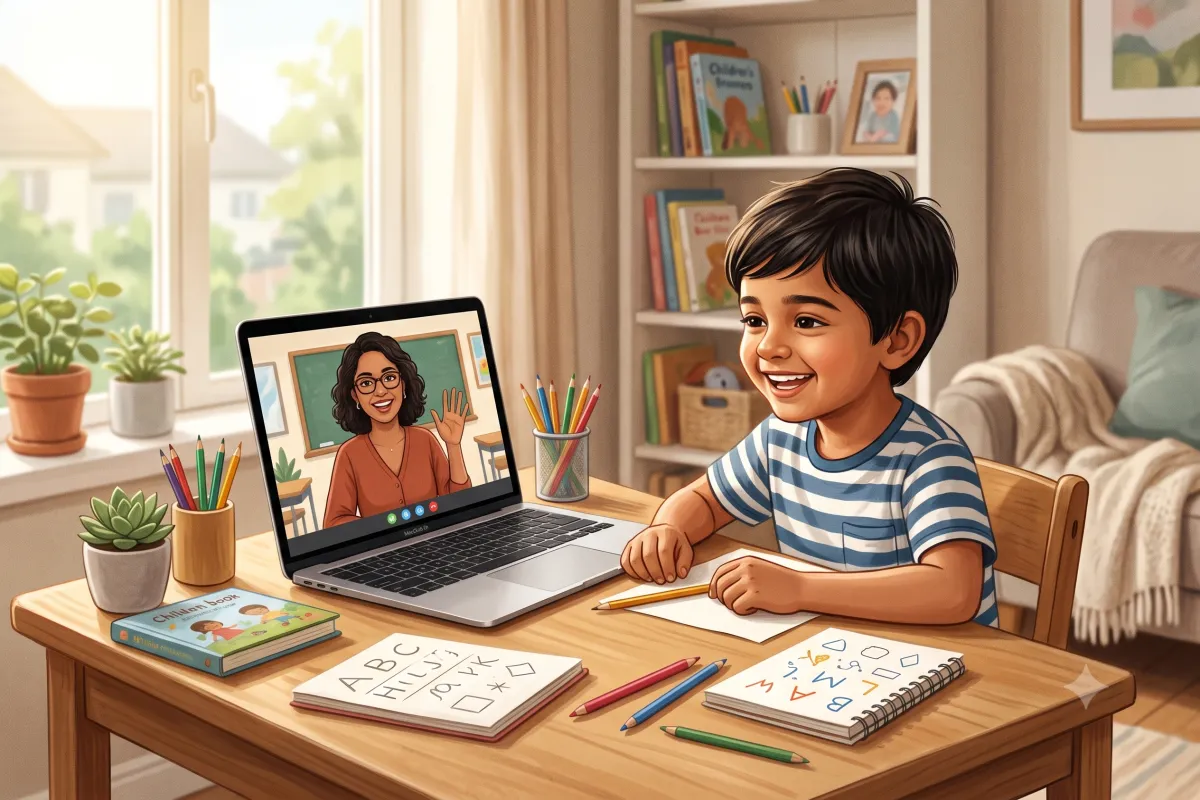
Ask all five on every demo call, in that order. Method and sequence knock out programs that teach the alphabet a to z; the live-correction question separates real teaching from video-watching; and any program that hesitates on the free trial has answered question five for you.
FAQs: Phonics Classes in India
Which is the best phonics class in India? The best phonics class in India is the one that teaches systematic synthetic phonics with live teacher feedback, small classes, visible progress for parents, and a free trial. Learn2Read tops this list on those criteria (declared openly, since we publish it), with PlanetSpark and Tiny Steps Learning as strong alternatives; test any two on a free trial and compare.
What age should my child start phonics classes in India? Most children are ready for structured phonics classes between ages 3 and 4, once they notice that words are made of sounds and can sit for a short activity. Starting around preschool age means the sound code is in place before school spelling tests begin, but older children catch up well with a program that assesses their level first.
Are online phonics classes better than offline centres in India? Neither wins automatically; what matters is live correction and class size. A good online class with a trained teacher correcting sounds in real time beats a crowded offline batch, while a strong local centre beats passive video lessons. Online adds practical wins for Indian families: no commute, easy scheduling, and access to good teachers from smaller towns.
How many phonics classes per week does a child need? Two to three short classes a week, plus 5-10 minutes of home practice on most days, is the rhythm that works for most children aged 3-8. Consistency beats intensity: daily contact with sounds moves a child faster than one long weekly session.
Will phonics classes help with school spellings and reading exams? Yes. Phonics teaches children to segment words into sounds for spelling and blend sounds for reading, which is exactly what school dictation and reading tasks demand. Children who rely on rote memorisation tend to plateau when word lists get longer; children with phonics have a system that scales.
How much do phonics classes cost in India? Fees vary widely by format: one-to-one classes cost the most, small groups sit in the middle, and apps or recorded courses cost the least but lack live correction. Rather than comparing price lists, compare cost per live speaking turn your child gets, and always use the free trial before paying anything.
Ten good options is a nicer problem than none, and India now genuinely has ten. Shortlist two, take the five questions to both trial classes, and let your child's face during the class cast the deciding vote. If one of those trials is with us, we'd be delighted.
Read Next

Latest Posts
2 September 2026
Homework Battles: 7 Do's & Don'ts for Ages 5-8 (2026)
29 August 2026
Kids' Attention Spans & Short Videos: What Parents Must Know
25 August 2026