7 October 2026
Can AI Teach Your Child to Read? An Honest Answer for Parents (2026)
Can AI Teach Your Child to Read? An Honest Answer for Parents (2026)
posted on : 11 August 2026
Your child asks the voice assistant for a story. An app promises an "AI reading tutor smarter than any teacher." Somewhere between amazement and unease, you're wondering the same thing as millions of parents this year: can AI actually teach my child to read?
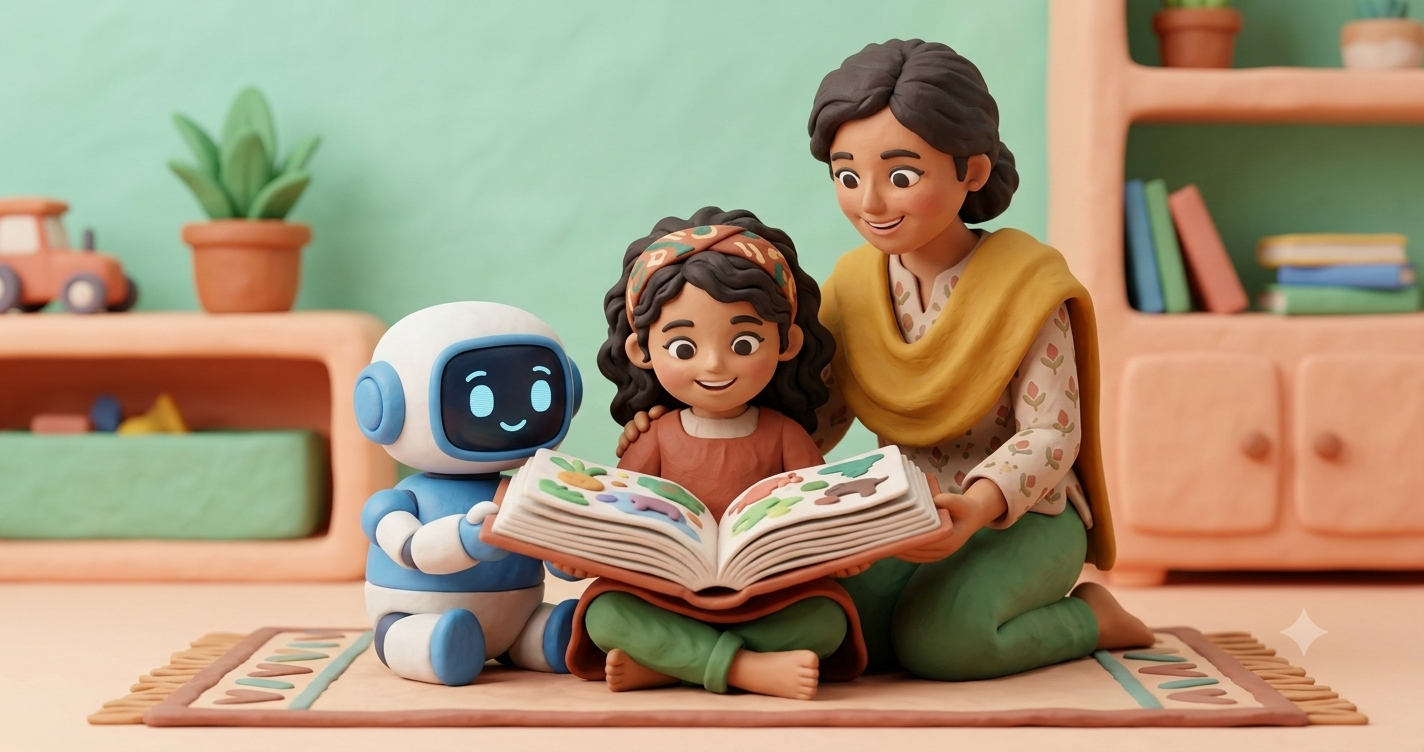
Here's the honest answer up front: AI can be a genuinely useful practice partner for a child who already reads — but it cannot do the core job of teaching a beginning reader, because young brains learn language from live human interaction, not from information delivery. The rest of this guide shows you exactly where the line sits, and how to use AI on the right side of it.
No fear-mongering, no hype. You'll leave knowing what AI reading tutors do brilliantly, where they quietly fail, and the five rules that make AI safe and useful at home.
In this guide:
What AI Reading Tutors Do Well
Credit where it's due — a good AI reading tutor brings real strengths that tired parents feel immediately. It never runs out of patience at 7pm. It answers "why?" for the forty-first time in the same cheerful tone. It can generate endless practice at exactly your child's level — five more short-a words, three more rhyming riddles, a fresh silly sentence for the word "ship."
This is not a small thing. Repetition is the fuel of reading practice, and AI produces it instantly, cheaply, and without sighing.
Parents have noticed. About 1 in 3 parents say their child has already used AI for school-related learning (Common Sense Media, 2025), and 1 in 10 children aged 5-12 now use AI chatbots like ChatGPT or Gemini (Pew Research Center, 2025). The question is no longer whether your child will meet AI. It's what role it should play.
What AI Can't Do for a Beginning Reader
A beginning reader — roughly ages 3 to 7 — isn't just absorbing information. Their brain is being wired, and decades of research show that wiring happens through live, back-and-forth human interaction.
The evidence is strikingly specific. In a well-known Child Development experiment, toddlers learned new words from a live video chat but not from a pre-recorded video of the very same speaker — because the live person responded to them (the "Skype Me!" study). Harvard's Center on the Developing Child calls this "serve and return": the child serves (a look, a sound, an attempt), the adult returns it, and that exchange physically builds brain architecture (more here).
An AI can imitate the return. It cannot mean it. As educator Anne Tapp Jaksa put it in Education Week this year: "Artificial intelligence can simulate the sounds of warmth and attentiveness — but it does not experience them" (her full argument).
There are practical gaps too. AI often mishears a 5-year-old's "th" attempt, so its pronunciation feedback wobbles exactly where a beginner needs precision. It confidently gets things wrong. And it can't see the wiggling, the drifting eyes, the crumbling confidence — the signals a teacher reads and responds to in seconds. So far, research simply does not show AI tutors outperforming human teachers for young learners — and for beginning readers, the interaction gap is the reason.
AI Tutor vs Human Teacher: Side by Side
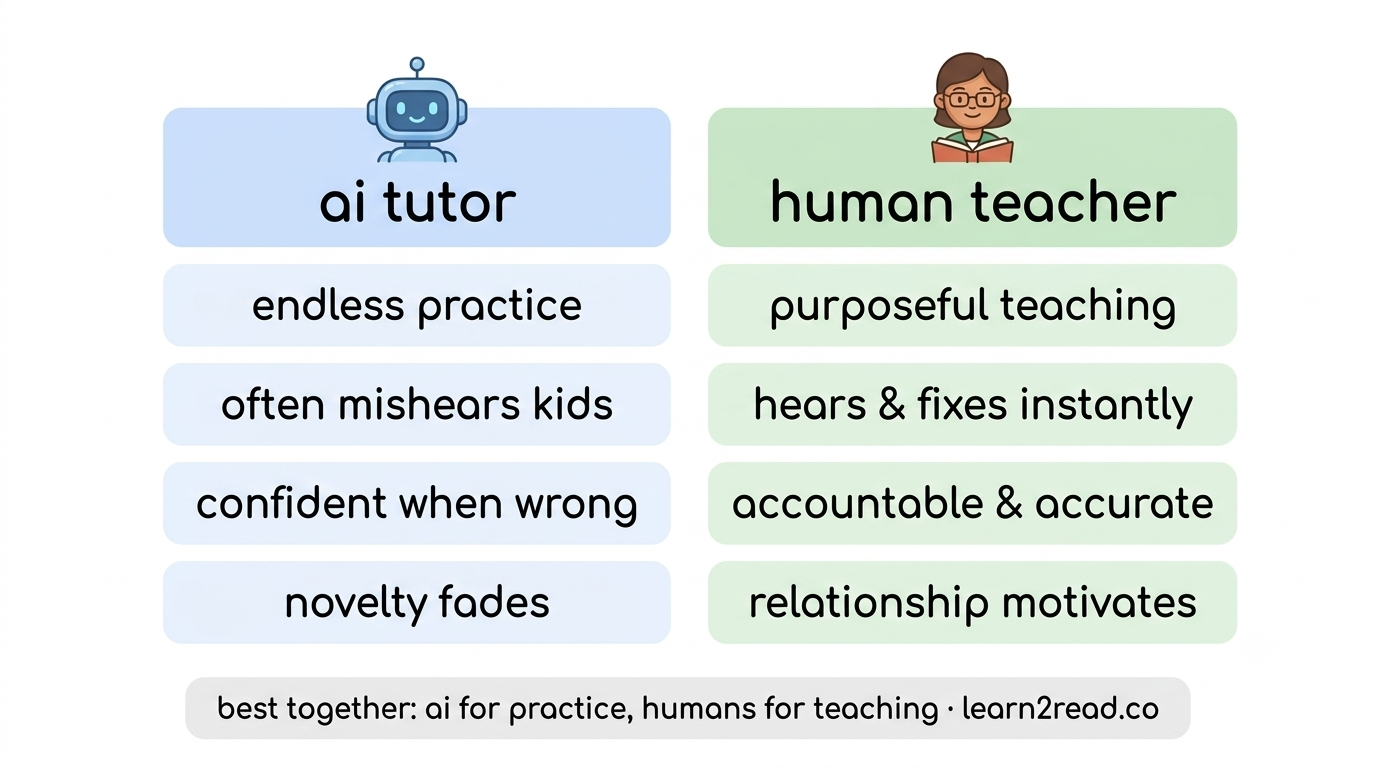
| AI reading tutor | Live human teacher | |
|---|---|---|
| Patience | Infinite, never tired | Human — but warm and real |
| Availability | 24/7, instant | Scheduled classes |
| Practice generation | Endless, instant, levelled | Prepared, purposeful |
| Hearing a child's attempt | Often mishears young speech | Hears, diagnoses, fixes on the spot |
| Accuracy | Confident even when wrong | Accountable, checkable |
| Motivation | Novelty (fades) | Relationship — "my teacher knows my name" |
| Serve-and-return | Simulated | Real — the thing young brains wire from |
| Best role | Practice partner, ages 6+ with an adult | Core teaching, ages 3-7 especially |
📌 Screenshot this table — it settles the family debate in one image.
The 5 Rules for Using AI the Smart Way
Used well, AI is a brilliant assistant to you — not a replacement for you. Our teachers' five rules:
- You drive, AI serves you. The winning move is a parent typing: "Give me 5 three-letter words with the short a sound for my 5-year-old" or "Write 4 rhyming riddles ending in -at." You get instant teaching material; your child gets you.
- AI is used together, never alone. Same stranger rule we set in our screen-time do's and don'ts: your child wouldn't chat alone with a friendly stranger, however clever.
- Teach the golden sentence. "AI can be wrong — let's check." Children who hear this early build the one thinking habit the AI age demands.
- Keep AI away from first phonics. Letter sounds must be taught precisely and in order — the approach the science of reading settled. Wrong sounds learned early take months to unlearn; this is the stage for a trained human.
- Protect the humans-only zones. Bedtime stories, cuddled-up reading, "read it to grandma" — no efficiency gain is worth trading these. They're where readers are made.
Where a Live Teacher Fits
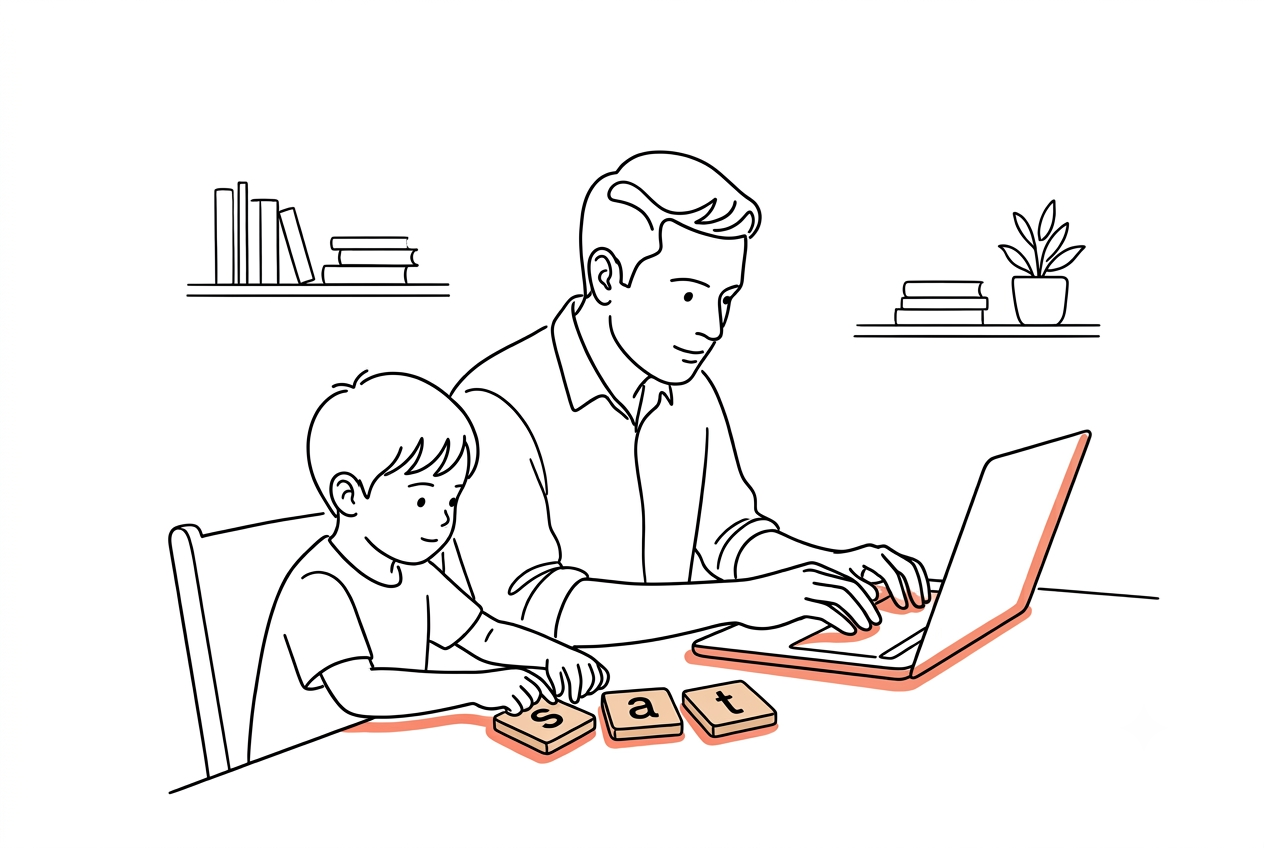
If AI's weakness is that it can only simulate the return, the fix isn't less screen — it's a real human on the screen. That's the entire design of Learn2Read: a live online phonics program for children aged 3-12, taught over video by real teachers across 35+ countries.
In a live class, the serve-and-return is real. The teacher hears your child attempt "sss," catches the slip, celebrates the win by name, and adjusts the next minute of the lesson to the child in front of her — everything the research says a beginning reader's brain needs, delivered through the same screen the AI apps use. Systematic phonics from a skilled human remains the most evidence-backed way to teach reading (National Reading Panel report).
Our simple formula for the AI age: AI for practice materials, humans for teaching, and you for the love of books. Wondering where your child stands right now? Five minutes with our reading milestones by age guide will tell you.
FAQs: AI and Learning to Read
Is ChatGPT safe for my 6-year-old to use alone? No — major AI chatbots are not designed for young children, and they can produce confident errors or content that needs adult judgment. Use AI together: you type, you read aloud, you filter. Treat it like a brilliant stranger — helpful in your company, never alone with your child.
Can AI apps replace phonics classes? Not for beginning readers. Apps and AI tutors are effective for extra practice — letter games, word drills — but learning the letter-sound code needs precise, responsive teaching: someone who hears the child's attempt and corrects it in the moment. Research consistently supports systematic, explicitly taught phonics, and AI can't yet hear and coach young speech reliably.
Do AI reading tutors actually work? For older children practising skills they already have, they can help. For children still learning to read, there is no strong evidence that AI tutors match human teachers — and clear evidence that young children learn language best from live, responsive interaction, as the "Skype Me!" study showed.
My child prefers talking to the AI over reading books. Should I worry? Treat it as a signal, not a crisis. AI chat gives instant answers with zero effort, which can outcompete the slower reward of reading. Rebalance: cap AI use to together-time, keep a daily no-screens story slot, and let your child pick the books — choice rebuilds pull toward reading.
What's the best way to use AI for reading practice at home? Let AI make materials while you do the teaching. Ask it for word lists by sound ("short e words for a 5-year-old"), rhyming riddles, or a silly story using this week's phonics words — then play those with your child on paper or out loud. Ten minutes of parent-led play beats an hour of child-alone app time.
At what age can a child use AI tools independently? There's no official age, but current chatbots are generally built for teens and adults — several require users to be 13+. Through age 12, keep AI use supervised and purposeful; under 8, AI should only ever be something you use together, briefly, with you holding the device.
Read Next
- The Science of Reading, Explained for Parents — the method debate behind this whole question.
- Screen Time for Kids: 7 Do's and Don'ts That Actually Work — including the AI stranger rule.
- Advantages and Disadvantages of AI in Education for Young Kids — the broader classroom picture.
Want to see real serve-and-return through a screen — a live teacher who knows your child's name?
Book a Free Trial Class →
— The Learn2Read Team

Latest Posts
3 October 2026
Early Signs of Dyslexia in Children: Ages 4 to 7, and 5 Things That Look Like It
30 September 2026
My Child Can Read But Doesn't Understand: Why It Happens and How to Fix It (Ages 5 to 8)
26 September 2026