7 October 2026
My Child Can Read But Doesn't Understand: Why It Happens and How to Fix It (Ages 5 to 8)
My Child Can Read But Doesn't Understand: Why It Happens and How to Fix It (Ages 5 to 8)
posted on : 30 September 2026
Your child reads the page beautifully. Every word, decent pace, barely a stumble. You ask what happened in the story and get a shrug.
If your child can read but doesn't understand what they read, the cause is almost never carelessness and almost never laziness. Reading is two separate skills stacked on top of each other, and your child has one of them. The other one is missing, and it is a different skill with a different fix.
This guide explains which half is missing, how to find out with one ten-minute check tonight and one tomorrow, and what to do about it. It covers the reason most often missed with children who speak another language at home, which is rarely what parents are told it is.
In this guide:
Why can a child read words but not understand them? · The four reader profiles: which one is your child? · What if English isn't the language you speak at home? · Six signs your child is reading words without meaning · How to fix it when your child can read but doesn't understand · Unseen passage marks dropping? What Indian and Gulf parents see first · When does a comprehension problem need more than home practice? · FAQs
Why Can a Child Read Words But Not Understand Them?
A child can read words but not understand them because reading comprehension needs two separate abilities, and saying words correctly only proves one of them. Reading researchers call this the Simple View of Reading, proposed by Gough and Tunmer in 1986. Many research studies have since supported it.
The formula, as the Massachusetts Department of Elementary and Secondary Education writes it:
fluent word reading × language comprehension = reading comprehension
Multiply the two. Do not add them. If either side is near zero, the answer is near zero, however strong the other side is.
Fluent word reading is turning letters into sounds and sounds into words, fast enough that it stops costing effort. Language comprehension is understanding those words when you hear them: vocabulary, grammar, and knowing enough about the world for the sentence to mean something.
A child who reads a page aloud perfectly and remembers nothing has the first ability and not the second. Teachers sometimes call this word calling: correct sounds, no meaning behind them.
There is a third possibility that gets missed constantly. A child can be decoding so slowly and effortfully that there is nothing left over for meaning.
The words come out right, but every drop of attention went into producing them. From the outside that looks identical to a vocabulary problem. The check further down separates the two over a couple of evenings.
The Four Reader Profiles: Which One Is Your Child?
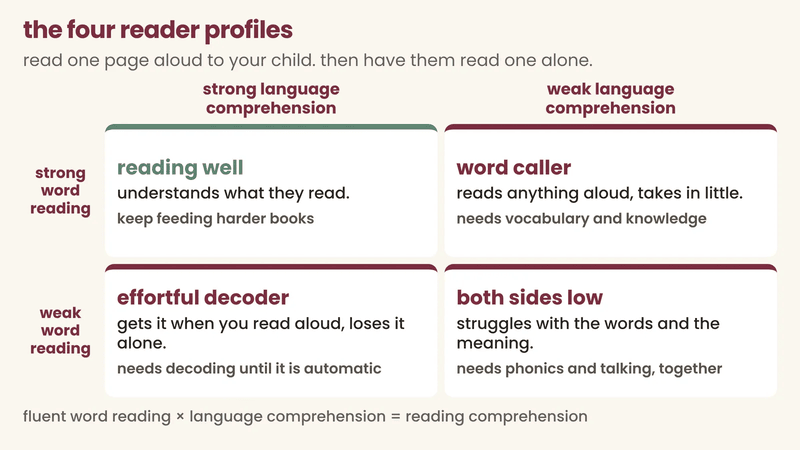
Every reader sits in one of four boxes, and a child who can read but doesn't understand is in one of two of them. Finding the right box is the whole diagnosis, and it takes one evening.
Strong language comprehension | Weak language comprehension | |
Strong word reading | ✅ Reading well. Keep feeding harder books. | Word caller. Reads anything, understands little. Needs vocabulary and background knowledge. |
Weak word reading | Effortful decoder. Understands everything you read to them, loses it when reading alone. Needs decoding practice until it gets automatic. | Both sides low. Needs structured phonics and spoken language work together. |
📌 Screenshot this. Most parents find their child in one box within about thirty seconds.
Profile | What helps | What is wasted |
Word caller | Vocabulary, background knowledge, talking about books | More phonics drills, more reading practice |
Effortful decoder | Decoding practice until it is automatic | Comprehension worksheets |
Both sides low | Structured phonics and spoken language together | Doing only one of the two |
Reading well | Harder books | Anything corrective |
Here is the check that places your child. Pick a book your child would find a bit hard, roughly what you would read to them at bedtime.
Tonight, read one page aloud to them, then ask: "who was this bit about, and what did they want?" Tomorrow night, have them read a page of the same book themselves, and ask the same two questions.
Understands it when they hear it, loses it when they read it → effortful decoder. The bottleneck is word reading.
Struggles both ways → language comprehension is the gap.
Understands both ways → whatever is happening is about attention or interest, rather than skill.
If the words themselves were easy both times and only the meaning was missing, that is the word caller box. If the words were a struggle too, both sides need work.
What If English Isn't the Language You Speak at Home?
A child who speaks another language at home can read English accurately and still understand very little of it. This is the situation parents are most often given the wrong advice about, and in India and the Gulf it is the most misread of all.
Your child sits in an English-medium classroom all day and speaks Hindi, Arabic, Tamil, Bangla, Malayalam or Tagalog at home from three o'clock. So they learn to decode English long before they know what all the words mean. English as a second language reading is a vocabulary problem wearing a reading problem's clothes.
Reading researcher Timothy Shanahan puts the problem exactly, writing at Reading Rockets: phonics instruction does benefit second-language learners, but "the effects for such instructional efforts are more modest than those for first-language learners," because phonics is "a necessary but insufficient condition for reading comprehension" when a child does not know what the English words mean.
So when a bilingual child can read but doesn't understand, the standard advice a parent gets, more phonics and more reading practice, is aimed squarely at the half your child already has.
What actually moves this child:
Talk about the book in whichever language flows best. Understanding a story in Hindi and then meeting it in English is faster than not understanding it in either. Your home language helps here.
Pre-teach five words before reading, not after. Look at the pictures, name the five words the page depends on, say them, act them out. Then read.
Keep reading aloud to them in English well past the age they can read alone. For most children at this age, listening vocabulary runs well ahead of reading vocabulary. That gap is where new words come from.
Choose books about things they already know. A story set in a kitchen beats a story set in a barn if they have never seen a barn. Background knowledge is half of language comprehension.
Watch English with subtitles on. Hearing the word and seeing it spelled at the same moment does real work.
Run the same check in your home language. Read a page of a Hindi or Arabic book aloud and ask the same two questions.
What happens | What it means | What to do |
Answers well in the home language, poorly in English | English vocabulary gap | Build English words. Skip comprehension exercises |
Struggles in both languages | Language comprehension gap, not a language-of-instruction one | Talk more, in whichever language is strongest |
Answers well in both when heard, poorly when reading English | Decoding effort in English | Go back to phonics first |
📌 Worth screenshotting before your next PTM.
One correction worth making out loud, because parents in India and the Gulf get told the opposite: speaking another language at home is not what causes English reading problems. As Shanahan puts it, decoding "provides pronunciation, but not comprehension" when a child does not yet know the words. So the fix is more English meaning, while keeping your own language strong.
Six Signs Your Child Is Reading Words Without Meaning
Reading words without meaning shows up as a pattern, not as a single bad evening. Any one of these can happen when a child is tired. Three or more, most weeks, is the pattern that says your child can read but doesn't understand.
Reads aloud fluently, then cannot answer a simple question about what just happened. This is the classic my child reads fluently but doesn't understand pattern.
Can tell you what happened on the last page but not what the chapter was about.
Never asks what a word means, at any age, in any book.
Reads straight past a sentence that makes no sense, including one you have deliberately scrambled.
Retells the story as a list of things that happened, with no reason why any of it happened.
Reading level and listening level look completely different: bored by the audiobook they love, stuck on the book they read.
Sign 4 is the most useful and the easiest to run. Take a page your child knows and quietly change one word so a sentence turns into nonsense. A child who is reading for meaning stops and frowns. A child who is word calling reads straight through.
How to Fix It When Your Child Can Read But Doesn't Understand
Reading comprehension for kids is built by talking about books. Fifteen minutes an evening, four evenings a week, is the dose our teachers use. Here is the order that works.
Weeks 1 and 2: stop asking recall questions
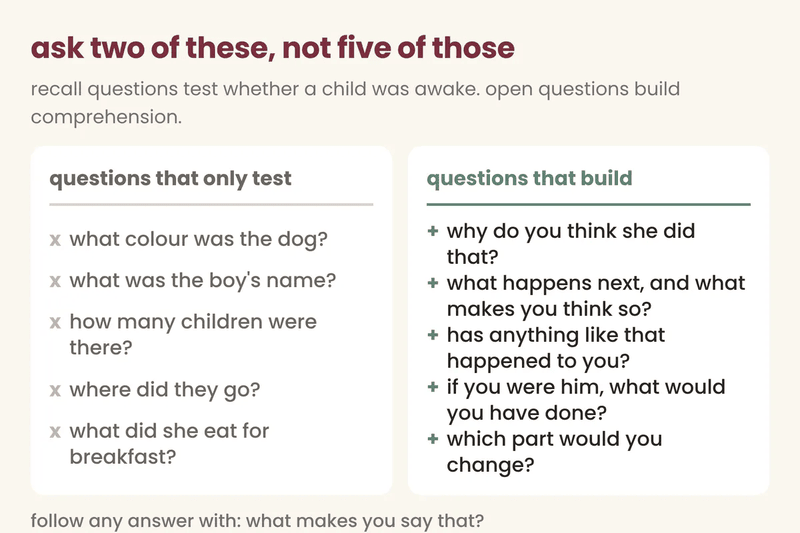
"What colour was the dog?" teaches nothing. Recall questions only test whether a child was awake. Swap them for questions with no single right answer:
Why do you think she did that?
What do you think happens next, and what makes you think so?
Has anything like that ever happened to you?
If you were him, what would you have done?
Which part would you change?
Two questions is plenty. Accept a short answer and follow it with "what makes you say that?"
When the answer is "I don't know", which it will be on night one, do not move on and do not answer for them. Say: "have a look back at the page and tell me what you see." Then wait. The silence is where the work happens, and most children fill it within about ten seconds.
Weeks 3 and 4: add the two-sentence retell
At the end of each reading, ask for the whole thing in two sentences. Just two sentences, however long the chapter was. Retelling a story in two sentences is the cheapest of all reading comprehension activities, and the most useful, because squeezing a chapter into two sentences forces a child to decide what mattered. Expect this to be hard at first. It gets easier fast.
Weeks 5 and 6: teach them to notice when they are lost
Strong readers stop when a sentence stops making sense. Weak readers keep going. Teach the stop: "if you get to the end of a page and you cannot tell me what happened, go back. That is not failing. That is what good readers do."
Then model it out loud yourself. Read a sentence, pause and say, "hang on, I do not know who he is here. Let me look back." Children copy what they see far more reliably than what they are told.
What this looks like at 5 versus at 8
At 5 and 6, keep it spoken. One question, no retell, and expect the answer to be one word. Most of the gain at this age comes from you reading aloud rather than from anything you ask.
By 7 and 8, a child can manage the two-sentence retell and can be taught to notice when they are lost. Reading comprehension age 6 sits in between: ask the questions, but do not expect the retell yet.
All six weeks: keep reading aloud to them
This is the highest-value fifteen minutes in the day, and building vocabulary for kids is slower than it sounds, so it is worth protecting. Read a level or two above what they can decode. That is where new vocabulary lives, and vocabulary is the fuel comprehension runs on. Our guide on reading aloud to your child covers how long and how often at each age.
If the check pointed at decoding instead: fix that first, because no amount of comprehension work helps a child who is spending everything on the words. Start with how to teach blending, and if your child leans on pictures and context to work out words, read why children guess at words first.
Unseen Passage Marks Dropping? What Indian and Gulf Parents See First
In Indian and Gulf schools this problem usually shows up as marks lost on the unseen passage, long before anyone calls it a comprehension problem. Your child reads the passage correctly and still answers the questions wrong.
If your child is in class 1, 2 or 3 at an English-medium school, that is the same gap seen through an exam paper. The marks are not a reading-speed problem and more practice passages will not move them.
In Dubai, Abu Dhabi and Sharjah the pattern is identical whether the school follows CBSE or a British curriculum: English all day at school, Arabic or Malayalam or Hindi at home from three o'clock, and a child who decodes far ahead of what they understand.
At a parent-teacher meeting (PTM, or parents' evening), bring the specific thing you saw. "She read the page correctly and could not tell me who the story was about" gets you a useful conversation. "Her comprehension is weak" gets you a nod.
When Does a Comprehension Problem Need More Than Home Practice?
Comprehension needs more than home practice when six to eight weeks of daily talking about books has produced no visible change, or when a child's understanding is also weak in ordinary conversation and not only in reading. Bring it to your child's teacher at that point.
A few specific things are worth raising sooner. A child who struggles to follow spoken instructions, misses the point of jokes, or finds conversation hard as well as reading may have a language difficulty underneath the reading one. Speech and language therapists are the right people for that. A child who read with striking accuracy very early, from three or four, but understands very little of what they read is worth mentioning to your paediatrician. Doctors sometimes call this pattern hyperlexia. It is not something you can identify at home, and your paediatrician is the right person to look at it. Your doctor and your child's teacher are the two people who can point you to the right assessment where you live.
At Learn2Read, a live online phonics and early literacy programme for children aged 3 to 12 in 35+ countries, the comprehension conversation comes up most often with children whose families speak another language at home. What works is deliberate vocabulary work running alongside the decoding, which is a different lesson plan.
FAQs
Why can my child read but not understand what they read?
A child can read but doesn't understand because reading out loud and understanding are two different skills. Fluent reading only proves the first. Comprehension needs vocabulary and enough knowledge of the world for the sentence to mean something, and decoding gives a child neither of those. The quickest way to find out which half is missing is to read a page aloud to them and ask two questions, then have them read a page themselves and ask two more. A child who understands it when they hear it but not when they read it is spending everything on the words. A child who struggles both ways has a vocabulary and language gap.
Is it normal for a 6-year-old to read without understanding?
Partly, yes. At age 6 most children still spend so much effort on the words themselves that little attention is left for meaning. That is a normal stage. It becomes worth attention when reading has turned smooth and comprehension still does not follow, or when a child also struggles with a story read aloud to them.
What is word calling in reading?
Word calling is reading words aloud accurately without taking in their meaning. It looks like strong reading, and it often gets praised as strong reading, which is why it goes unnoticed for years. The check is to ask a child to retell what they read in one or two sentences. A word caller can repeat phrases but cannot say what the passage was about.
Does speaking another language at home cause reading comprehension problems in English?
No. Speaking Hindi, Arabic, Tamil or any other language at home does not cause English comprehension problems. What limits it is how much English meaning a child meets. So give more English words through talking, listening and being read to. Keep your own language strong at the same time.
How can I improve my child's reading comprehension at home?
Talk about books instead of testing on them. Ask two open questions after each reading, ask for a two-sentence retell, and keep reading aloud to your child a level above what they can read alone. Fifteen minutes over four evenings a week is the dose our teachers use. Worksheet packs do far less than conversation does.
Should I make my child read aloud to check if they understand?
Reading aloud checks accuracy, which is a different question. A better check is silent reading of a short passage, then two questions. Reading aloud adds performance pressure, and that can hide comprehension a child actually has. Use reading aloud to hear how the decoding is going. Use conversation to find out what landed.
Read next
How to Teach Blending: When Your Child Knows the Sounds but Can't Read the Word if the check pointed at effortful decoding.
Reading Aloud to Kids: How Long, How Often, When to Stop because reading aloud is where vocabulary comes from.
Reading Milestones by Age: What Your Child Should Do at 3, 4, 5, 6 and 7 to see whether the comprehension gap is a stage or a signal.
If you are not sure which half of reading your child is missing, a trained teacher can usually tell in one live session, and tell you plainly what to do about it.
Written by Nitin Jain, Founder, Learn2Read. Learn2Read teaches phonics and early literacy to children aged 3 to 12 through live online classes in 35+ countries.

Latest Posts
3 October 2026
Early Signs of Dyslexia in Children: Ages 4 to 7, and 5 Things That Look Like It
30 September 2026
My Child Can Read But Doesn't Understand: Why It Happens and How to Fix It (Ages 5 to 8)
26 September 2026