7 October 2026
Early Signs of Dyslexia in Children: Ages 4 to 7, and 5 Things That Look Like It
Early Signs of Dyslexia in Children: Ages 4 to 7, and 5 Things That Look Like It
posted on : 3 October 2026
Your child is bright. They tell long, detailed stories, remember the name of every dinosaur, and spot your car in a full car park before you do.
But letters will not stick. Sounding out a three-letter word takes longer than it should.
So at some point you typed is my child dyslexic into a search box, and now you are here.
Here is the short answer. The early signs of dyslexia in children are mostly about sound, not about letters looking backwards.
Trouble hearing rhyme. Trouble breaking a word into its separate sounds.
Letter sounds that will not stay learned from one week to the next. Reading that stays slow and effortful long after other children in the class have sped up.
One sign on its own means very little. A cluster of them, holding steady for months despite proper teaching, is worth acting on.
And this is the part almost nobody puts in writing. Five very ordinary situations produce exactly the same picture, and only one of the six explanations on this page is dyslexia.
This guide covers both halves, because telling dyslexia symptoms in children apart from the ordinary look-alikes is the whole job.
In this guide:
What are the early signs of dyslexia in children? · Signs of dyslexia at ages 4 to 7, age by age · Signs of dyslexia in a 5 year old, and in lkg, ukg and class 1 · Is my child dyslexic, or one of these five things? · How do you tell dyslexia from a vocabulary gap at home? · What should you do this week if you think your child is dyslexic? · When should you ask for a dyslexia assessment? · FAQs about dyslexia in young children
What Are the Early Signs of Dyslexia in Children?
The early signs of dyslexia in children are difficulty hearing and playing with the sounds inside words, letter sounds that will not stick despite regular practice, very slow and effortful reading of simple words, and a family history of reading or spelling difficulty. These signs appear together and persist for months, even when a child is being taught well.
Dyslexia is a language-based learning difficulty that changes how easily the brain connects sounds to letters. It has nothing to do with how clever a child is.
The International Dyslexia Association describes dyslexia as "a cluster of symptoms, which result in people having difficulties with specific language skills, particularly reading." It estimates that perhaps as many as 15 to 20% of the population have some of those symptoms, from slow reading to poor spelling.
That number surprises most parents. It also means the classroom next door almost certainly has a child in the same position as yours.
"He is so bright. Why can't he read?"
That sentence is the one parents say first, and the mismatch behind it is real. Dyslexia has no relationship to general intelligence, which is exactly why a child can reason brilliantly and still stall on a three-letter word.
Two words you will hear from every teacher
Phonological awareness is the ability to hear the sounds inside spoken words: hearing that cat and hat rhyme, or that sun starts with sss. It happens with the ears, and it is where dyslexia shows up first.
Decoding is turning printed letters back into sounds and blending them into a word. Decoding is built on phonological awareness.
Signs of Dyslexia at Ages 4 to 7, Age by Age
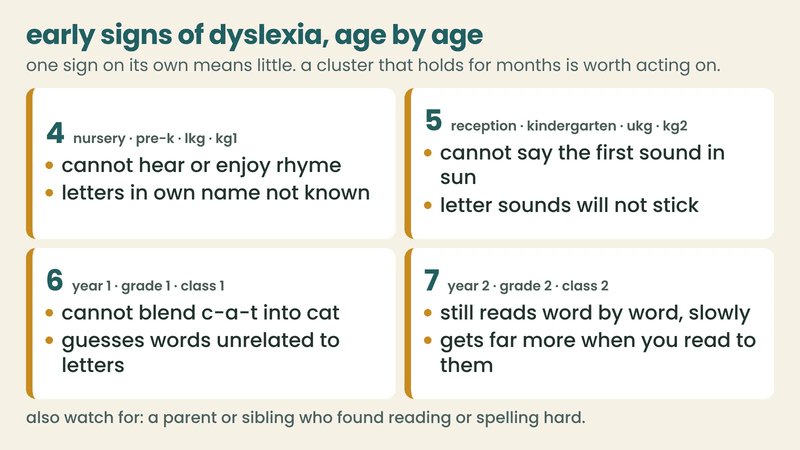
The signs of dyslexia change with age: at 4 they show up in rhyme, at 5 in letter sounds that will not stay learned, at 6 in blending, and at 7 in reading that stays slow and effortful. The table below combines the preschool and early-school indicators published by the Yale Center for Dyslexia and Creativity with what our teachers see most often in class, grouped by age, because class names differ everywhere.
Items marked (Yale) come from the Yale Center for Dyslexia and Creativity. The rest are what Learn2Read teachers see most often. Class names differ around the world, so ages come first.
Age | School year (UK / US and Canada / India / Gulf) | Signs worth noticing |
4 | Nursery / Pre-K or Junior Kindergarten / LKG / KG1 | Cannot hear or enjoy rhyme at all, even after months of rhyming songs; trouble learning common nursery rhymes (Yale); mispronounces familiar words longer than other children do (Yale); does not recognise the letters in their own name (Yale) |
5 | Reception / Kindergarten or Senior Kindergarten / UKG / KG2 | Knows fewer than half the letter sounds despite regular practice; cannot tell you the first sound in sun; letter sounds learned on Monday are gone by Friday; cannot clap the beats in el-e-phant |
6 | Year 1 / Grade 1 / Class 1 | Cannot blend c-a-t into cat after being taught how; reading errors show no link to the sounds of the letters on the page, such as reading dog as puppy (Yale); avoids reading, or disappears when it is reading time (Yale); spelling looks nothing like the sounds in the word |
7 | Year 2 / Grade 2 / Class 2 | Still reads word by word with enormous effort; cannot retain common words seen hundreds of times; reads a page correctly but is too drained to say what it was about; understands far more when you read to them than when they read alone |
📌 Screenshot this table. It is the one parents send each other, and it is worth re-reading at each birthday.
Signs of Dyslexia in a 5 Year Old, and in LKG, UKG and Class 1
The signs of dyslexia in a 5 year old are knowing fewer than half the letter sounds after a term of teaching, being unable to say the first sound in a word like sun, letter sounds learned on Monday and gone by Friday, and a family member who found reading hard.
Age 5 is when the picture sharpens, because most school systems start teaching letter sounds properly and a child finally has something to respond to. Watch for non-stickiness more than slowness: sounds taught carefully on Monday that have vanished by Friday, week after week, while classmates hold on to them.
What Indian and Gulf parents notice first
Indian and Gulf parents usually notice it in UKG or KG2, and act in class 1. In LKG and KG1 the signal is rhyme. In UKG and KG2 it is letter sounds that will not stay learned.
Dyslexia in class 1 is usually spotted when a child still cannot blend c-a-t into cat after a full term of teaching. That is the point most Indian and Gulf schools raise it, and the one worth putting to the next parent-teacher meeting (PTM).
A quick test at 5: on Friday, ask your child for the three letter sounds their teacher taught on Monday. Most 5-year-olds hold at least two. A child who has lost all three, week after week for a term, is showing you the clearest single early sign there is at this age.
One more indicator matters as much as anything in the table: a family history of dyslexia, meaning a parent, sibling, aunt or uncle who found reading or spelling hard. It is one of the strongest early indicators there is.
A family history is a reason to look early. It settles nothing on its own.
For what is typical at each age when nothing is wrong, see our guide to reading milestones by age.
Is My Child Dyslexic, or One of These Five Things?
Five ordinary situations produce the same picture as the early signs of dyslexia: letter reversals before age 7, English not being the home language, being taught to guess instead of decode, undetected hearing or vision problems, and being the youngest child in the class.
Every list of dyslexia signs on the internet stops at the signs. That is where the real confusion starts.
1. Letter reversals b and d, or reading was as saw
This is the sign parents panic about most, and it is the weakest one. Understood.org puts it plainly: reversals are "typical and fairly common up until second grade," and "most kids who reverse letters before age 7 end up not having dyslexia."
Letters like b and d are the same shape facing different ways. Nothing else in a child's world changes its name when you flip it. A cup is a cup either way round.
2. English is not the language spoken at home
A child who speaks Hindi, Arabic, Tamil, Malayalam or Tagalog at home may decode English words perfectly well and still stall, because they do not know what the words mean. That is a vocabulary gap, and it looks nothing like dyslexia once you test it properly.
The tell: ask them to read a nonsense word like sog. A child with a vocabulary gap reads it easily. A child with a decoding difficulty cannot.
3. Your child was taught to guess rather than to decode
Some children are taught to work out a word from the picture and the first letter. That method produces confident-sounding reading which collapses the moment the pictures stop.
It reads exactly like a decoding problem because it is one, just not a built-in one. Our guide on why children guess at words covers the fix.
4. Ears and eyes
A run of ear infections at ages 2 to 4 can quietly cost a child the months when they should have been tuning into speech sounds. Uncorrected long sight makes close print tiring.
Both are common and both get missed. One appointment rules out each.
5. Being the youngest in the class
A child born in the last months of the intake year is compared, every day, against children up to eleven months older. At age 5, eleven months is close to a fifth of a lifetime.
Studies in several countries have found the same pattern: the youngest children in a year group are referred for assessment more often than the oldest, and more often turn out to be developing typically. Age is doing part of the work here.
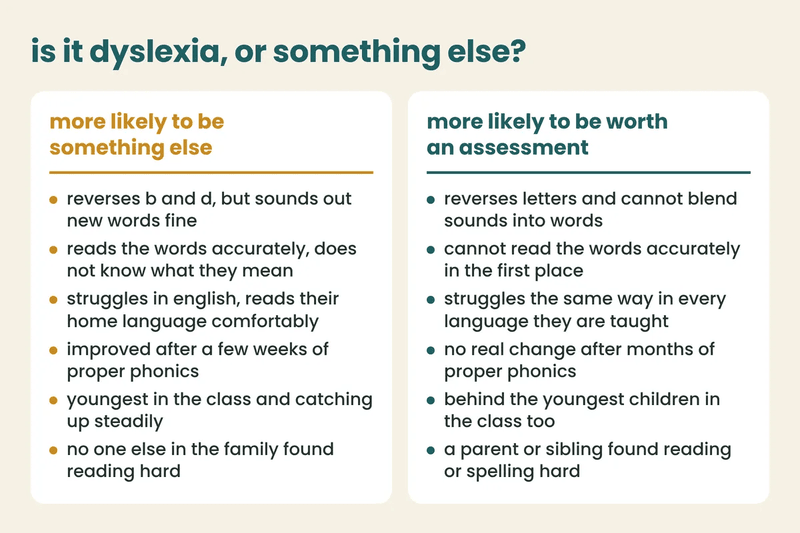
More likely to be something else | More likely to be worth an assessment |
Reverses b and d, but sounds out new words fine | Reverses letters and cannot blend sounds into words |
Reads the words accurately, does not know what they mean | Cannot read the words accurately in the first place |
Struggles with English, reads their home language comfortably | Struggles the same way in every language they are taught |
Improved noticeably after a few weeks of proper phonics | No real change after months of proper phonics |
No one else in the family found reading hard | A parent or sibling found reading or spelling hard |
Youngest in the class and catching up steadily | Behind the youngest children in the class too |
📌 Screenshot this one too. It is the fastest way to answer the question you actually came here with.
How Do You Tell Dyslexia from a Vocabulary Gap at Home?
Four five-minute checks at home separate a decoding difficulty from a vocabulary gap: a rhyme check, a first-sound check, a nonsense-word check and a listening-gap check. Do them on separate days when your child is fresh, never after school when everyone is tired.
You are not diagnosing anything. You are collecting the specific information that makes a teacher or a doctor useful.
Check | What you say | Try it from | What would worry you |
1. Rhyme | "cat, hat, dog. Which one does not belong?" | age 4 | Still cannot do it at 5, after several tries |
2. First sound | "What sound does moon start with?" | age 4 | Fewer than half right at age 5 |
3. Nonsense word | "Read these: sog, tib, lup, ked" | age 6 | Reads real words fine, cannot read these |
4. Listening gap | Two questions on a page you read. Then two on an easier page they read | age 6 | Understands when heard, not when read |
📌 This is the table worth sending to your parent group.
Checks 1 and 2: rhyme and first sound
Repeat the rhyme check with pin, win, sun and bed, red, cup, and the first-sound check with sock, fish and leg. For first sounds, say the sound mmm, never the letter name.
A 5-year-old who cannot do either after several tries is telling you something real. These are the earliest signals there are.
Check 3: the nonsense word test
The nonsense word test is the most useful check here, and almost nobody tells parents about it. Write down sog, tib, lup and ked, and ask your child to read them. Only do this from age 6, once your child has been taught to blend. Below 6, checks 1 and 2 are the ones that tell you something; come back to checks 3 and 4 after their first year of phonics teaching.
These are not real words, so they cannot be memorised or guessed from a picture. A child who reads plenty of real words but cannot read sog has been memorising the words.
A child who reads sog comfortably has the code, whatever else is going wrong.
Check 4: the listening gap
Read a page aloud to your child, then ask two questions about it. The next day, give them a page they can already decode, a level below what you read aloud, and ask two questions of the same kind. Pick a page they can get through without help. If it is too hard, all you find out is that it was too hard. What you are watching for is a child who reads an easy page correctly and still cannot tell you what happened in it, because every scrap of effort went into the words.
If they understand it easily when they hear it but not when they read it, the bottleneck is decoding. If they struggle both ways, the bottleneck is language and vocabulary, which is a different problem with a different fix.
Write down what happens in each check, with the date. Two weeks of notes will tell a teacher more than an hour of worried conversation.
What Should You Do This Week If You Think Your Child Is Dyslexic?
If you think your child may be dyslexic, this week: book a hearing and vision check, go back to sound games before letters, and set ten focused minutes a day instead of one long weekend session. Everything below helps a child with dyslexia and helps a child who turns out not to have it, so none of it is wasted while you wait for answers.
Book a hearing and vision check. It is quick, and it removes the two most fixable causes from the list. Do this first.
Go back to sounds before letters. If rhyme and first sounds are shaky, more flashcards will not help. Play sound games in the car and the bath, two minutes at a time.
Ten focused minutes a day beats an hour on Sunday. Our teachers across 35+ countries see the same thing year after year: the daily-ten-minutes children overtake the weekly-marathon children, and it is not close.
Use a system, not a pile of apps. The National Reading Panel review (2000) found that explicitly and systematically teaching children to work with the sounds in words significantly improves reading and spelling. Systematic means a planned order, taught the same way each time. Random worksheets are how children get confused.
Always use letter sounds, and write them in lowercase. Say sss, not "es". Write s, a, t, p, i, n the way books print them. Reading is built from sounds, and children meet lowercase first.
Protect one book a day that is pure pleasure. No testing, no sounding out, nothing to prove. The moment reading becomes punishment, you lose the child before you fix the reading.
Tell the teacher what you are seeing, with your notes. At a parent-teacher meeting (PTM), "he cannot hear the first sound in sun and the letter sounds do not stick from Monday to Friday" gets a real answer. "I am worried about his reading" usually does not.
Many children who look like this at 5 or 6 turn out not to be dyslexic. If you are wondering when to worry about reading, the honest line is this: a struggling reader who has not moved in six months needs looking at now.
When Should You Ask for a Dyslexia Assessment?
Ask for a dyslexia assessment for children when a cluster of signs has held steady through at least three to six months of proper, systematic teaching, and when the home checks above point at decoding rather than vocabulary. Waiting to see whether a child grows out of it is the one approach with no evidence behind it.
In India and the Gulf the PTM is often the only slot you get, so go in with dates and specifics.
Who to ask depends on where you live. In most school systems the first step is the class teacher and the school's learning support staff. Your child's paediatrician or family doctor is the right person for the hearing, vision and speech side, and can point you to the local assessment route.
A formal assessment is usually carried out by an educational psychologist or a specialist assessor. In India, ask the school counsellor about an assessor registered with the Rehabilitation Council of India (RCI) and what provisions your board offers. In the Gulf, ask the school's inclusion or special needs department first, since most schools route assessments through it. In the UK, ask to speak to the school's SENCO (the special educational needs coordinator), who decides what the school assesses in-house and when it refers on. In the United States, put a request for a school evaluation in writing to the school, which starts the timeline. In Canada the route is a psychoeducational assessment: ask the school for a referral to the board's psychology services first, because the public waiting list is long and a private assessment costs considerably more.
Nothing in this guide is a diagnosis, and no online checklist is. If several of these signs sound like your child, bring your two weeks of notes to the teacher and to your paediatrician, and ask what the assessment route looks like where you live.
One thing to hold on to while you wait. A dyslexia diagnosis does not change what your child needs next: structured, systematic, sound-first phonics teaching is the answer either way.
What the assessment changes is what support the school must provide and how much extra time your child gets in exams. It does not change tonight's ten minutes.
At Learn2Read, a live online phonics programme where trained teachers work with children aged 3 to 12 across 35+ countries, a large share of the children we teach arrived exactly here: bright, stuck, and somewhere on a waiting list.
FAQs About Dyslexia in Young Children
At what age can dyslexia be spotted in a child?
Signs can be seen from about age 4, though no single sign is conclusive. The Yale Center for Dyslexia and Creativity lists preschool indicators including trouble learning common nursery rhymes, not recognising the letters in their own name, and not hearing rhyming patterns like cat, bat, rat. Before age 4 the useful signals are about speech and sound rather than reading. A formal assessment is usually done from age 6 or 7 onwards, once a child has had real teaching to respond to.
Does writing letters backwards mean my child has dyslexia?
On its own, no. Letter reversals b and d are a normal stage of learning to handle symbols, and what matters is what they arrive with. Reversing letters counts only when it arrives alongside difficulty hearing the sounds inside words and letter sounds that will not stick from one week to the next. A child who reverses letters but sounds out new words comfortably is very unlikely to be dyslexic.
My child speaks another language at home. Could that be why reading in English is hard?
Often, yes. A child learning to read in a language they do not speak at home may decode words accurately and still not understand them, which looks like a reading problem but is a vocabulary gap. The quickest way to tell them apart is a nonsense word such as sog or tib: a child with a vocabulary gap reads it easily, while a child with a decoding difficulty cannot. Dyslexia, by contrast, usually shows up in every language a child is taught to read, though it can look different in each.
Is dyslexia genetic?
Dyslexia runs strongly in families, and a history of reading or spelling difficulty in a parent, sibling, aunt or uncle is one of the most useful early indicators there is. It is not a guarantee in either direction. If reading was hard for you as a child and it is now hard for your child, treat that as a reason to start structured phonics early.
Can a child with dyslexia learn to read well?
Yes. Children with dyslexia learn to read through the same route as every other child, taught more explicitly, in smaller steps, with far more repetition. What changes the outcome is starting early and being systematic. Many strong adult readers were slow, effortful readers at 7.
Does dyslexia mean my child is not intelligent?
No. Dyslexia affects how easily the brain links sounds to letters, and it has no relationship to general intelligence. The mismatch is often the first thing a parent notices: a child who talks brilliantly, reasons well and remembers everything, then stalls on a three-letter word. That gap between spoken ability and reading is itself one of the clearer early signs of dyslexia.
Can phonics help a child with dyslexia?
Yes, and it is the most evidence-backed help there is. Children with dyslexia need the same systematic, sound-first phonics as anyone else, delivered in smaller steps with much more practice before moving on. What does not work is a mixed approach that also encourages guessing from pictures and context, which makes the underlying weakness harder to see and harder to fix.
Read next
Why Your Child Guesses at Words (and How to Stop It) because guessing is the single most common thing mistaken for dyslexia.
How to Teach Blending: When Your Child Knows the Sounds but Can't Read the Word because blending is the exact step most children get stuck on.
Reading Milestones by Age for what is typical at 3 to 7 when nothing is wrong. This page is for when something looks wrong.
If any of this sounds like your child, the most useful next hour is one where a trained teacher sits with them, works out exactly where the sounds break down, and tells you honestly what they see.
Written by Nitin Jain, Founder, Learn2Read. Reviewed by the Learn2Read teaching team, September 2026. Learn2Read teaches phonics and early literacy to children aged 3 to 12 through live online classes in 35+ countries.

Latest Posts
3 October 2026
Early Signs of Dyslexia in Children: Ages 4 to 7, and 5 Things That Look Like It
30 September 2026
My Child Can Read But Doesn't Understand: Why It Happens and How to Fix It (Ages 5 to 8)
26 September 2026