7 November 2026
How Many Minutes Should a Child Read a Day? Guide by Age
How Many Minutes Should a Child Read a Day? Guide by Age
posted on : 31 October 2026
By Nitin Jain, Founder, Learn2Read · Published 31 October 2026
Nitin Jain founded Learn2Read, which teaches live online phonics classes to children aged 3 to 12. Sources checked against the American Academy of Pediatrics, the UK Department for Education's Reading Framework, India's NIPUN Bharat guidelines and peer-reviewed reading research. Last reviewed: 31 October 2026.
The school diary says "read daily". The class WhatsApp group says 20 minutes.
Your neighbour's son apparently reads for an hour. And your child is four.
So how many minutes should a child read a day? About 15 to 20 minutes at age 3, rising to 30 to 40 minutes by class 2 and 3, split into two or three short parts. Most of that time, for a young child, is you reading to them.
That time is made of three different things: being read to, a few minutes of phonics practice, and, once your child can decode, reading aloud to you. The mix changes a lot between nursery and class 3.
The number matters less than the habit. Ten minutes every day does more than an hour on Sunday.
This guide gives you an age-by-age table, explains where the famous "20 minutes" comes from, what counts as reading time, and how to fit it into a day that already has school, homework and tuition. It's written for children in nursery, LKG, UKG, class 1, class 2 and class 3 in India, KG1 to Grade 3 in the Gulf, and preschool to Grade 3 or Year 3 elsewhere.
In this guide:
How many minutes by age? · Where does "20 minutes a day" come from? · Does reading to my child count? · Short sessions or one long one? · What counts as reading time? · Fitting it into a busy day · Do's and don'ts
How Many Minutes Should a Child Read a Day, by Age?
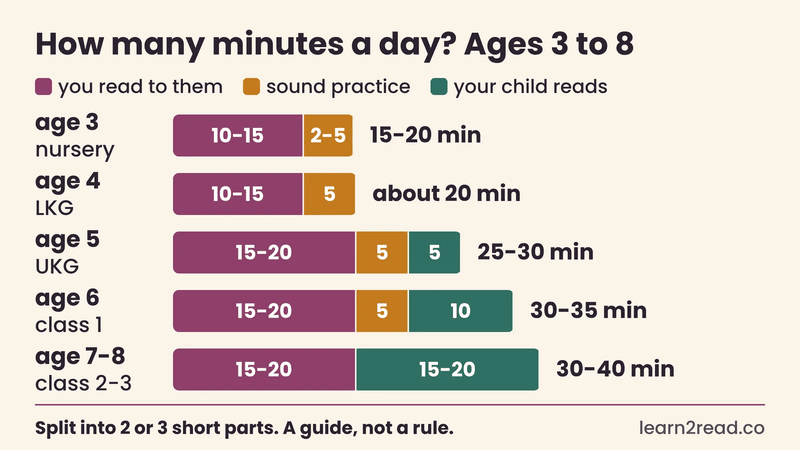
A child aged 3 to 4 needs about 15 to 20 minutes a day, mostly being read to, and a child aged 5 to 8 needs about 25 to 40 minutes, with more of it spent reading aloud. These are Learn2Read's suggested totals for home, built from the guidance below. They are a practical guide, and no research sets an exact number of minutes for each age.
Age (school year) | Being read to | Phonics or sound practice | Your child reads | Suggested total |
3 (nursery, pre-KG) | 10 to 15 min | 2 to 5 min of sound games | Retells the pictures | about 15 to 20 min |
4 (LKG, KG1) | 10 to 15 min | about 5 min | A few tiny words | about 20 min |
5 (UKG, KG2) | 15 to 20 min | about 5 min | 5 min from a decodable book | 25 to 30 min |
6 (class 1, Grade 1) | 15 to 20 min | about 5 min | about 10 min aloud | 30 to 35 min |
7 to 8 (class 2 and 3) | 15 to 20 min | as needed | 15 to 20 min, aloud and alone | 30 to 40 min |
The being-read-to column matches our guide to reading aloud to your child. The totals here add your child's own reading and sound practice on top, which is why they're higher.
If you've seen 10 to 20 minutes elsewhere, including in our love of reading guide, that usually counts one part of the day, not all three. Under three? About 5 to 10 minutes of being read to, in short bursts, is plenty.
So how long should a 5 year old read each day? About 25 to 30 minutes in UKG, and still more than half of it being read to.
Split each total into two or three parts across the day. A 20-minute day for a four-year-old might be five minutes of sound games after breakfast and a 15-minute bedtime story.
For the sound-practice minutes, our guide on how to teach blending shows what to do once your child knows a few letter sounds. Think of this table as reading time for kids by age, with the parts you control at home.
A decodable book is a beginner book written mostly with the letter sounds your child has already learned, so they can read it without guessing. Our guide to decodable books explains how to choose them.
These numbers sit on top of what school already does. The UK's Reading Framework says that "direct teaching of phonics takes place every day" from the start of Reception, and India's NIPUN Bharat guidelines recommend "organizing separate reading periods in daily school timetable" for the early classes. Home time adds the parts school can't: being read to by someone who loves your child, and a listener for every page they read.
Where Does "20 Minutes a Day" Come From?
The "20 minutes a day" rule mostly traces back to a 1988 study of older children, and it is a sensible target for class 2 and above, not a law for a four-year-old. In a 1988 Reading Research Quarterly study, researchers Richard Anderson, Paul Wilson and Linda Fielding tracked how much fifth graders (about age 10 to 11) read outside school.
Their figures are striking. A child reading books for about 21 minutes a day read an estimated 1,823,000 words a year, while a child reading for about 5 minutes read about 282,000 (the study's table, reprinted by Corwin). Small daily differences add up to huge yearly ones.
Two things get lost when this study is passed around.
It measured 10 and 11 year olds who could already read, so the minutes don't transfer neatly to a child who is still learning letter sounds. And it showed a link between reading time and words read. It never proved that a timer makes a better reader.
Use 20 minutes as a direction for older children. For a younger child, the answer to how many minutes should a child read a day is smaller, and the daily habit and the being-read-to part matter more than hitting a number.
Does Reading to My Child Count as Reading Time?
Yes. For children under six, being read to is the biggest and most important part of daily reading time. It builds vocabulary, listening and a love of stories long before your child can read the words.
A 2019 Ohio State University study led by Jessica Logan estimated that children whose parents read them five books a day enter kindergarten having heard "about 1.4 million more words" than children who are never read to. Even one book a day added up to about 290,000 more words by age five.
The American Academy of Pediatrics encourages "shared reading beginning at birth", and its earlier policy describes reading together "as a daily fun family activity". The UK Reading Framework is just as firm about school: "The daily time for stories is a priority."
Many families don't manage it. Scholastic's 2019 survey found that 55% of children aged 0 to 5 are read books aloud at home at least five days a week in the US, so close to half are not.
Stories in Hindi, Tamil, Arabic or any home language count too. Being read to builds listening and vocabulary in whatever language the story is in. Keep going after your child starts reading: our guide to reading aloud to your child covers how long and when to stop.
Short Sessions or One Long One?
Short, frequent sessions work better for young children than one long sitting. Two or three five-to-ten-minute pieces spread across the day beat a 30-minute block that ends in tears.
Research on children's learning points the same way. In a 2012 study in Child Development, Vlach and Sandhofer taught science lessons to children aged 5 to 7 and found that "spacing lessons out in time resulted in higher generalization performance" than giving the same lessons all at once. The study didn't test reading, but it's the same reason daily reading beats a weekly marathon.
Attention matters too. The early childhood organisation Zero to Three notes that with a toddler, "you may only be able to read or talk about a few pages in a book at a time". That's normal, and it's fine to stop and come back later.
You may have seen a rule like "a child's attention span is their age times two minutes." We couldn't find any research behind it, so don't use it to judge your child.
Signs a session has gone on too long: yawning, guessing wildly at words, slumping, or asking "how many more pages?" every page. Stop on a good moment, and come back after a snack.
What Counts as Reading Time?
Anything with words your child hears or reads with you counts, but the part where your child decodes the words alone is the one that builds independent reading. Make sure that part happens most days once your child can blend sounds.
Counts | Counts, as listening | Doesn't count |
Picture books read aloud | Audiobooks and story podcasts | Cartoons and videos |
Decodable books and the school reader | Stories told from memory | Reading apps that read every word for the child |
Signs, labels, menus, cereal boxes | Songs and rhymes | Copying words without reading them |
Comics and children's magazines |
Audiobooks are good for vocabulary and for car rides, and they don't replace a child reading words off a page. The Reading Framework says that in school, "children read a decodable book or other decodable text most days". At home, those few minutes of your child reading to you are the minutes to protect.
How to Fit Daily Reading Into a Busy Day
Fit daily reading into your child's day by attaching each short piece to something that already happens every day, such as breakfast, the ride home or bedtime. A reading routine tied to a fixed moment survives school, homework and tuition far better than "we'll read when we get time."
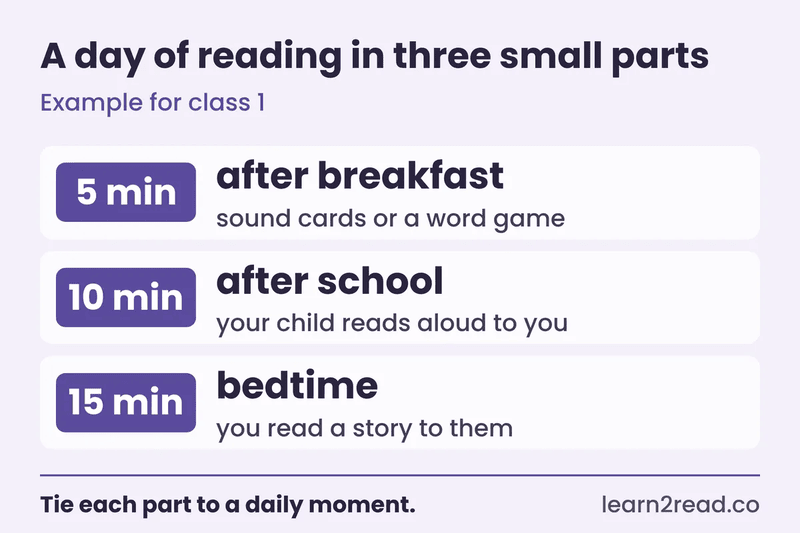
Here's one way a class 1 day can look.
After breakfast, 5 minutes. Quick sound cards or a tricky word game while your child finishes their milk.
After school, 10 minutes. Your child reads the school reader or a decodable book aloud to you, before homework starts and energy runs out.
Bedtime, 15 minutes. You read a story your child couldn't read alone yet. No questions needed. Just enjoy it.
In August 2026, Delhi's government directed its schools to introduce a daily 30-minute reading session. Schools are giving reading a fixed daily slot, and a fixed slot at home works the same way.
This isn't extra homework. If school sets about 10 minutes of homework in class 1, the after-school reading slot can be its warm-up. If reading time has become a daily fight, our guide to homework battles has scripts that help.
Try it tonight. Pick one fixed moment, the one your family will actually keep, and do just that part for a week before adding the next.
Do's and Don'ts for Daily Reading Time
The most useful thing a parent can do is make reading daily and short, and stop before your child is tired. Most of us worry about too little reading. With young children, too much at once causes just as many problems.
Don't | Do this instead | Why |
Save it all for one long weekend session | Read a little every day | Daily practice builds the habit and the skill |
Set a timer and watch it | Stop at a natural break, like the end of a page | Clock-watching turns reading into a chore |
Stop reading aloud once your child can read | Keep a bedtime story going until 8 and beyond | Stories read aloud carry richer words than your child can read alone |
Count audiobooks as your child's reading practice | Count them as extra listening | Decoding needs eyes on the words |
Push through when your child is exhausted | Move the session to a fresher time | Tired reading means more guessing and more tears |
Compare minutes with other parents | Watch your own child's progress month to month | Children learn to read at different speeds |
If your child reads every day but stays slow and choppy, our guide on when a child can read words but not sentences explains the next step. If progress has stalled for months, talk to the class teacher at the next PTM (parent-teacher meeting).
At Learn2Read, a live online phonics programme for children aged 3 to 12, classes are kept short and frequent for young children, and parents get a small amount of home practice to do in between.
FAQs
How many minutes should a child read a day?
Most children need about 15 to 20 minutes of reading time a day at age 3, rising to 30 to 40 minutes by age 7 or 8, split into two or three short sessions. Younger children spend most of it being read to, and older children spend more of it reading aloud. Daily practice matters more than the exact number.
Is 20 minutes of reading a day enough?
Twenty minutes a day of a child reading on their own is a reasonable target from about age 7, alongside time being read to. The figure comes mainly from a 1988 study of fifth graders, so it is a direction, not a rule for preschoolers. Children aged 3 to 5 need less of their own reading and more time being read to.
Does reading to my child count as reading time?
Reading aloud to a child counts as reading time and is the most important part for children under six. A 2019 Ohio State University study estimated that children whose parents read them five books a day hear about 1.4 million more words before kindergarten than children who are never read to. Stories in a home language count too.
How long should a 4 year old read each day?
A 4 year old in LKG or KG1 does well with about 20 minutes a day of reading time. That is usually 10 to 15 minutes of being read to and about 5 minutes of letter sound games. Short sessions spread across the day work better than one long sitting at this age.
How much time should my UKG child read at home daily?
Most UKG children do well with about 25 to 30 minutes of reading time a day at home. That is about 15 to 20 minutes of being read to, 5 minutes of letter sounds and 5 minutes reading a decodable book. Split it into two or three short parts across the day.
How long should phonics practice be for a UKG child?
About five minutes a day of phonics practice at home is enough for most UKG children, on top of what school teaches. Spend it reviewing letter sounds already taught and blending them into short words, then stop while the child is still enjoying it, and keep the session at the same time each day.
How do I know if reading practice is too much?
Reading practice is too much when a child starts yawning, guessing wildly at words, slumping or asking how many pages are left. Tears or daily refusal also mean the sessions are too long or too hard. Shorten the session, use an easier book, and end on a page the child reads well.
Read Next
Reading Aloud to Kids: How Long, How Often, When to Stop: the biggest part of daily reading time for young children.
Decodable Books: A Parent's Complete Guide: the books your child can read alone in those daily minutes.
Homework Battles: 7 Do's and Don'ts: when reading time turns into a fight.
How to Make Your Child Love Reading: for the child who reads only because you ask.
Reading Milestones by Age: what most children can read at each age.
How many minutes should a child read a day? Less than most parents fear, as long as it happens every day. Split it into small pieces tied to moments that already happen. If you'd like a teacher to guide your child's reading, book a free trial class.

Latest Posts

4 November 2026
Capital or Small Letters First? ABCD vs abc for LKG Kids
31 October 2026
How Many Minutes Should a Child Read a Day? Guide by Age
28 October 2026
Child Keeps Forgetting Letter Sounds? How to Make Them Stick

A new chapter from Learn2Read
Read Before They Read
Before you teach your child to read, read this. A calmer, clearer way into your child’s reading journey—with a practical guide written for real Indian homes.