21 October 2026
How to Choose a Phonics Program: A Parent's 10-Question Checklist

How to Choose a Phonics Program: A Parent's 10-Question Checklist
posted on : 24 July 2026
Every phonics program says the same two things: "proven method" and "kids love it". Which leaves you, the parent, with eleven open tabs and no way to tell them apart.
This guide fixes that. It gives you a clear way to judge how to choose a phonics program: the 10 questions to ask any provider (app, workbook, local centre, or live online classes), the answers you should hear, and the red flags that end the conversation. At the end, we run our own program through the same 10 questions, so you can see the checklist working on a real example.
Table of Contents
What Makes a Good Phonics Program?
A good phonics program teaches letter sounds in a planned sequence, shows children how to blend those sounds into real words early, gives live feedback on pronunciation, and moves at the child's pace rather than the batch's pace.
The evidence behind that description is unusually strong. The UK's Education Endowment Foundation, which reviews teaching methods for schools, rates phonics as high impact with extensive evidence, worth about five months of extra reading progress on average, and stresses that the teaching must be explicit and systematic. The National Reading Panel, a landmark US government review, reached the same conclusion years earlier: systematic phonics beats unsystematic or no phonics.
So the question is rarely "does phonics work?". It is "does THIS program do phonics properly?". The checklist below exists to answer exactly that.
The 10-Question Checklist: Ask These Before You Enroll
Take this list to any trial class or sales call. A program worth your money answers all ten without flinching.
| # | Ask them | The answer you want |
|---|---|---|
| 1 | Which method do you follow? | Systematic synthetic phonics, named and explained |
| 2 | Can I see your teaching sequence? | A written order of sounds starting simple (s, a, t), not a to z |
| 3 | Do you teach letter sounds before letter names? | Yes: "sss" before "ess" |
| 4 | When will my child blend real words? | Within the first few weeks, not after all 26 letters |
| 5 | How many children per class? | Small enough that every child reads aloud every session |
| 6 | Who corrects mispronounced sounds, and when? | A trained teacher, live, in the moment |
| 7 | How do you decide my child's starting level? | An assessment of the child, not age alone |
| 8 | How will I see progress? | Regular, specific updates a parent can actually check |
| 9 | What happens between classes? | Short guided home practice, 5-10 minutes |
| 10 | Can we try before we pay? | A free trial class or assessment |
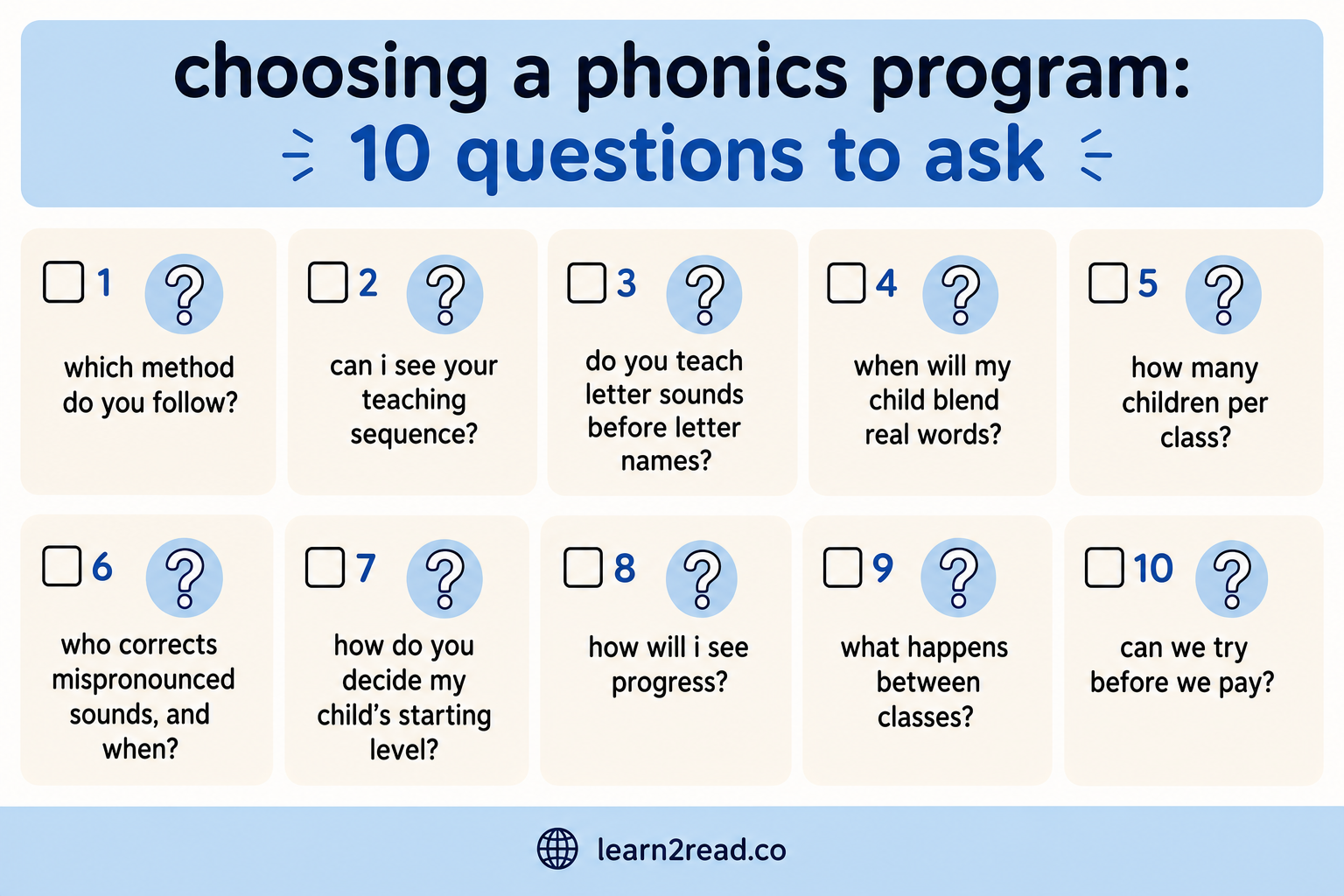
Questions 5 and 6 knock out more programs than any others. Phonics is a listening-and-speaking skill before it is a reading skill, and a child who mispronounces "th" for six weeks with nobody noticing is quietly practising the wrong thing.
App, Workbook, Centre, or Live Online Classes: Which Format Fits?
The format question matters less than parents fear and more than marketers admit. Each option trades something away.
| Format | Strengths | Watch out for | Best for |
|---|---|---|---|
| Learning apps | Low cost, gamified, works anywhere | Nobody hears or corrects mispronounced sounds; easy to tap through without learning | Extra practice between real lessons |
| Workbooks / home curriculum | Parent-led, flexible, cheap | Needs a parent with time, patience and confidence in the method | Homeschooling families |
| Local tuition centre | Face-to-face teaching, routine | Batch sizes, commute time, teacher training varies centre to centre | Children who settle better in person |
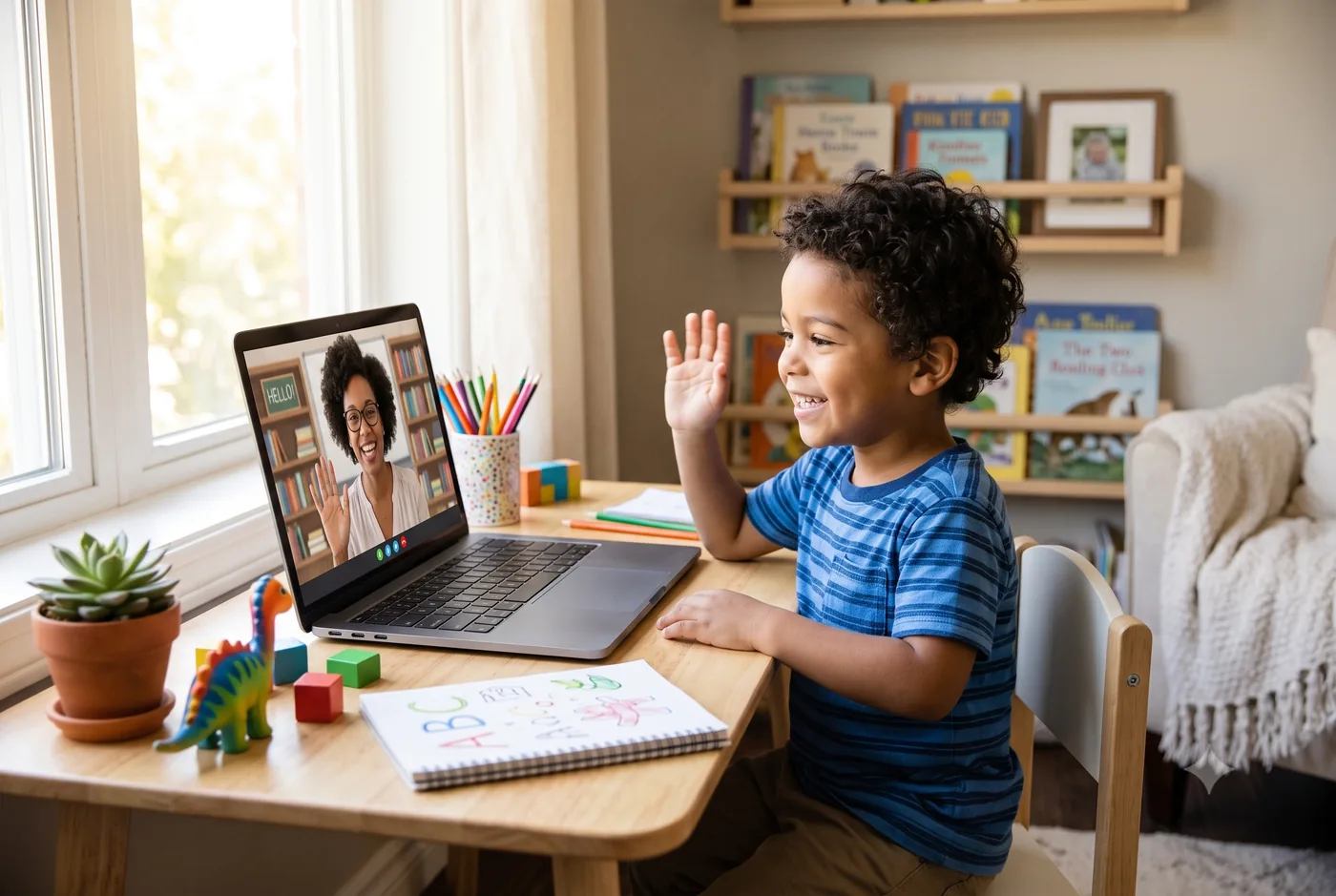
| Live online classes | Trained teacher, live correction, no commute, easy scheduling | Needs a quiet corner and a working camera; it is still screen time | Consistent feedback without depending on what's near your home |
Whichever way you lean, the deciding question stays the same: who hears your child's mistakes, and how quickly are they corrected? Live feedback is the one ingredient an app cannot fake, which is why apps work best as a supplement rather than the main event.
What Are the Red Flags?
Most weak programs fail in the same handful of ways, and none of them are obvious from a glossy brochure. Walk away, or at least dig deeper, if you see letters taught in alphabet order from a to z, capital letters taught first, letter names before sounds, or months of letter work with no word blending in sight.
Two more deserve a mention. A child who "reads" by memorising a word list will hit a wall the first time an unfamiliar word appears. And a batch so large that your child speaks once per class is a listening session, not a phonics class.
If you spotted your child's current program in that list, you have not failed at anything; these things are genuinely hard to see from the outside. That is what the 10 questions are for.
The Checklist in Action: A Worked Example
We build phonics classes for a living, so it is only fair to run our own program through the same ten questions. Here is how Learn2Read, a live online phonics program for children aged 3-12, answers them; hold any program you are considering to exactly the same standard.
Method and sequence: systematic synthetic phonics, taught in small live classes over Zoom by trained teachers, starting with simple lowercase sounds like s, a and t and moving step by step towards blending, digraphs (two letters making one sound, like "sh") and beyond. Children begin blending real words early rather than waiting for the full alphabet. Levels run from Junior Readers (ages 3-3.5) for first sounds to Junior Readers PLUS (ages 3.5-4) for blending and first sight words, with placement based on where your child actually is. And question 10 is easy: the first class is a free trial, which is where any honest program should be happy to be judged.
FAQs: Choosing a Phonics Program
What age should a child start a phonics program? Most children are ready for structured phonics between ages 3 and 4, once they can hold short attention and notice that words are made of sounds. Before that, rhymes, songs and daily read-alouds build the listening foundation phonics sits on. Older children who struggle with reading benefit from phonics too; it is a catch-up tool, not just a starter tool.
Synthetic phonics or analytic phonics: which is better? For beginner readers, the evidence favours systematic synthetic phonics, where children learn individual letter sounds in a planned order and blend them into words. Analytic phonics, which starts from whole words, asks beginners to do the harder task first. Major reviews by the National Reading Panel and the Education Endowment Foundation both back the systematic, explicit route.
Are online phonics classes effective? Yes, when they are live and interactive. A trained teacher on a video call can hear and correct a child's sounds in real time, which is the part of phonics that matters most. Pre-recorded videos and apps alone are weaker for beginners because nobody catches mispronunciations.
Is a phonics app enough on its own? Usually not. Apps are excellent for practice between lessons, but phonics is a speaking-and-listening skill first, and an app cannot hear your child. Pair an app with a live teacher (or a confident, trained parent) and it becomes genuinely useful.
How long does a phonics program take to show results? With 2-3 sessions a week plus a few minutes of daily practice, most children blend their first short words within the opening weeks, and move from first sounds to reading simple books over roughly a year or two. Pace varies child to child, which is exactly why question 7 on the checklist (level assessment) matters.
My child is 7 and still struggling to read. Is it too late for phonics? Not at all. The Education Endowment Foundation notes phonics can be especially helpful for lower-attaining children. A struggling 7-year-old usually has gaps in the sound code, and a program that assesses first and fills those specific gaps can change things quickly.
Choosing a phonics program stops being overwhelming the moment you know what to ask. Print the 10 questions, take them to every trial class, and trust what you hear. If you would like to see how our teachers answer them in person, the first class is on us.
Read Next

Latest Posts
17 October 2026
My Child Knows the Alphabet (ABCD) but Can't Read: Letter Names vs Letter Sounds, Ages 3 to 6
14 October 2026
How to Teach a Child to Write Sentences ?
10 October 2026
b and d Confusion: Is It Dyslexia? How to Fix It (Ages 4-7)

A new chapter from Learn2Read
Read Before They Read
Before you teach your child to read, read this. A calmer, clearer way into your child’s reading journey—with a practical guide written for real Indian homes.