
5 September 2026
How to Make Your Child Love Reading (and Why So Many Kids Quit by Age 8)

How to Make Your Child Love Reading (and Why So Many Kids Quit by Age 8)
posted on : 18 July 2026
Your child used to bring you the same picture book five times a night. Now, getting them to read anything feels like a negotiation.
If you have been wondering how to make your child love reading again, your timing is spot on. Reading for pleasure is falling across the world, and the steepest slide starts around age 8. The encouraging part: research points clearly at why children stop, and every one of those reasons has a fix you can start tonight.
This guide walks through the 2026 numbers, the age-by-age moments where the love of reading leaks away, and the habits (do's and don'ts included) that keep it alive for good.
Table of Contents
- Why Do Children Stop Reading for Fun?
- The Age-by-Age Slide: Where the Love of Reading Leaks Out
- The Real Reason Behind "My Child Hates Reading"
- Keep Reading Aloud (Long After They Can Read Alone)
- Let Them Choose (Yes, Even the Comic About Underpants)
- The Do's and Don'ts of Raising a Reader
- A 15-Minute Daily Rhythm Any Family Can Keep
- FAQs
Why Do Children Stop Reading for Fun?
Children typically stop reading for fun when reading feels like hard work, when adults stop reading aloud to them, when books turn into homework, and when screens fill the space books used to hold.
The numbers behind that are hard to ignore. A US Department of Education report from June 2026 found that only 37% of 9-year-olds read for fun almost every day, with reading skills declining steadily since 2012, long before the pandemic. In the UK, the National Literacy Trust's 2026 survey of over 125,000 children brought a rare bit of good news, the first overall rise in reading enjoyment since 2021, yet enjoyment among 5 to 8 year olds still slipped slightly, driven mostly by boys. The UK has even named 2026 its National Year of Reading, which tells you how seriously this dip is being taken.
Here is what those headlines miss, though. None of the four causes above is about children changing. All four are about what happens around them, and all four sit within a parent's reach.
The Age-by-Age Slide: Where the Love of Reading Leaks Out
The love of reading rarely disappears in one dramatic moment; it leaks out at predictable ages, for predictable reasons.
| Age | Where the love leaks out | The fix |
|---|---|---|
| 0-2 | Books compete with screens from the start; reading aloud happens "when there's time" | Five minutes of lap reading at the same point every day; keep a basket of board books within crawling reach |
| 3-5 | Letters arrive as memorisation and testing; a child starts feeling "bad at it" before reading has even begun | Teach letter sounds through play (lowercase s, a, t), and keep story time completely separate from practice time |
| 6-8 | Adults stop reading aloud, reading becomes homework, and free choice of books disappears | Keep the read-aloud alive, protect free choice, and never use reading as a chore or punishment |
That middle-right cell in the bottom row deserves its own statistic. Research from children's publisher Farshore found that by age 8, only one in five children are read to every day, largely because parents treat reading as a skill: once a child can do it alone, the read-alouds quietly stop. That is usually the exact moment enjoyment starts to fade.
The Real Reason Behind "My Child Hates Reading"
A child who has to fight through every word will never choose reading for fun, because effortful decoding leaves no room to enjoy the story.
Decoding means turning letters into sounds and sounds into words. When it is slow, reading a page feels like watching a film where every fifth subtitle is missing: technically possible, no fun at all. The child is not lazy or "not a book person". The mechanics are simply eating all the enjoyment.
This is why confidence work is enjoyment work. Phonics gives children the code, so words stop being puzzles and start being automatic. At Learn2Read, a live online phonics program for children aged 3-12, our teachers across 35+ countries see the same pattern again and again: the week blending clicks is the week a child starts picking up books nobody assigned. Junior Readers PLUS (ages 3.5-4) is built exactly for that click.
Keep Reading Aloud (Long After They Can Read Alone)
Reading aloud to a child who can already read remains one of the strongest ways to protect reading enjoyment, because it separates story-pleasure from reading-effort.

When you read aloud, your child gets richer stories than they could decode alone, with zero effort cost. The American Academy of Pediatrics' HealthyChildren.org notes that time spent with a favourite book builds brain pathways essential for language, social skills and emotional wellbeing. None of that stops mattering at age 6.
Make it easy to keep going. Read one level above what they can manage alone, do the silly voices, and stop at cliffhangers so tomorrow's chapter gets demanded. Distance is no excuse either: one grandparent reads a chapter over video call every Sunday, and the grandchild would riot if she skipped it.
Let Them Choose (Yes, Even the Comic About Underpants)
Free choice of reading material is one of the most reliable ways to build a child's reading for pleasure.
A child who is allowed to read "junk" keeps reading. A child who is only handed worthy books often stops. Comics, graphic novels, joke books, football annuals and fact books about volcanoes all count: they build vocabulary, fluency and, most importantly, the identity of "I'm someone who reads". So take them to the library and let them walk out with whatever they grabbed, even if it is the same dinosaur book for the fourth time. Rereading builds fluency; being trusted with the choice builds the habit.
The Do's and Don'ts of Raising a Reader
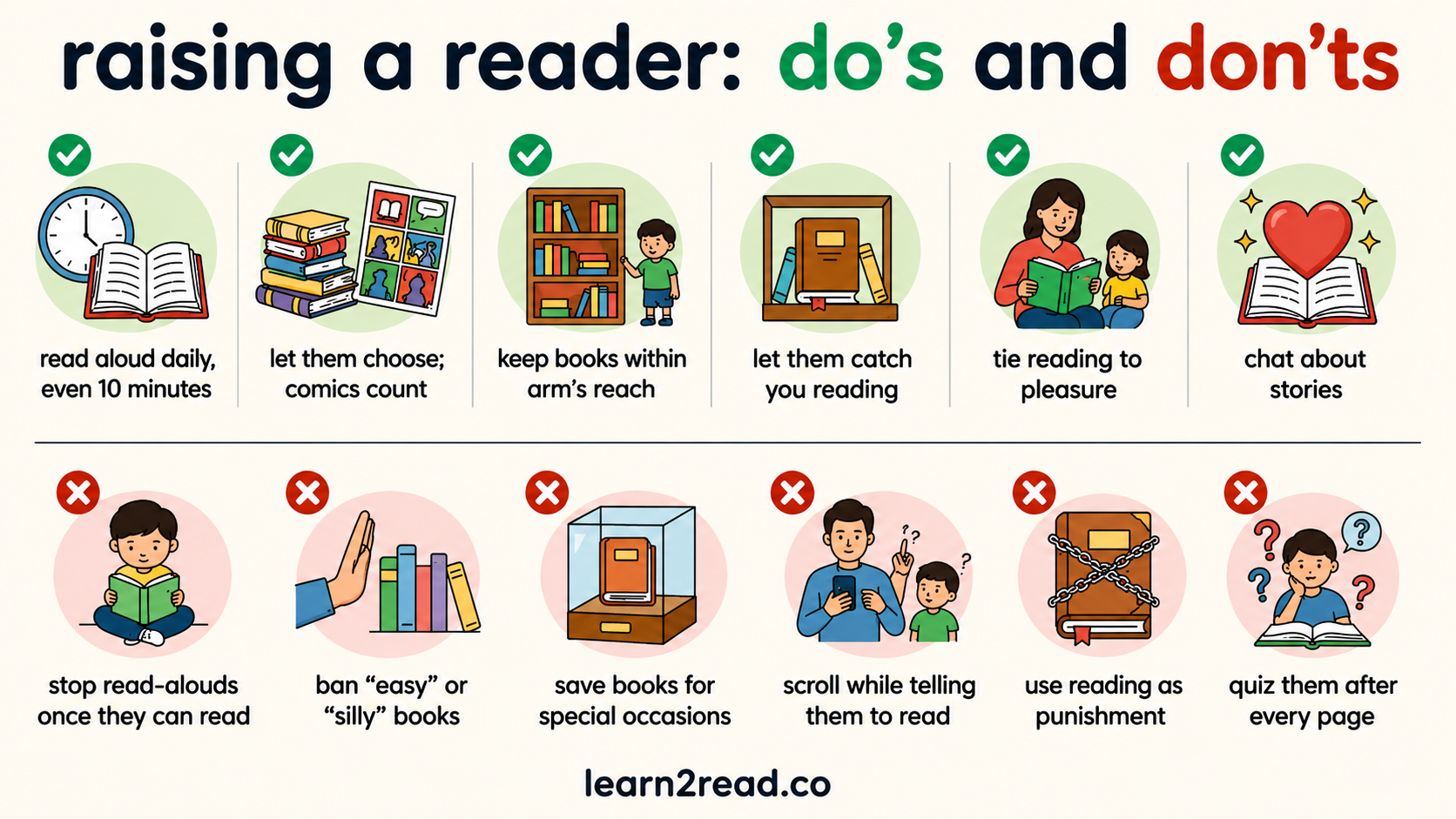
| ✅ Do | ❌ Don't |
|---|---|
| Read aloud daily, even just 10 minutes | Stop read-alouds the moment they can read alone |
| Let them choose; comics and joke books count | Ban "easy" or "silly" books as not proper reading |
| Keep books within arm's reach (car, bag, bedside) | Keep books on a high shelf for special occasions |
| Let them catch you reading for fun | Expect them to love books they never see you open |
| Tie reading to pleasure: torches, dens, 10 minutes later at bedtime | Use reading as a punishment, chore or condition |
| Chat about stories ("which character would you be?") | Quiz comprehension after every single page |
If you spotted yourself in the don'ts column, welcome to the club; most of us have done at least three of them. Children recover fast the moment the pressure lifts.
A 15-Minute Daily Rhythm Any Family Can Keep
Fifteen minutes a day, split three ways, is enough to rebuild a child's reading habit within a few weeks.
Here is the split our teachers suggest to parents. Five minutes where your child reads (or just looks at) anything they chose. Five minutes where you read aloud, one level above what they manage alone. Five minutes of talk and silliness about the story, with no questions that feel like a test. Same time daily beats a long weekend session, and after-dinner or bedtime slots survive real life best.
That is the whole method for how to make your child love reading: lower the effort, raise the choice, and keep sharing stories long after they "can do it themselves".
FAQs: Raising a Reader
How do I make my child love reading again? Lower the effort and raise the fun. Let them choose their own books (comics count), read aloud to them daily so stories stay pleasurable, keep sessions to 10-15 minutes, and never use reading as a punishment or chore. If decoding itself is the struggle, short daily phonics practice removes the biggest barrier.
My child can read but refuses to. Why? Usually because reading still costs more effort than it returns in fun. Common culprits are books pitched too hard, reading framed as homework, and the end of read-alouds. Drop the book level, restore free choice, and bring back a nightly read-aloud; refusal typically fades within weeks.
Do comics and graphic novels count as real reading? Yes. Comics and graphic novels build vocabulary, fluency and story understanding, and they keep reluctant readers reading. Many children use them as a bridge into longer chapter books, so treat them as a gateway rather than a detour.
How long should my child read each day? For ages 3-8, around 10-20 minutes a day is plenty, as long as it happens most days. Consistency beats length: a short daily habit builds more skill and more enjoyment than one long weekly session.
When should I stop reading aloud to my child? Ideally, not for years after they learn to read; many families happily continue to age 10 or 11. Reading aloud lets children enjoy richer stories than they can decode alone, so stopping early often marks the point where reading for pleasure starts to fade.
Are audiobooks cheating? No. Audiobooks build vocabulary, listening comprehension and love of story, especially on car rides and quiet afternoons. Pair them with print (following along, or reading the next book in the series) and they feed directly into independent reading.
Read Next

Latest Posts
2 September 2026
Homework Battles: 7 Do's & Don'ts for Ages 5-8 (2026)

29 August 2026
Kids' Attention Spans & Short Videos: What Parents Must Know
25 August 2026