5 September 2026
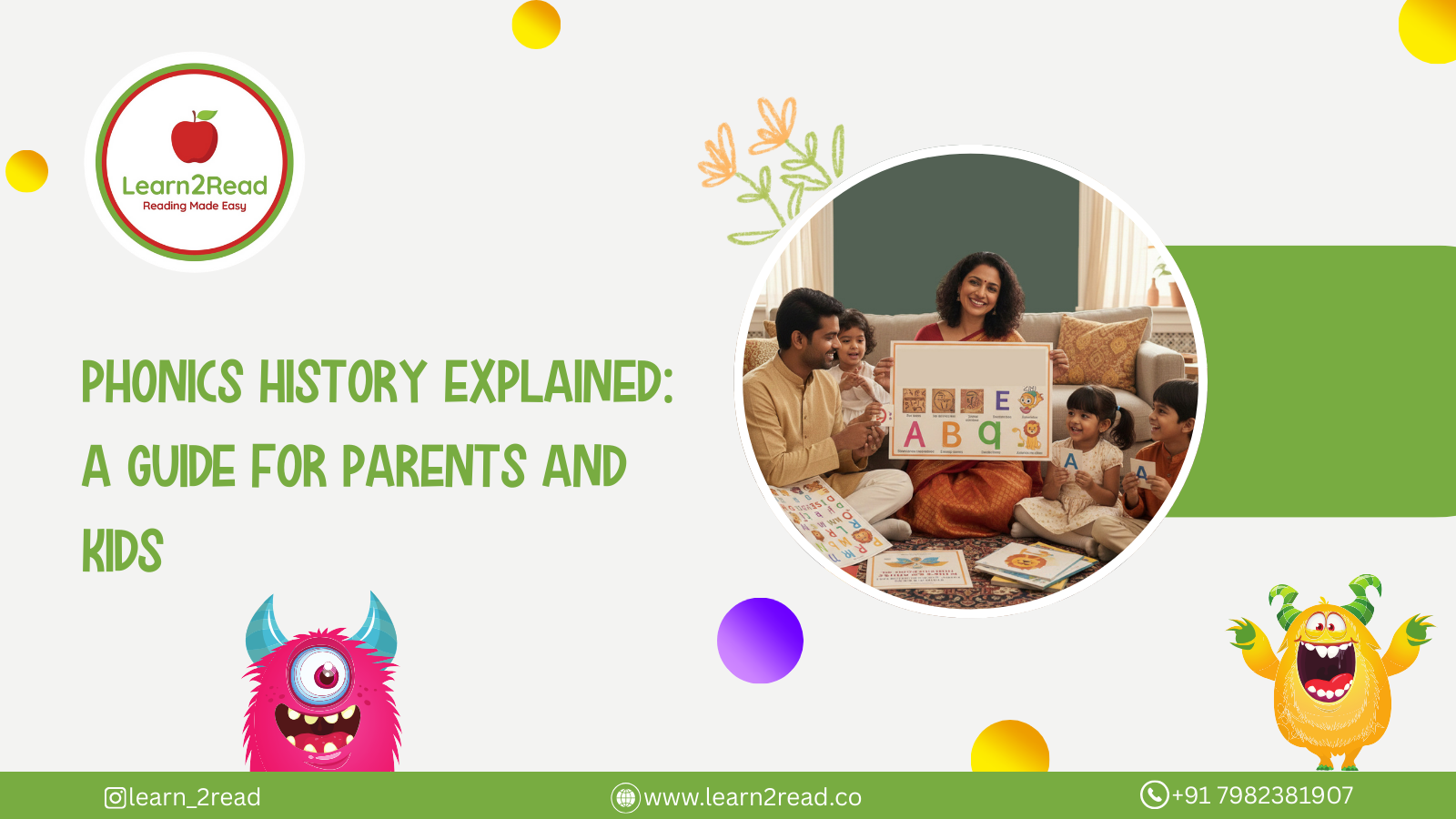
Phonics History Explained: A Guide for Parents and Kids
Phonics History Explained: A Guide for Parents and Kids
posted on : 29 December 2025
Learning to read is like a journey for every child. And phonics makes that journey easier. Phonics history is long and fascinating. It has evolved over the centuries. Over time, the phonics teaching method has also transformed. Today, engaging apps, activities, and flashcards are used to make learning fun & interesting.
Teaching phonics to your children at an early age is a smart choice. It helps them decode words faster and read with confidence. The method and approach have definitely changed, but the goal has remained the same. The goal is to make children understand how the language works and help them read efficiently.
In this blog, you’ll read what phonics is, the history of phonics, its origin, and why it’s important for young readers.
What Is Phonics?
Phonics is an approach to help children understand the relationship between letters and sounds. They learn that words are made of different letters and that these letters have specific sounds.
For example, the word ‘dog’ is made of three sounds: /d/, /o/, and /g/.
Instead of memorizing patterns, you can teach them all the sounds. Once they understand the connection between letters and sounds, they can easily decode new words. With practice, they also improve their pronunciation and spelling skills.
Important Phonics Elements
- Letter & Sound Recognition: You can help children understand which sound goes with which letter.
- Blending: Your child will be able to connect sounds to form words.
- Segmentation: Phonics helps children understand how to break words into sounds, which improves their spelling skills.
- Reading Complex Words: Gradually, your child will learn advanced phonics rules and decode tricky words.
Thus, phonics lays a strong foundation for reading and writing. You can make learning fun with interactive phonics activities and games to help your child develop the skill.
The Origins of Phonics
You might have questions like ‘Who introduced phonics?’ and ‘Where does phonics originate?’ So let’s dive into knowing more about phonics history:
Some believe phonics history is as old as ancient civilizations. While some believe that phonics originated in the early 16th and 17th centuries. Earlier, learners used to rely on spelling and sound recognition for reading English.
However, by the 19th century, connecting letters to their sounds was considered more effective for reading. In the 20th century, phonics became a foundation for literacy development.
Every accomplishment has some struggles. In the mid-20th century, there was a reading war between phonics vs. whole language.
Whole language says children should understand whole words through their meaning, context, and storytelling.
Phonics helps children break down words into individual sounds and then learn blending to read and understand new words.
However, it was proven that systematic phonics learning is more effective for developing reading & writing skills. Take a look at our English phonics junior readers course to build a strong foundation in reading and phonemic awareness for your child.
How Modern Phonics Works Today
Modern phonics serves as the bridge that guides children from learning individual sounds to fluent reading. Modern phonics teaching is more structured and uses meaningful techniques and technology.
It’s important to understand the difference between phonics vs. traditional reading methods. Let’s find out the contemporary approach and how it’s different from old phonics:
Core Principles of Modern Phonics Instruction
- Phonics is taught systematically to children. They learn letter-sound relationships, blending, and segmenting in a logical sequence, i.e., from easy to hard.
- Modern phonics has switched to regular short-term sessions rather than infrequent long lessons.
- Multisensory methods are popular to engage children. Multisensory techniques, like combining sight, sound, touch, and movement, help children learn phonics concepts.
- Modern phonics is assessment-driven. Educators check the progress and instruct groups or individuals based on their performance.
Thus, modern phonics is more organized and flexible. It’s designed to help your child build strong literacy skills. Learning phonics will make your child become a confident reader.
The Importance of Phonics for Kids
Phonics helps your child build a foundation for reading and clear pronunciation. Without it, your kid may find it difficult to read, write, and speak the English language. Understand the importance of phonics for young readers:
- Builds a Strong Foundation: Phonics helps to build a strong base for literacy development.
- Improves Reading Skills: Phonics will help your child decode new words and improve comprehension skills.
- Boosts Confidence: With practice, your child will develop confidence and interest in learning.
- Improves Pronunciation & Spelling Skills: Phonics will help your child improve their spelling and pronunciation.
- Enhances Writing Skills: Phonics not only boosts reading but also writing skills. With strong vocabulary, better comprehension, and spelling skills, your child will improve their writing skills.
It’s important to teach phonics to your children at an early age. Introduce basic concepts first to teach phonics to preschoolers . You can use visuals and interactive activities to make learning fun. Once your kid is familiar with the basic concept, they will practice reading on their own.
Conclusion
Phonics history is interesting and has grown stronger. It originated to make reading less challenging for children. Phonics is a powerful tool that helps your child understand the connection between letters and sounds.
Today, interesting games and activities are used to make learning more fun. Modern phonics is more structured and focuses on a systematic teaching approach. Whether you’re a parent who wants to support your child learn phonics at home. Or a teacher guiding young learners to master phonics skills. The goal remains the same: Teaching phonics step-by-step, which helps them build a strong foundation.
The history of phonics is a story of progress that shapes how you teach and learn. Over time, utilizing digital tools and resources for learning phonics has become popular. Check out Learn2Read for the best English phonics courses that cater to your child’s learning style, help them develop literacy skills, & enhance their learning experience.
Frequently Asked Questions (FAQs)
1. What is the history of phonics?
The phonics history has deep roots. Phonics became popular in the 16th and 17th centuries. Back then, educators started connecting individual letters to their specific sounds. Over time, this became a systematic approach to introducing phonics to young learners. However, some popular sources say that the history of the phonics timeline is associated with ancient India.
2. Where does phonics originate?
Some reputed sources believe that phonics became popular in the 16th century. However, the core principles of studying sounds originate from ancient India.
3. Who invented phonics for schools?
Phonics was not introduced by an individual in schools. Gradually, teachers and instructors started adopting phonics to make learning easier and faster.
4. Who introduced phonics?
In 1570, John Hart suggested teaching reading through connecting letters and sounds. Plus, in 1655, Blaise Pascal developed a phonics method known as synthetic phonics.
5. Who created Jolly Phonics?
Jolly Phonics was developed by Sue Lloyd and Sara Wernham.
6. Who invented phonics sounds?
At first, John Hart presented the idea of connecting the letters with their respective sounds to teach reading.

Latest Posts
2 September 2026
Homework Battles: 7 Do's & Don'ts for Ages 5-8 (2026)
29 August 2026
Kids' Attention Spans & Short Videos: What Parents Must Know

25 August 2026