21 October 2026
Phonics Sound Chart for Kids: All 44 Sounds with Examples
Phonics Sound Chart for Kids: All 44 Sounds with Examples
posted on : 14 April 2026
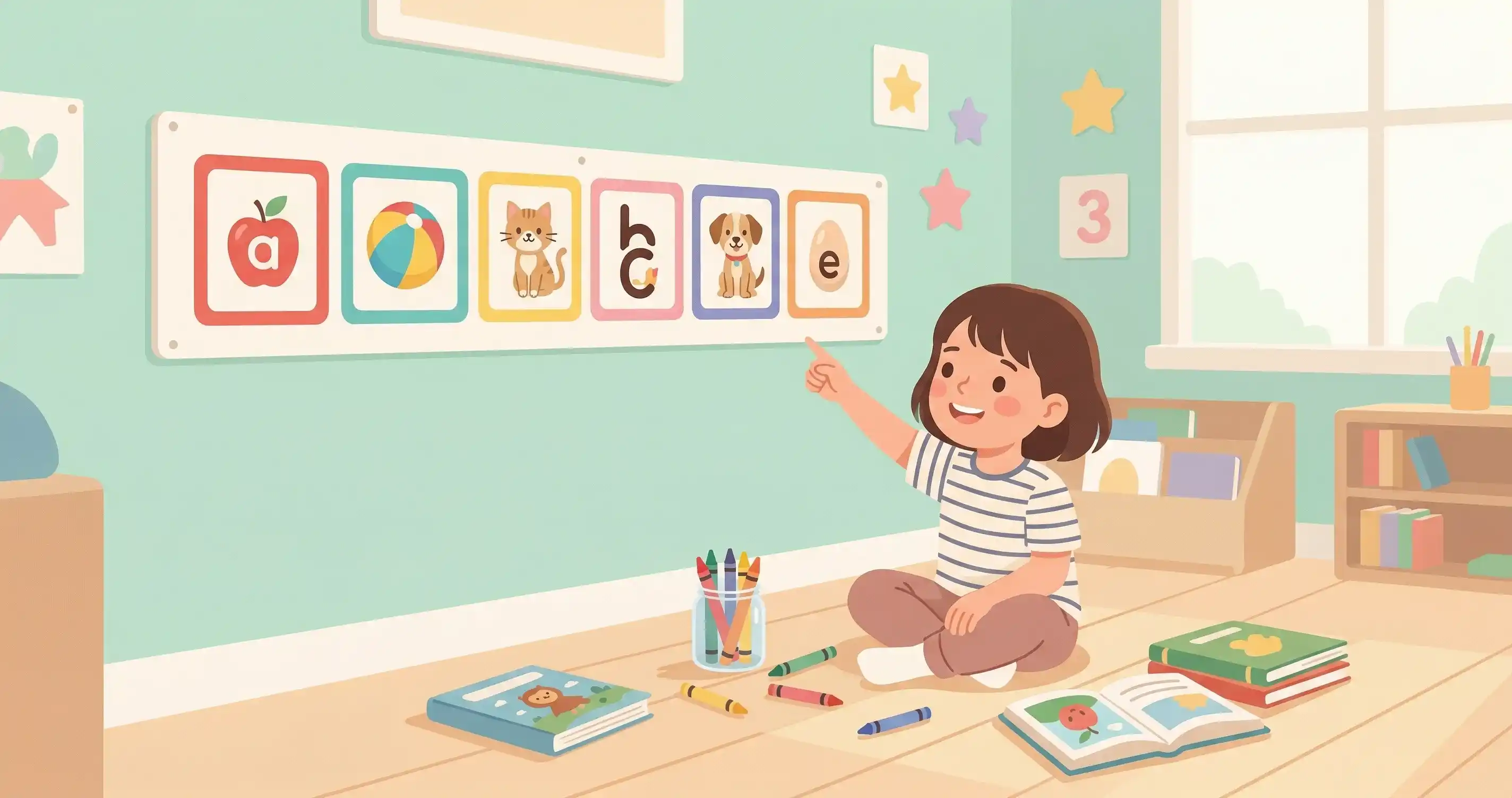
Learning to read is one of the biggest milestones in a child's life. But here's something most parents don't realize — the English alphabet has 26 letters, but the English language has 44 different sounds.
That means just teaching your child the ABCs isn't enough. They need to learn the sounds that letters make, not just their names. And the best tool for this? A phonics sound chart.
In this guide, we'll explain what a phonics sound chart is, walk you through all 44 sounds with examples, and show you exactly how to use it at home — even if you've never heard of phonics before.
Table of Contents
What Is a Phonics Sound Chart?
A phonics sound chart is a simple visual guide that shows your child three things:
- A letter (or group of letters)
- The sound that letter makes
- A word that uses that sound
For example, the letter b makes the sound /b/, like in ball.
That's it. No complicated rules. Just letters, sounds, and examples.
The reason this works so well is that children are visual learners. When they can see a letter, hear its sound, and connect it to a word they already know — reading clicks. They stop guessing at words and start decoding them.
This is the foundation of phonics-based reading, and research from the National Reading Panel confirms it's the most effective way to teach young children to read.
Want to hear all the letter sounds? Watch our phonics sound songs — perfect for daily practice with your child.
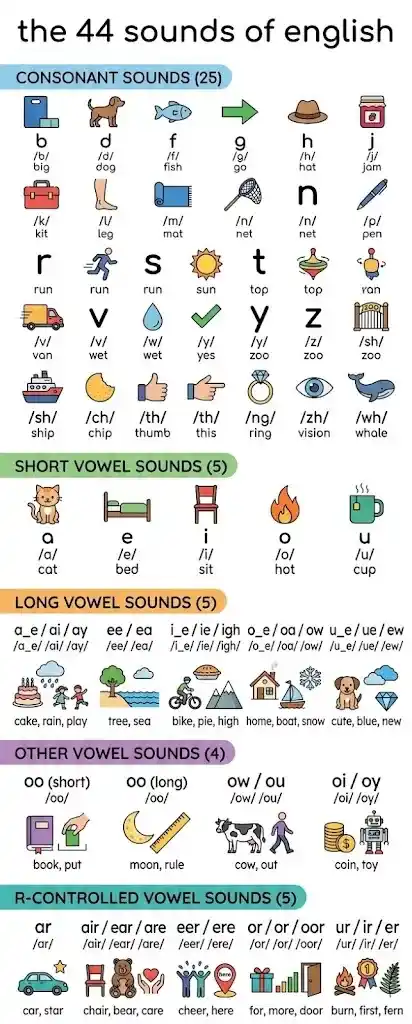
All 44 Phonics Sounds (Broken Down Simply)
English has 44 sounds, and they fall into these groups:
1. Consonant Sounds (25 sounds)
| letters | sound | example word | other spellings |
|---|---|---|---|
| b | /b/ | big | bb (rubber) |
| d | /d/ | dog | dd (add), ed (filled) |
| f | /f/ | fish | ff (puff), ph (phone) |
| g | /g/ | go | gg (egg) |
| h | /h/ | hat | — |
| j | /j/ | jam | g (cage), dge (bridge) |
| k | /k/ | kit | c (cat), ck (duck) |
| l | /l/ | leg | ll (bell) |
| m | /m/ | mat | mm (hammer), mb (lamb) |
| n | /n/ | net | nn (dinner), kn (knee) |
| p | /p/ | pen | pp (apple) |
| r | /r/ | run | rr (carrot), wr (write) |
| s | /s/ | sun | ss (dress), c (city) |
| t | /t/ | top | tt (kitten), ed (jumped) |
| v | /v/ | van | — |
| w | /w/ | wet | wh (when) |
| y | /y/ | yes | — |
| z | /z/ | zoo | zz (buzz), s (is) |
| sh | /sh/ | ship | ti (nation) |
| ch | /ch/ | chip | tch (catch) |
| th | /th/ | thumb | — (unvoiced — air only) |
| th | /th/ | this | — (voiced — vibration) |
| ng | /ng/ | ring | n (think) |
| zh | /zh/ | vision | s (measure) |
| wh | /wh/ | whale | — |
Note: Some sounds have multiple spellings. The /k/ sound alone can be written as c (cat), k (kit), or ck (duck). That's just how English works!
2. Short Vowel Sounds (5 sounds)
Short vowels are the first vowel sounds children learn. They're quick and snappy.
| letters | sound | example word |
|---|---|---|
| a | /a/ | cat |
| e | /e/ | bed |
| i | /i/ | sit |
| o | /o/ | hot |
| u | /u/ | cup |
Tip for parents: When you say the short vowel sound, keep it quick. Say /a/ (like the middle of "cat"), not "ayyyy."
3. Long Vowel Sounds (5 sounds)
Long vowels "say their own name." The letter 'a' in "cake" sounds like the name of the letter a.
| letters | sound | example words |
|---|---|---|
| a_e, ai, ay | /ā/ | cake, rain, play |
| ee, ea, e_e | /ē/ | tree, sea, these |
| i_e, ie, igh | /ī/ | bike, pie, high |
| o_e, oa, ow | /ō/ | home, boat, snow |
| u_e, ue, ew | /ū/ | cute, blue, new |
4. Other Vowel Sounds (4 sounds)
These don't fit neatly into "short" or "long" — they're their own thing.
| letters | sound | example words |
|---|---|---|
| oo | /oo/ (short) | book, put, could |
| oo, u_e | /oo/ (long) | moon, rule, truth |
| ow, ou | /ow/ | cow, out, house |
| oi, oy | /oy/ | coin, toy |
5. R-Controlled Vowel Sounds — "Bossy R" (5 sounds)
When the letter 'r' comes after a vowel, it changes the vowel sound completely. Teachers call these "bossy r" sounds.
| letters | sound | example words |
|---|---|---|
| ar | /ar/ | car, star |
| air, ear, are | /air/ | chair, bear, care |
| eer, ere | /eer/ | cheer, here |
| or, ore, oor | /or/ | for, more, door |
| ur, ir, er | /ur/ | burn, first, fern |
Why a Phonics Chart Works Better Than Memorization
Many parents try to teach reading by having their child memorize whole words. "This word is CAT. This word is DOG. Remember them."
The problem? English has over 170,000 words. No child can memorize them all.
With a phonics sounds chart, your child learns the system behind reading. They learn that c makes /k/, a makes /a/, and t makes /t/. So when they see c-a-t, they can sound it out themselves — even if they've never seen the word before.
This is called decoding, and it's the single most important reading skill a child can develop between ages 3 and 7.
Practice with your child — play this video while pointing at the chart together. Hearing + seeing = faster learning.
How to Use a Phonics Sound Chart at Home (5 Easy Steps)
You don't need to be a teacher to use a phonics chart with your child. Here's how:
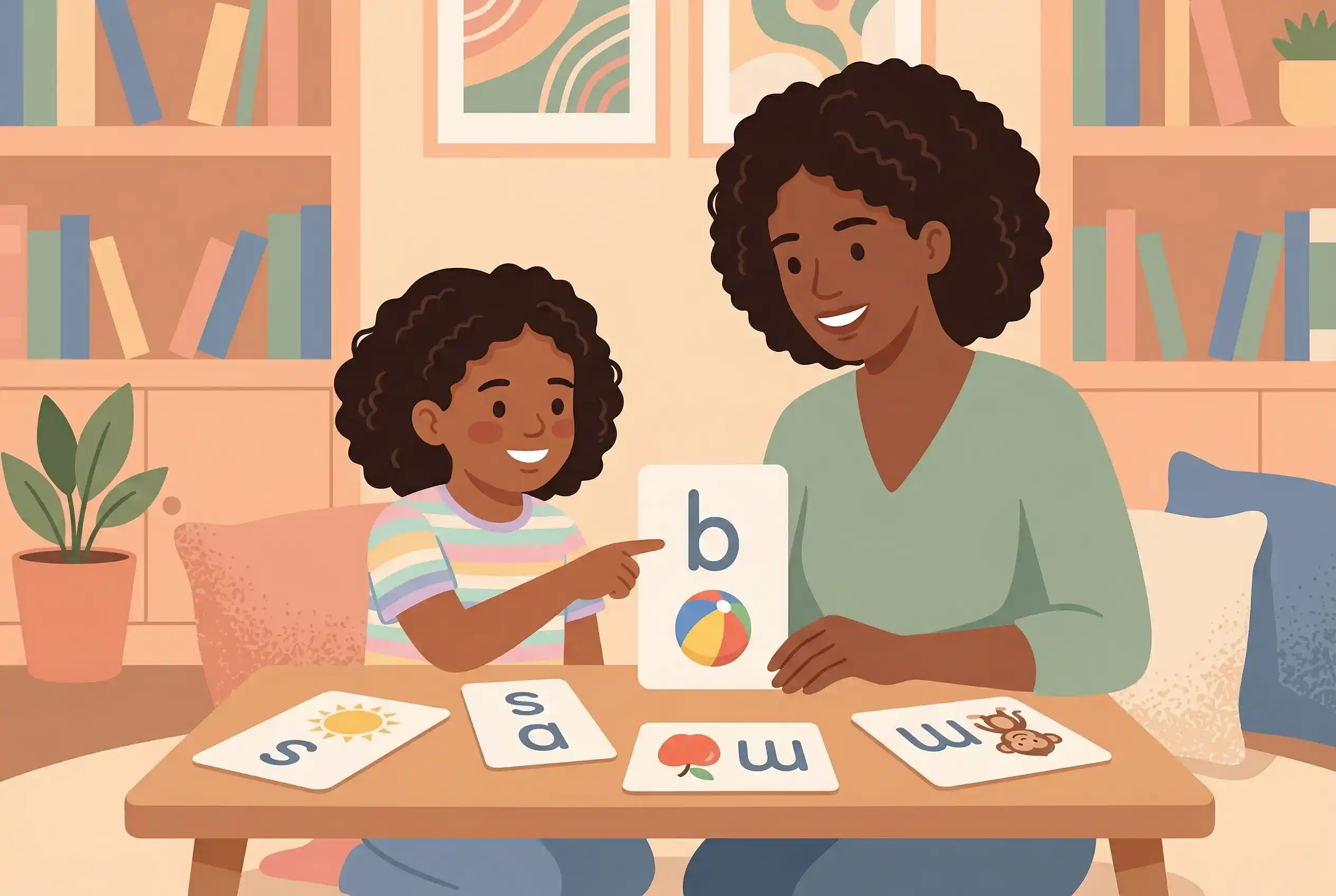
Step 1: Start with sounds, not letter names. Instead of saying "this is the letter B," say "this letter makes the sound /b/." Letter names come later — sounds come first.
Step 2: Do 3-5 sounds per day. Don't try to cover the whole chart in one sitting. Pick 3 to 5 sounds, practice them, and move on. Short daily sessions (10-15 minutes) beat long weekly ones.
Step 3: Use real objects. Point to the letter s on the chart, say the sound /s/, then ask your child to find something in the room that starts with /s/. Sock? Spoon? Sofa? This makes it a game.
Step 4: Blend sounds into words. Once your child knows a few sounds, start blending. "What word do /c/ + /a/ + /t/ make?" This is the moment reading begins to click.
Step 5: Be patient and playful. Some sounds are harder than others. Digraphs like "th" and "sh" take extra practice. That's completely normal. Keep it fun, keep it short, and celebrate every small win.
When Should Your Child Start Learning Phonics?
Most children are ready to start learning letter sounds between ages 3 and 4. By age 5, they should be blending sounds into simple words. By age 6-7, they're typically reading short sentences and simple books.
But every child is different. If your child shows interest in letters and books early, follow their lead. If they're not ready yet, don't force it — give it a few months and try again.
The key is consistency over intensity. Ten minutes a day, every day, beats an hour once a week.
Ready to give your child a head start? Learn2Read's Junior Readers course is built for children aged 3–3.5 who are just beginning to explore letter sounds, blending, and early reading — all in small group live classes with trained phonics teachers. For children aged 3.5–4 who already know some letters, the Junior Readers PLUS course takes them further with blending, sight words, and reading confidence.
Common Mistakes Parents Make with Phonics
Mistake 1: Teaching letter names first. Your child doesn't need to know the letter is called "bee." They need to know it makes the sound /b/. Names can wait.
Mistake 2: Saying sounds with an "uh" at the end. The sound for b is /b/, not "buh." That extra "uh" makes blending much harder later. Say sounds cleanly and crisply.
Not sure how to say the sounds correctly? Watch this — it demonstrates each sound clearly.
Mistake 3: Skipping digraphs. Many parents teach a-z and stop. But digraphs (sh, ch, th, etc.) are essential. Without them, children can't read words like "the," "she," or "when" — some of the most common words in English.
Mistake 4: Moving too fast. It's tempting to rush through the chart. Resist. Mastery of a few sounds is more valuable than exposure to all 44.
Mistake 5: Using uppercase letters. Reading is taught with lowercase letters — because that's what children see in books. Always practice with lowercase first. Uppercase can come later.
FAQs
What is a phonics sound chart? It's a visual guide that shows every letter (and letter combination) alongside the sound it makes and a word example. It helps children learn to read by connecting letters to sounds instead of memorizing words.
How many sounds are in the English language? There are 44 distinct sounds (called phonemes), even though there are only 26 letters. That's because some sounds are made by combining two letters (like sh or ch), and vowels change when paired with 'r' (like in "car" or "bird").
What age is best to start using a phonics chart? Most children are ready between ages 3 and 4. Start with simple consonant and short vowel sounds, then progress to digraphs, blends, and r-controlled vowels.
What's the difference between phonics and phonetics? Phonics is a method for teaching reading — it connects letters to sounds. Phonetics is the scientific study of all speech sounds. For teaching your child to read, phonics is what you need.
Can I teach phonics at home without a tutor? Absolutely. A phonics sound chart, 10-15 minutes a day, and the steps in this guide are enough to give your child a strong start. If you want expert-led instruction, Learn2Read's live online phonics classes can accelerate progress with structured lessons and qualified teachers.
Every confident reader starts with a single sound. Book a Free Trial Class

Latest Posts

17 October 2026
My Child Knows the Alphabet (ABCD) but Can't Read: Letter Names vs Letter Sounds, Ages 3 to 6

14 October 2026
How to Teach a Child to Write Sentences ?
10 October 2026
b and d Confusion: Is It Dyslexia? How to Fix It (Ages 4-7)

A new chapter from Learn2Read
Read Before They Read
Before you teach your child to read, read this. A calmer, clearer way into your child’s reading journey—with a practical guide written for real Indian homes.