21 October 2026
Phonics vs Sight Words: Which Should You Teach First (and Why It Matters)
Phonics vs Sight Words: Which Should You Teach First (and Why It Matters)
posted on : 30 April 2026
Your child's school says they're learning phonics. The workbook you bought focuses on sight words. Your mother-in-law swears her generation just "learned to read naturally." And you're left wondering — phonics or sight words? Which one actually works?
Here's the short answer: your child needs both. But they need them in the right order, at the right time, and for different reasons. Getting this wrong is one of the most common mistakes parents make when teaching kids to read.
This guide breaks down exactly what phonics and sight words are, how they're different, when to teach each one, and how they work together to turn your child into a confident, fluent reader.
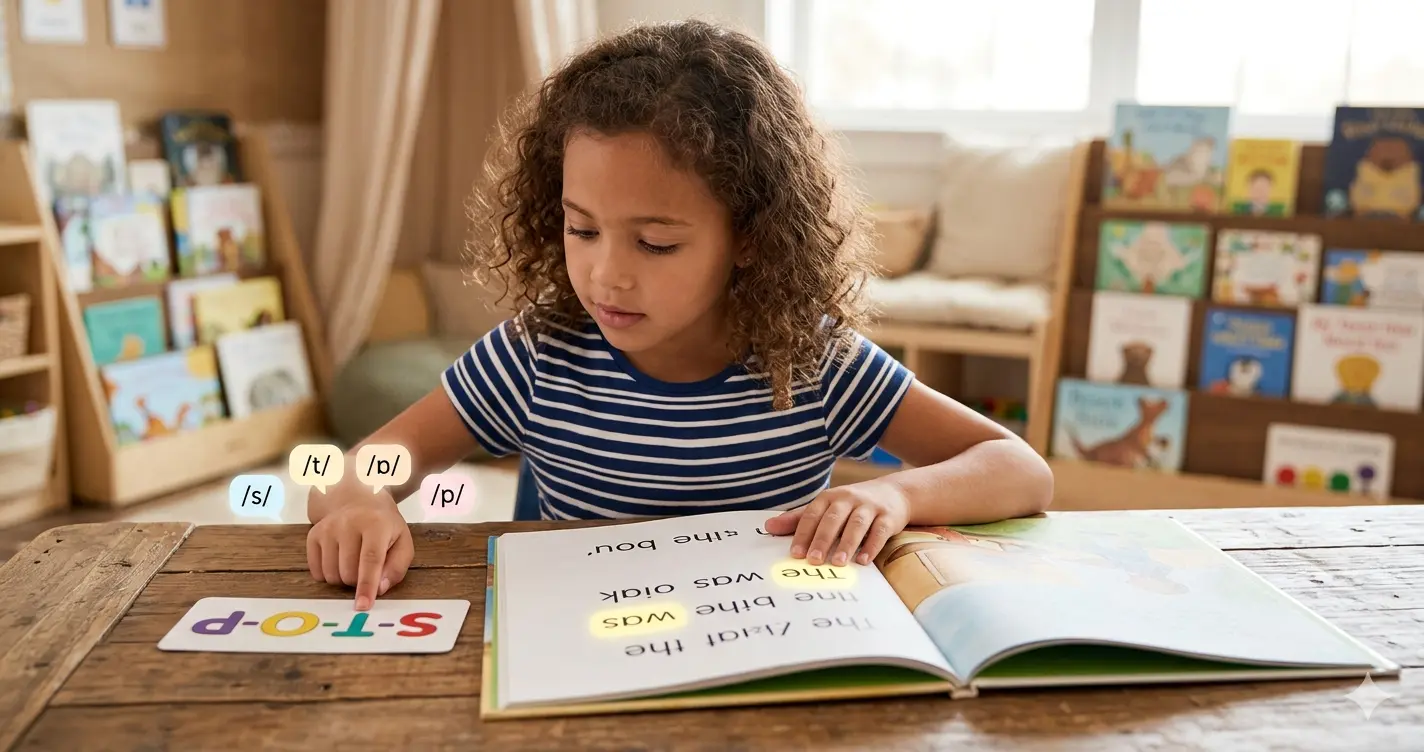
Table of Contents
What Is Phonics?
Phonics is a method of teaching reading by connecting letters to sounds. Your child learns that the letter 'b' makes the sound /b/, the letter 'a' makes /a/, and the letter 't' makes /t/. Then they blend those sounds together: /b/ + /a/ + /t/ = bat.
This process is called decoding — and it's the single most important skill in learning to read. Why? Because once a child can decode, they can read any word they've never seen before. They don't need to memorize every word in the English language — they just need to understand the code.
Research from the National Reading Panel confirms that systematic phonics instruction is the most effective way to teach children to read, especially between ages 3 and 7.
Watch how blending works — once your child gets this, reading clicks.
What Are Sight Words?
Sight words are common words that your child learns to recognize instantly — without sounding them out. Words like:
the, said, was, one, two, have, come, does, were, what
Notice anything about these words? Most of them don't follow normal phonics rules. Try sounding out "said" — if you follow phonics, you'd get /s/ + /a/ + /i/ + /d/, which sounds like "say-id." But we pronounce it "sed." The word breaks the rules.
That's exactly why sight words exist. English has roughly 100-200 high-frequency words that appear so often in text (they make up about 50-75% of everything your child reads) that recognizing them on sight makes reading dramatically faster and smoother.
The most widely used sight word lists are the Dolch Word List (220 words) and the Fry Word List (1,000 words, grouped by frequency).
Phonics vs Sight Words: What's Actually Different?
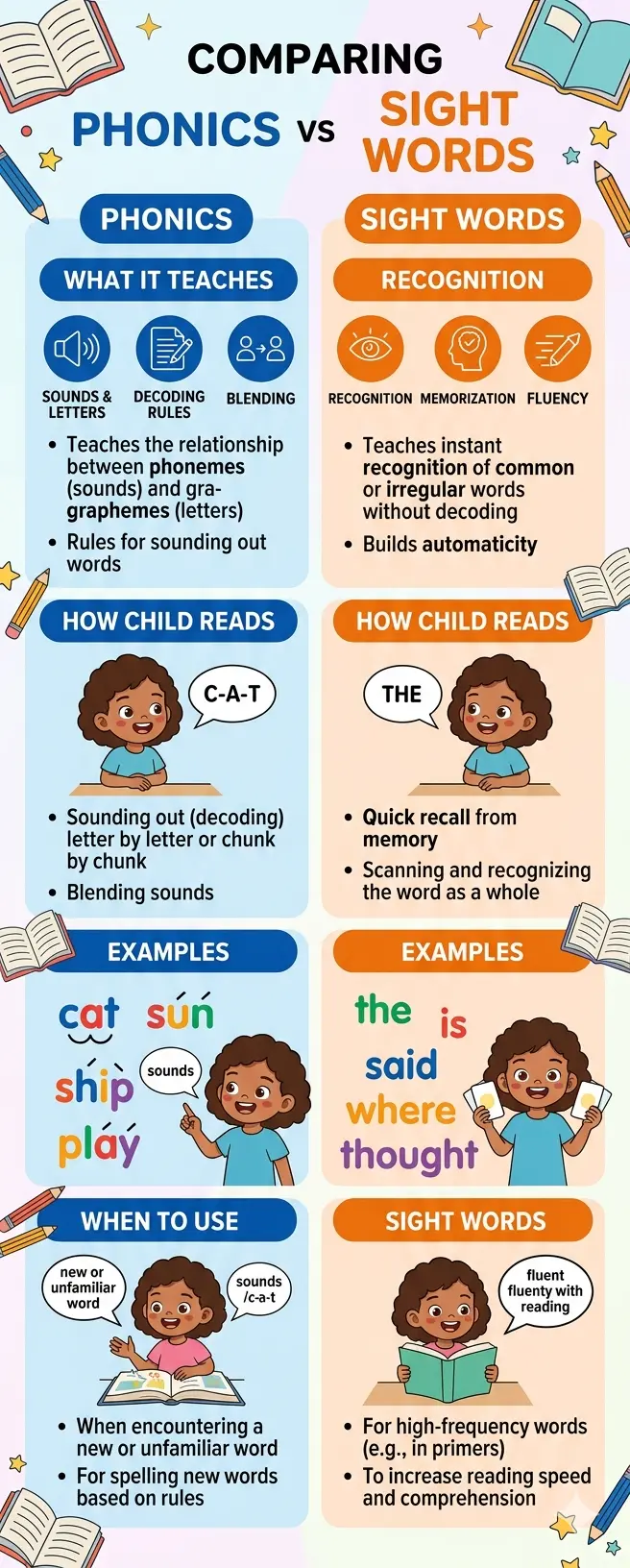
Here's a side-by-side comparison that makes the difference crystal clear:
| Feature | Phonics | Sight Words |
|---|---|---|
| What it teaches | How to decode ANY word by sounding it out | How to instantly recognize specific common words |
| How the child reads | Breaks the word into sounds, blends them together | Sees the whole word and recognizes it immediately |
| Works for | Regular words that follow spelling rules (cat, ship, train) | Irregular or high-frequency words (the, said, was, one) |
| Number of words | Unlimited — any decodable word | Limited — typically 100-300 specific words |
| The skill it builds | Independence — "I can figure out new words on my own" | Speed — "I can read common words without slowing down" |
| Example | c-a-t → /k/ /æ/ /t/ → "cat" | Seeing "the" and instantly knowing it |
| Weakness alone | Slow, choppy reading if EVERY word must be decoded | Child hits a wall when they encounter a word not on the list |
The key insight: phonics gives your child the engine. Sight words give them the fuel. You need both for the car to run.
Which Should You Teach First — Phonics or Sight Words?
Phonics first. Always.
Here's why: phonics teaches your child how reading works. It gives them the decoding skill — the ability to look at a word they've never seen and figure it out. This is the foundation that everything else is built on.
If you start with sight words alone, your child is essentially memorizing. They can recognize "the" and "said" and "was" — but when they encounter "cat" or "ship" or "frog" for the first time, they have no strategy. They'll guess, or they'll look at you and wait.
If you start with phonics, your child can sound out "cat" and "ship" and "frog" on their own. Then when you add sight words for the tricky ones like "the" and "said," they already understand how reading works. The sight words become a supplement, not a crutch.
The research-backed sequence:
- Ages 3-4: Start with letter sounds (phonics). Learn the sound each letter makes.
- Ages 4-5: Begin blending sounds into simple words (c-a-t, s-i-t, m-a-p). Introduce the first 20-30 sight words alongside.
- Ages 5-6: Progress to digraphs (sh, ch, th), long vowels, and blends. Expand sight word vocabulary to 100+.
- Ages 6-7: Read simple books fluently using both phonics decoding AND automatic sight word recognition.
Ready to get your child started with phonics? Learn2Read's Junior Readers course is built for children aged 3–3.5 who are beginning to explore letter sounds, blending, and early reading in small group live classes. For ages 3.5–4, the Junior Readers PLUS course adds blending, sight words, and reading confidence.
See how Learn2Read teaches phonics and blending in a live class — this is what real progress looks like.
How Phonics and Sight Words Work Together
Here's a sentence a 5-year-old might encounter in a book:
"The cat sat on the mat."
Watch how both skills work together:
- "The" → sight word (recognized instantly — no decoding needed)
- "cat" → phonics (/k/ + /a/ + /t/ → "cat")
- "sat" → phonics (/s/ + /a/ + /t/ → "sat")
- "on" → sight word (recognized instantly)
- "the" → sight word (again)
- "mat" → phonics (/m/ + /a/ + /t/ → "mat")
The child decoded 3 words using phonics and recognized 3 words as sight words. The result? A fluent, smooth reading experience. Neither skill alone would get them there — the combination is what creates fluency.
This is what reading scientists call the "simple view of reading": Decoding (phonics) × Language Comprehension = Reading. Sight words accelerate the decoding part for high-frequency words, freeing up brain power for comprehension.
5 Practical Ways to Teach Both at Home
- Start every session with 3 letter sounds: Pick 3 sounds from the phonics chart. Say the sound (not the letter name), show the letter, and ask your child to repeat. Do this for 3-5 minutes. Consistency beats intensity — daily is better than weekly.
- Blend sounds into words every day: Once your child knows 6-8 sounds, start blending. Use 3-letter words: "What word do /s/ + /a/ + /t/ make?" This 2-minute exercise is where reading starts to click.
- Introduce 2-3 sight words per week: Write each sight word on a card. Show it, say it, use it in a sentence. Stick the cards on the fridge and point to them during the day. Don't rush — mastery of 3 words per week beats exposure to 10.
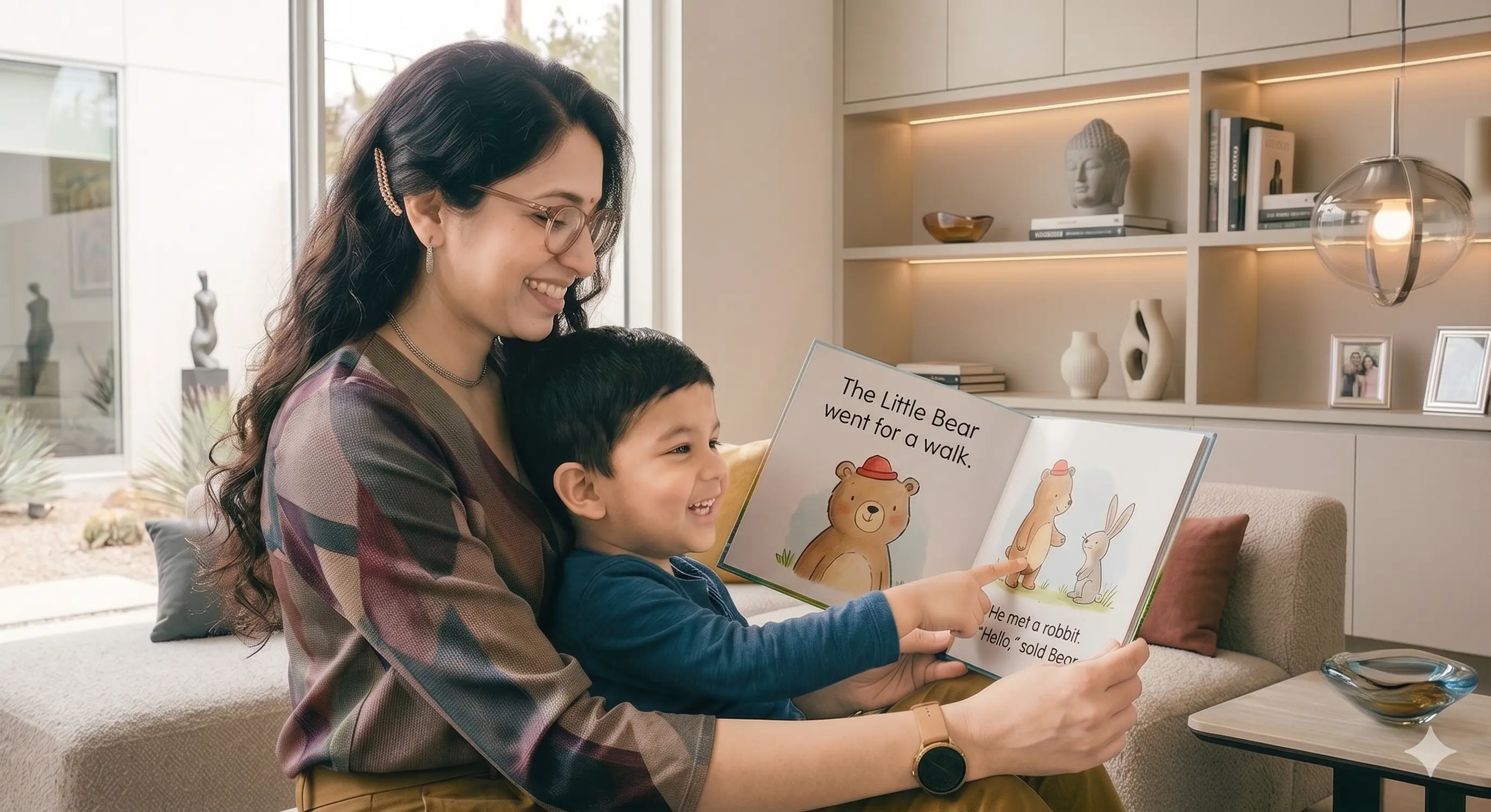
- Read together every night — and let them spot both: While reading a bedtime story, occasionally point to a word and ask: "Can you sound this one out?" (for decodable words) or "Do you remember this word?" (for sight words). This bridges practice to real reading.
- Make it a game, not a lesson:
- Sight word treasure hunt around the house
- Sound-of-the-day challenge ("Today we're looking for things that start with /m/")
- Word-building with magnetic letters on the fridge
Need activity ideas? Watch this for fun phonics games you can play at home.
Common Mistakes Parents Make
Mistake 1: Teaching ONLY sight words and skipping phonics. This is the biggest one. A child who only memorizes sight words has no strategy for new words. They'll guess based on pictures or the first letter — which works in picture books but collapses by grade 2 when texts get harder.
Mistake 2: Waiting too long to start. The optimal window for phonics is ages 3-6. You don't need to wait for school. Ten minutes a day at home gives your child a massive head start.
Mistake 3: Making it stressful. If your child is crying during reading practice, stop. Learning to read should feel like play, not punishment. Short, fun sessions build a positive relationship with reading that lasts a lifetime.
Mistake 4: Thinking the school will handle everything. Many schools teach phonics for only 15-20 minutes per day in a class of 25+ kids. That's not enough for most children. The gap is where home practice (even 10 minutes) makes the difference.
FAQs
What is the difference between phonics and sight words? Phonics teaches children to decode words by connecting letters to sounds and blending them together. Sight words are common words (like "the," "said," "was") that children memorize and recognize instantly without sounding out. Phonics builds decoding independence; sight words build reading speed.
Should I teach phonics or sight words first? Phonics first. It gives your child the foundational skill of decoding — the ability to figure out new words on their own. Once they understand how letters map to sounds, introduce sight words alongside phonics for the high-frequency words that don't follow standard spelling rules.
Are sight words part of phonics? Some sight words are phonetically regular (like "and," "in," "it") and can be decoded using phonics. But many common sight words (like "said," "was," "one," "the") are irregular and don't follow phonics rules — which is exactly why they need to be memorized separately.
What percentage of reading is sight words? Roughly 50-75% of the words in early children's books are high-frequency words from standard sight word lists. That's why instant recognition of these words dramatically improves a child's reading fluency and confidence.
Can my child learn to read with just sight words and no phonics? Technically, a child can memorize a few hundred words. But English has over 170,000 words — memorization alone isn't sustainable. Without phonics, a child has no strategy for new or unfamiliar words. Research consistently shows that children taught with systematic phonics become stronger, more independent readers.
What are some examples of phonics words vs sight words? Phonics words follow regular spelling patterns and can be sounded out: cat, ship, train, frog, jump. Sight words are high-frequency words often memorized whole: the, said, was, one, come, does, have, were.
The best readers aren't built on just one method — they're built on the right combination at the right time. Book a Free Trial Class

Latest Posts
17 October 2026
My Child Knows the Alphabet (ABCD) but Can't Read: Letter Names vs Letter Sounds, Ages 3 to 6
14 October 2026
How to Teach a Child to Write Sentences ?
10 October 2026
b and d Confusion: Is It Dyslexia? How to Fix It (Ages 4-7)

A new chapter from Learn2Read
Read Before They Read
Before you teach your child to read, read this. A calmer, clearer way into your child’s reading journey—with a practical guide written for real Indian homes.