5 September 2026
Is Your Child Ready for School? A 12-Point School Readiness Checklist (Ages 3-5)
Is Your Child Ready for School? A 12-Point School Readiness Checklist (Ages 3-5)
posted on : 14 July 2026
Somewhere between buying the school bag and labelling the water bottle, the question lands: is my child actually ready for this?
If that's you right now, this school readiness checklist will settle it. It covers the 12 skills that matter most in the first months of school, whether you call that year kindergarten, reception, KG1, or nursery (the year before Grade 1 in most countries). Every skill can be checked at home in minutes, and for any gaps you find, the fix is further down this page.
One reassurance before you start. Readiness is much wider than letters and numbers, and children arrive at it from very different starting points. In the US, the 2026 KIDS COUNT Data Book reports that 54% of children aged 3-4 are not enrolled in school, and many of those children still walk in on day one and thrive. Everything below can be built at home, in minutes a day.
Table of Contents
- What Does School Readiness Actually Mean?
- The 12-Point School Readiness Checklist (Save This One)
- Language and Pre-Reading Skills: The Part Most Checklists Rush
- Social and Emotional Readiness: What Teachers Notice First
- Independence: Lunchboxes, Toilets and Tidy-Up Time
- Motor Skills: From Playground to Pencil Grip
- What If Your Child Isn't Ready Yet?
- FAQs
What Does School Readiness Actually Mean?
School readiness means a child can manage the everyday demands of a classroom: listening, communicating, getting along with others, handling basic self-care, and holding the early building blocks of reading and numbers.
Notice what is missing from that definition: reading. School readiness does not mean reading before day one. Reading Rockets, a respected US literacy organisation, puts it plainly: school is where most children learn to read and write, and arriving already able to do so is neither required nor expected.
Ask teachers what they notice first and it is rarely the alphabet. A child who can wait for a turn, ask for help, and manage their own coat usually settles faster than a child who knows twenty letters but falls apart at goodbye time. A good school readiness checklist covers both sides: the head and the everyday habits.
The 12-Point School Readiness Checklist (Save This One)
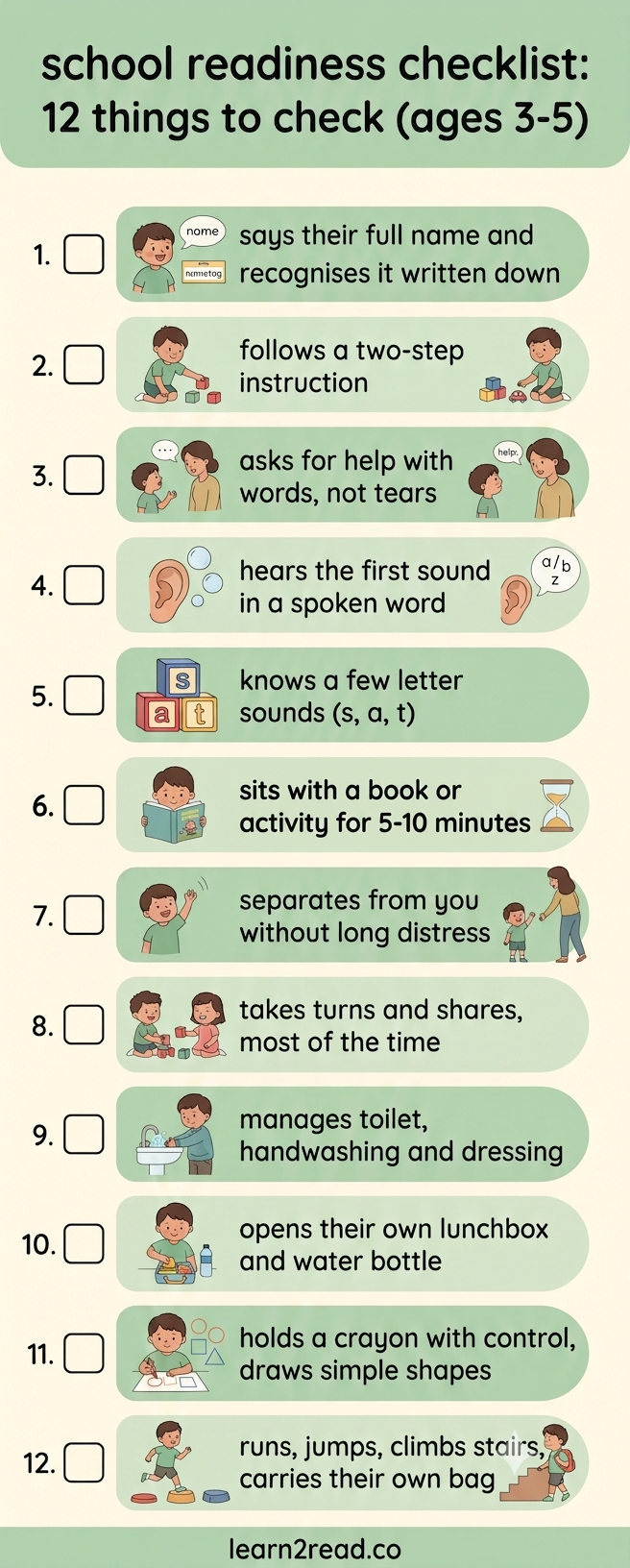
Run through the list with your child in mind. "Most of these, most of the time" is the standard here, not perfection. These skills are typical for children aged 4-5, and many are still developing at 3.
| # | Can your child... | Skill area |
|---|---|---|
| 1 | Say their full name, and recognise it written down | Language |
| 2 | Follow a two-step instruction ("get your shoes and wait by the door") | Listening |
| 3 | Ask for help with words rather than tears | Communication |
| 4 | Hear the first sound in a spoken word ("what sound does sun start with?") | Pre-reading |
| 5 | Recognise a few letters by their sounds (lowercase s, a, t) | Pre-reading |
| 6 | Sit with a book or activity for 5-10 minutes | Attention |
| 7 | Separate from you without long distress | Emotional |
| 8 | Take turns and share, most of the time | Social |
| 9 | Manage the toilet, handwashing and dressing with little help | Self-help |
| 10 | Open their own lunchbox, snack packets and water bottle | Self-help |
| 11 | Hold a pencil or crayon with control and draw simple shapes | Fine motor |
| 12 | Run, jump, climb stairs and carry their own small bag | Gross motor |
(In the US you will often see the same idea called a kindergarten readiness checklist. Different name, identical skills.)
Ticked 9 or more? Your child is in good shape. Between 5 and 8, you have a normal, workable to-do list. Under 5, don't panic: jump to "What if your child isn't ready yet?" below and pick two skills to start with this week.
Language and Pre-Reading Skills: The Part Most Checklists Rush
The pre-reading skills that predict an easier start at school are hearing the sounds inside spoken words, knowing a handful of letter sounds, and enjoying books, not reciting the alphabet on demand.
The first of those has a name: phonemic awareness (the ability to hear the separate sounds in a spoken word, like s-u-n in "sun"). The National Reading Panel, a landmark US government review of reading research, found that teaching children to notice and play with these sounds significantly improves how well they learn to read.
Here is the twist many parents miss: letter sounds beat letter names. A child who knows that s says "sss" holds a tool for reading real words. A child who only knows the name "ess" holds a piece of trivia. Both are fine to know, but sounds do the work.
Four quick checks you can run at bath time or in the car:
| Pre-reading check | Try this at home |
|---|---|
| Hears rhymes | "Do cat and hat rhyme? Do cat and bus?" |
| Hears first sounds | "What sound does mango start with?" |
| Claps syllables | Clap the beats in "ba-na-na" together |
| Knows some letter sounds | Point to lowercase s, a or t in a book: "what sound is this?" |
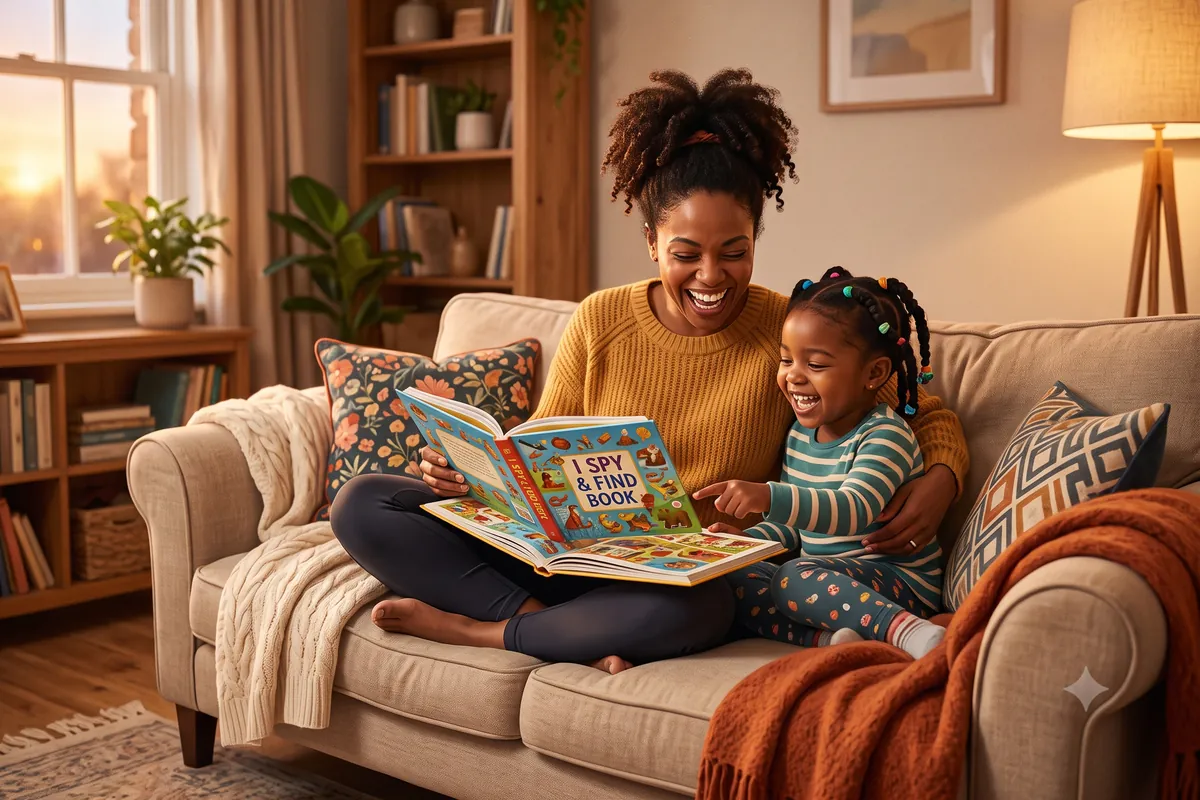
If your child enjoys these games and you would like a structured next step, this is exactly the ground covered in Junior Readers (ages 3-3.5) at Learn2Read, a live online phonics program for children aged 3-12.
Social and Emotional Readiness: What Teachers Notice First
Social and emotional readiness for school shows up as separating calmly, taking turns, recovering from small disappointments, and asking adults for help.
None of this requires a naturally confident child. Fatima might sob at drop-off all through the first week and be racing in by week three; that is a normal pattern, not a red flag. What helps is rehearsal: a short, predictable goodbye ritual (hug, high-five, wave at the window) practised at a grandparent's house or a friend's place before the school year starts.
Turn-taking is trainable too. Simple board games, card games like snap, and "your turn, my turn" chats at dinner all build the same muscle a classroom uses every hour.
Independence: Lunchboxes, Toilets and Tidy-Up Time
Independence at school age means managing the toilet, food containers, clothing and belongings with only light adult help.
The quickest win here is a dress rehearsal. Once a week, serve a meal in the actual lunchbox with the actual water bottle your child will take to school, and let them open everything themselves. You will find out fast which yoghurt tube or clip-lock box needs swapping, and so will they, with you nearby instead of a busy teacher.
Do the same with the school clothes. Shoes they can fasten themselves (velcro is your friend), a jumper or jacket they can pull on, and a bag they carry on the walk. Liam's dad calls it "the big kid walk"; the bag has nothing in it but a toy, and the habit is the point.
Motor Skills: From Playground to Pencil Grip
Motor readiness for school means comfortable big movements (running, climbing, stairs) and enough hand strength and control to use crayons, scissors and zips.
For the hands, ditch the worksheets. Playdough, tearing paper for collages, threading pasta onto string and chunky crayons build the same finger strength with none of the tears. A settled pencil grip typically develops between ages 4 and 6, so an awkward grip at 3 or 4 is rarely worth worrying about.
For the big movements, playgrounds do the job better than any programme. If you want a benchmark for what is typical at each age, the CDC's milestone checklists are the reference most doctors use. And if anything there genuinely concerns you, your child's doctor is the right person to ask, not a blog.
What If Your Child Isn't Ready Yet?
Gaps on a school readiness checklist are normal at ages 3-5, and most of them close with short, playful, daily practice.
Pick the two items that would make the biggest difference and leave the rest alone for now. Ten minutes after dinner, four days a week, on just two skills is enough to see real movement within a month. Keep it a game; the moment practice feels like a test, a young child checks out.
A few signs deserve a professional's eyes rather than a checklist: speech that people outside the family cannot understand by age 4, no interest in playing with other children, or losing skills a child previously had. If any of those sound familiar, a chat with your child's teacher or doctor is the right next step.
And for the pre-reading items specifically, small live classes can carry the load so home stays fun. Junior Readers PLUS (ages 3.5-4) picks up letter sounds, blending and first sight words in playful 1-to-1 or small-group sessions, and parents tell us the confidence spills over into the rest of the checklist.
FAQs: School Readiness
What age should a child start school? Most children start formal school between ages 4 and 6, depending on the country and school system. Readiness matters more than the exact birthday: a child who can separate calmly, follow simple instructions and manage basic self-care is typically ready, wherever they fall in that range.
Should my child be able to read before starting school? No. School is where most children learn to read, and teachers do not expect it on day one. Pre-reading skills help more: hearing rhymes, noticing the first sound in words, and knowing a few letter sounds (lowercase s, a, t) give a child a genuine head start.
What are the five areas of school readiness? The five areas most schools look at are language and pre-reading, social and emotional skills, independence and self-help, fine motor skills (hands and fingers), and gross motor skills (whole-body movement). A ready child has "most skills, most of the time" across all five, not perfection in any one.
How can I get my child ready for school in one month? Four weeks is enough for real progress. Set a consistent sleep routine, practise with the real lunchbox and school clothes weekly, run one 10-minute game a day on two chosen skills (letter sounds and turn-taking are common picks), and read aloud together every day.
My child knows letter names but not letter sounds. Is that a problem? It is not a problem, just an incomplete step. Letter sounds are what children actually use to read words, so start adding them now: point at lowercase s and say "sss", then hunt for things that start with that sound. Most children pick up several sounds within a couple of weeks of playful practice.
Is it better to delay school a year if my child seems young? Sometimes, but not automatically. Research on delaying entry is mixed, and the best guide is the pattern across this checklist plus the view of a preschool teacher who knows your child. If most skills are emerging, children usually grow into school; if many areas lag together, a conversation with the school is worth having.
Read Next

Latest Posts
2 September 2026
Homework Battles: 7 Do's & Don'ts for Ages 5-8 (2026)
29 August 2026
Kids' Attention Spans & Short Videos: What Parents Must Know
25 August 2026