
7 October 2026
After-School Meltdowns: Why Your Child Falls Apart at Home (and What Actually Helps)
After-School Meltdowns: Why Your Child Falls Apart at Home (and What Actually Helps)
posted on : 25 August 2026
After-School Meltdowns: Why Your Child Falls Apart at Home (and What Actually Helps)
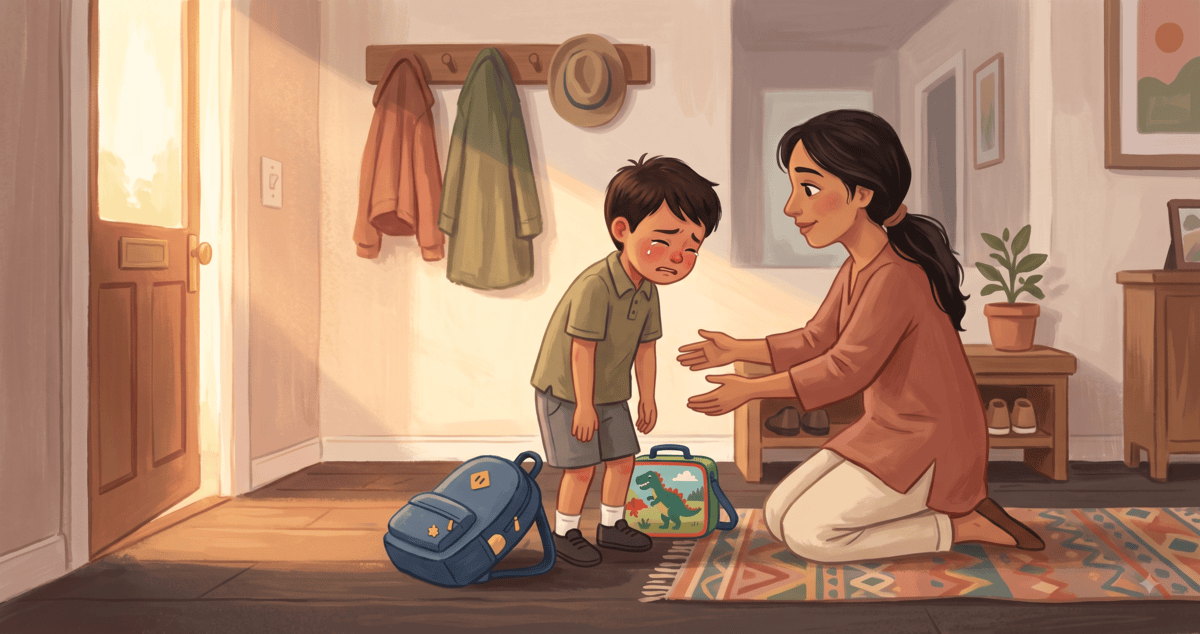
The teacher says your child was "an absolute delight today." Twenty minutes later, that same delight is on your kitchen floor, sobbing because the banana broke.
If your child is calm at school and a storm at home, you are not imagining it, and you are not doing anything wrong. It has a name — and once you understand it, your afternoons change.
This guide explains why after-school meltdowns happen, what they look like from ages 3 to 8, the 5-step reset that actually works, and the few signs that mean something more is going on.
In this guide:
What is after-school restraint collapse?
Why it's actually a good sign
What it looks like at ages 3-8
The 5-step after-school reset
What makes it worse
When it's more than a meltdown
FAQs
What Is After-School Restraint Collapse?
After-school restraint collapse is the sudden release of emotion — tears, anger, silliness, or shutdown — that happens when a child who has held it together all day at school finally reaches their safe place: you. The term was popularised by Canadian parenting educator Andrea Loewen Nair (Today's Parent has the original explainer), and the idea behind it is simple.
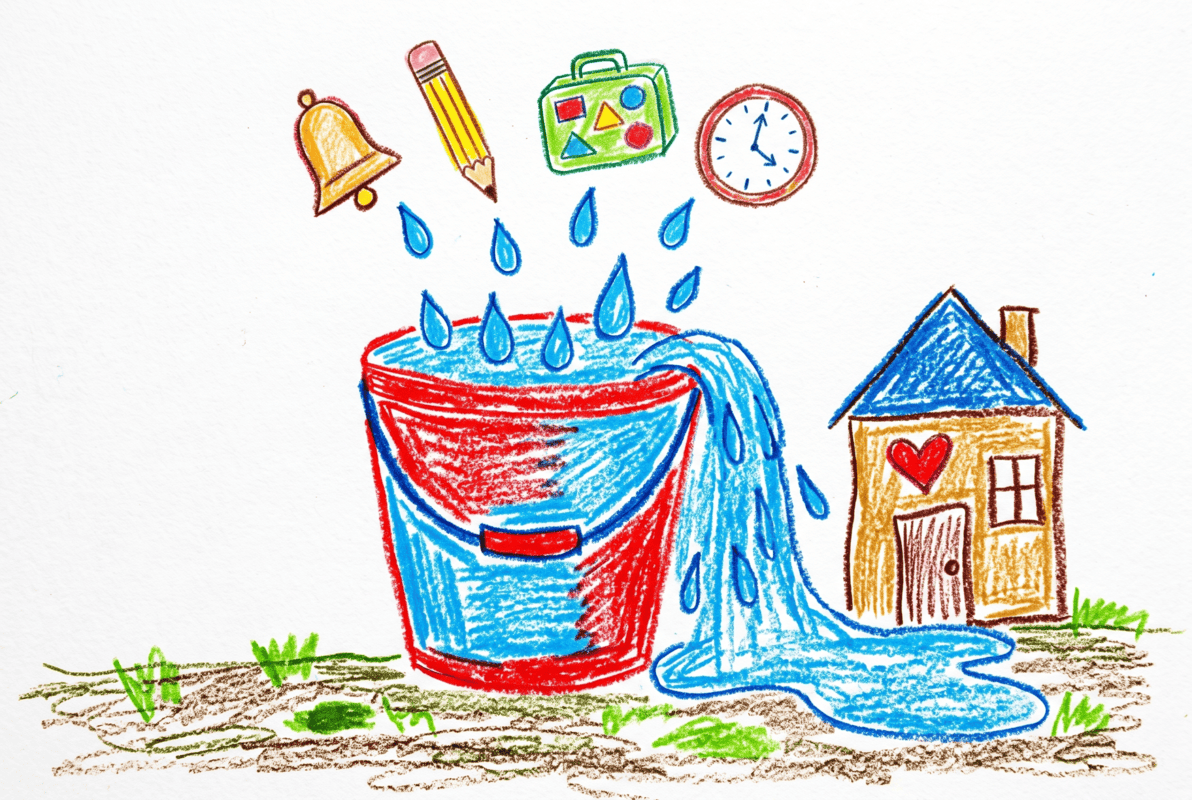
Self-control is not an unlimited resource in a young child. All day at school they are sitting still, waiting turns, following instructions, managing disappointments — spending self-regulation like coins from a small purse. Child development researcher Dr. Kristyn Sommer puts it plainly: by the end of the school day, many children have simply used up their capacity to self-regulate (her full explanation here).
The purse is empty. Then they see you — and everything they held in all day comes out at once.
Why It's Actually a Good Sign
Strange as it sounds, an after-school meltdown usually means two good things are true. First, your child can regulate themselves — they proved it for six straight hours. The skill is forming; it just runs out, the way a new runner's legs run out.
Second, they feel safest with you. Children save their hardest feelings for the person they trust to still love them afterwards. The meltdown is not a report card on your parenting — it's a compliment paid in the most exhausting currency imaginable.
Harvard's Center on the Developing Child describes self-regulation as a skill built slowly through years of practice with supportive adults (more on that science here). Ages 3-8 are the middle of that construction site. Some dust and noise is part of the build.
What It Looks Like at Ages 3-8
The collapse changes costume as children grow. Most children typically show it like this:
📌 Screenshot this table — and notice one thing: in every row, the storm is aimed at home, not school. That's the signature of restraint collapse, not of a behaviour problem.
(School days differ around the world — whether pickup is 1pm or 4pm, the empty-purse effect is the same.)
| Age | The after-school collapse often looks like... |
| 3-4 | Full tantrums over tiny triggers (the wrong cup, the broken banana); clinginess; instant tears at pickup |
| 5-6 | Snapping and rudeness at you (and only you); refusing simple requests; wild silliness that tips into tears |
| 7-8 | Slamming doors; "school was FINE, stop asking"; picking fights with siblings; collapsing over homework |
The 5-Step After-School Reset
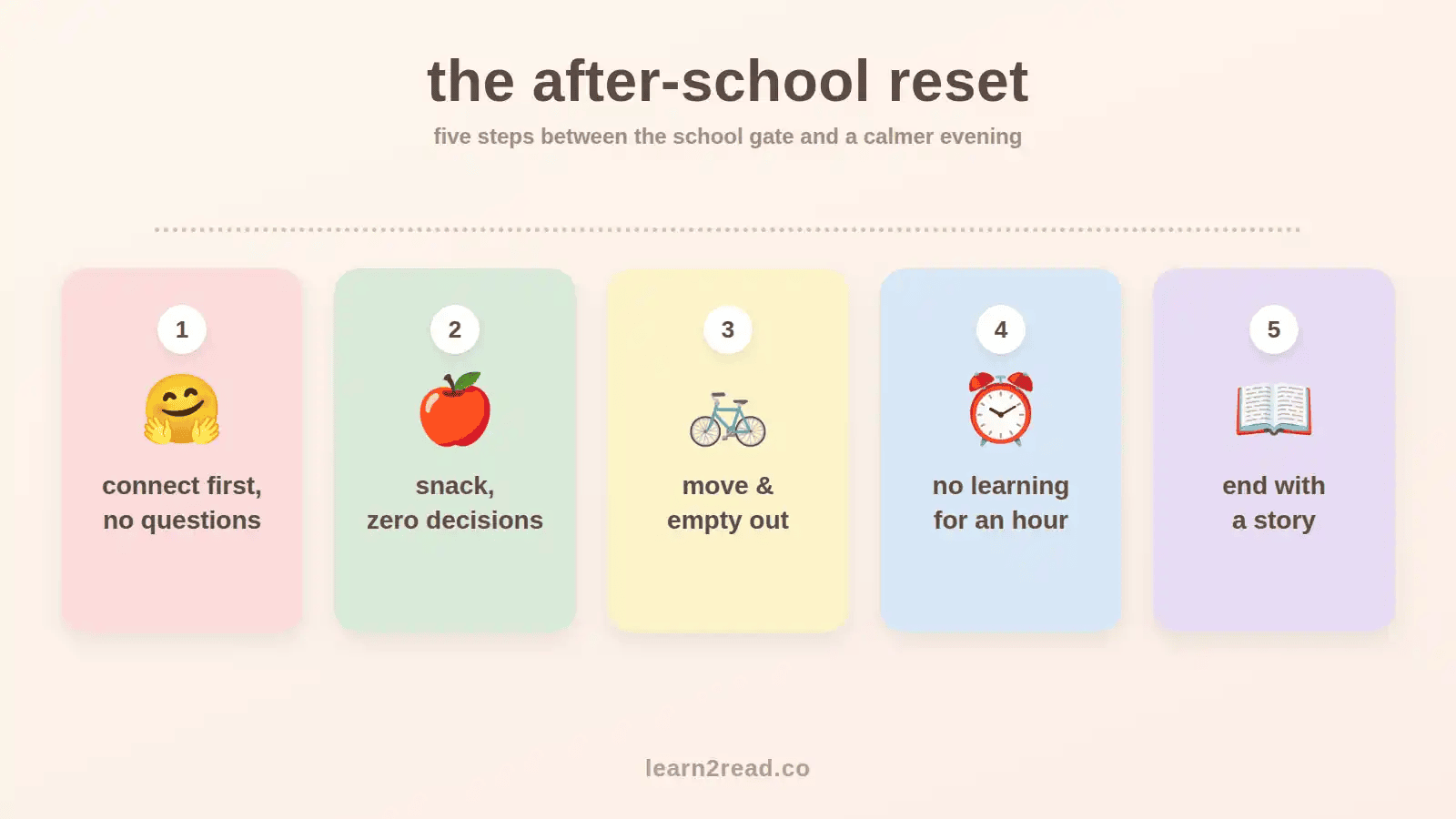
You cannot talk a child out of a collapse — but you can build an afternoon that catches it. Our teachers recommend this exact sequence to families across 35+ countries:
Connect before questions. At pickup: a hug, a smile, "I missed you." Nothing else. Save "how was school?" for later — questions are demands on an empty tank.
Feed without decisions. Have one snack ready, no choosing required. A hungry, decision-fatigued child cannot regulate; a fed one might.
Let them empty out. 30-60 minutes of movement or drift — park, bike, garden, lying on the floor with toys. Boring is fine. Boring is the point.
Hold all learning for at least an hour. No homework, no reading practice, no classes straight off the bus. Learning poured into an empty tank spills; the same 10 minutes after the reset actually lands.
End with a reconnect ritual. The bedtime story is the best one ever invented — warm, predictable, zero performance pressure. It refills the purse for tomorrow. (More on raising a book-lover in our guide to making kids love reading.)
What Makes It Worse
Most of us have done all of these — no guilt, just physics:
The pickup interview. "How was school? Who did you play with? Did you eat your lunch?" Every question withdraws another coin from the empty purse. Let silence do the driving home.
Straight to homework. Racing from school gate to worksheet is the most common trigger we see. The hour you "save" costs you the evening.
The instant screen plug. A tablet does stop the meltdown — by pressing feelings down, not letting them out. Then bedtime inherits them. We covered the better route in our screen-time do's and don'ts — screens are a sometimes-tool, not the daily decompression plan.
The overloaded weekday. School + activity + class + homework on the same afternoon leaves no room for the reset. If afternoons are constant war, the schedule — not the child — usually needs the edit.
That last one matters for learning, too. At Learn2Read — a live online phonics program for children aged 3-12 — the difference between a child who joins class straight off the school bus and one who's had their reset hour is visible on screen within minutes. Practice timed to a full tank is worth double. (Wondering what your child should be practising at their age? Our reading milestones by age guide breaks it down.)
When It's More Than a Meltdown
Restraint collapse is loud, daily-for-a-few-weeks, and fades as the school year settles. Talk to your child's teacher or pediatrician if you notice a different pattern:
Meltdowns are intensifying months into the school year, not easing
Your child hurts themselves, others, or destroys things in most collapses
School refusal is growing — genuine dread, not Monday grumbles
You see regression: lost skills, new bedwetting, big sleep changes
The teacher reports the same struggles at school (restraint collapse, by definition, mostly stays home)
Some children — including many neurodivergent children — spend extra effort holding it together at school, so their collapse runs bigger and longer. That's not bad parenting or a bad child; it is a bigger purse being emptied further. If several of these signs feel familiar, a chat with the teacher and your pediatrician is the right next step, not a failure.
FAQs: After-School Meltdowns
Is it normal for my child to be good at school and terrible at home? Yes — common enough that it has its own name, after-school restraint collapse. Children spend their limited self-control at school and release the built-up strain with the person they feel safest with. The pattern typically peaks in the first weeks of a school year or a new class and eases as routines settle.
How long does after-school restraint collapse last? For most children, the intense phase lasts a few weeks at the start of a school year, then shrinks to occasional hard days. Each individual collapse usually passes within 15-30 minutes when met with connection, food and rest rather than questions. If daily intense meltdowns continue for months, loop in the teacher and your pediatrician.
Should I punish after-school meltdowns? No — punishment treats a capacity problem as a defiance problem, and it makes the afternoons worse. Hold your normal limits ("I won't let you hit"), but treat the meltdown itself the way you'd treat exhaustion: food, rest, connection. Discipline conversations, if needed, work far better an hour later.
When should my child do homework or reading practice? Not straight after school. Give at least an hour of snack, movement and downtime first — learning attempted on an empty tank turns into a battle and teaches your child that practice equals misery. Ten focused minutes after the reset (or in the morning, or on weekend mornings) beats forty minutes of struggle at 4pm.
My child explodes only with me, never with my partner. Why me? Because you're the safe one — usually the parent who does pickup or the most daily care. Children aim their collapse at their primary safe person. It stings, but it's attachment working exactly as designed, and it usually spreads more evenly as the season settles.
Is the after-school meltdown a sign of ADHD or autism? Not by itself — restraint collapse is typical development. But if meltdowns are extreme, happen at school too, or come with other persistent differences (attention, sensory reactions, communication), those are worth discussing with your pediatrician. Trust patterns over single hard days.
Read Next
Screen Time for Kids: 7 Do's and Don'ts That Actually Work — including why the tablet isn't the best decompression tool.
Reading Milestones by Age: What Your Child Should Do at 3-7 — what to practise once the tank is refilled.
How to Make Your Child Love Reading (and Why So Many Kids Quit by Age 8) — the bedtime reconnect ritual, perfected.
Want your child's learning scheduled when their tank is full — with a live teacher who gets the wiggles? Book a Free Trial Class →
— The Learn2Read Team

Latest Posts

3 October 2026
Early Signs of Dyslexia in Children: Ages 4 to 7, and 5 Things That Look Like It

30 September 2026
My Child Can Read But Doesn't Understand: Why It Happens and How to Fix It (Ages 5 to 8)
26 September 2026