
18 November 2026
Child Keeps Forgetting Letter Sounds? How to Make Them Stick
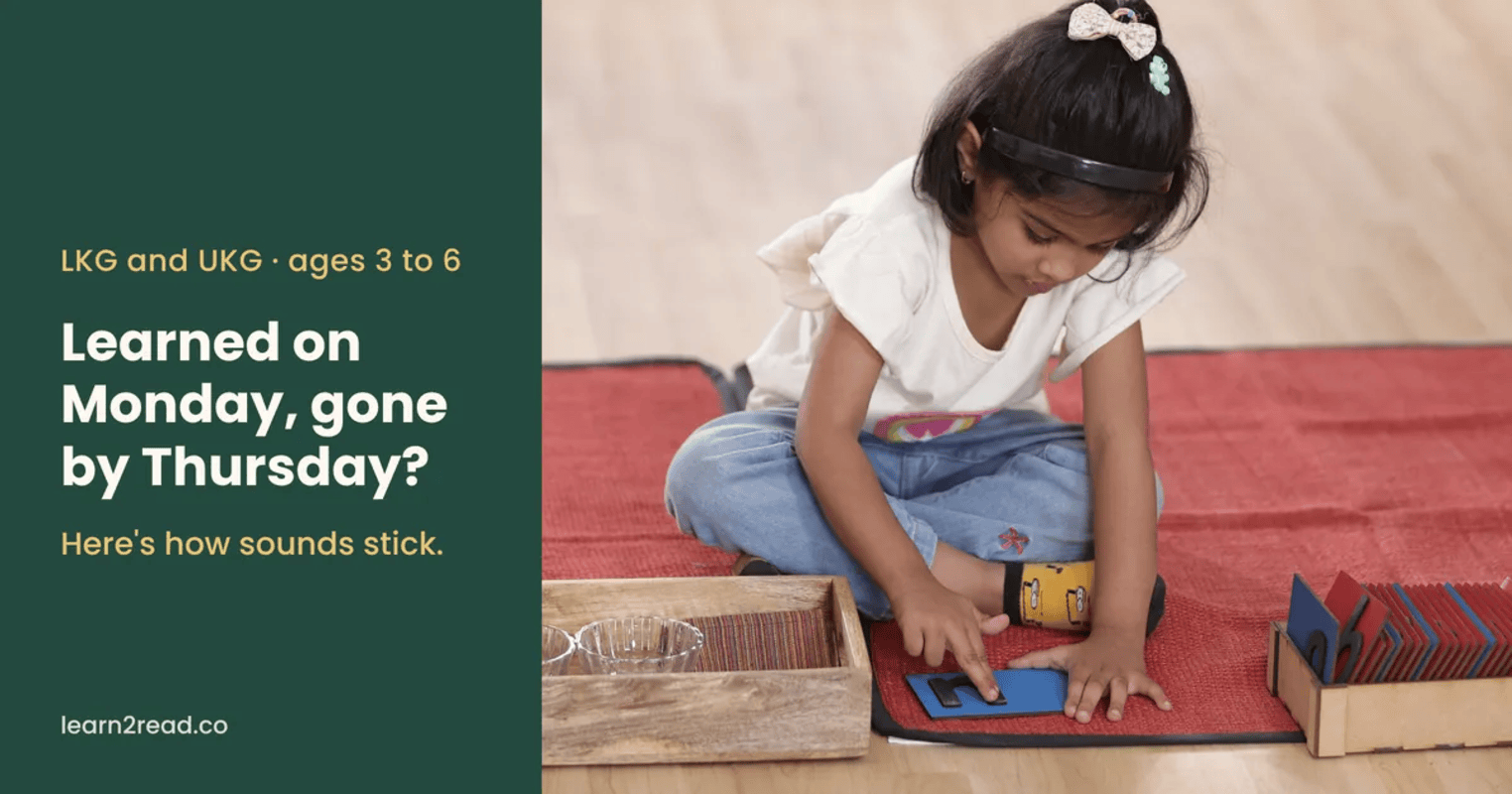
Child Keeps Forgetting Letter Sounds? How to Make Them Stick
posted on : 28 October 2026
By Nitin Jain, Founder, Learn2Read · Published 28 October 2026
Nitin Jain founded Learn2Read, which teaches live online phonics classes to children aged 3 to 12. Sources checked against the UK Department for Education's Reading Framework, the US National Early Literacy Panel and peer-reviewed research on spaced practice. Last reviewed: 28 October 2026.
On Monday your child said /s/ for s without a pause. On Thursday you hold up the same card and get a blank look, then a guess.
You start to wonder whether the class is going too fast, or whether something is wrong.
If your child keeps forgetting letter sounds, the usual reason is simple: the sounds were met but not reviewed enough to stick. Forgetting is a normal part of learning letter sounds in LKG and UKG. The fix is less new teaching and more short, spaced review of the sounds your child has already met.
The UK phonics programme Little Wandle puts it plainly in its guidance for teachers: "It can take some children a lot of practice for sounds to stick." Lots of practice is something you can give at home in five minutes a day.
This guide explains why sounds slip away, how to tell when a sound is really learned, a 5-minute daily review, and when forgetting is worth a closer look. It's written for children in nursery, LKG and UKG in India, KG1 and KG2 in the Gulf, and preschool, Reception or kindergarten elsewhere.
In this guide:
Why does my child keep forgetting letter sounds? · Is it normal? · How do you know a sound is learned? · A 5-minute daily review · Do's and don'ts · When should you worry?
Why Does My Child Keep Forgetting Letter Sounds?
Most children forget letter sounds because each sound was practised for a few days and then left behind while new sounds were added. A sound that isn't met again within a few days fades. It needs to come back, briefly, again and again, until your child knows it instantly in any order.
These are the most common reasons, and what helps with each.
Reason | What you'll notice | What helps |
New sounds keep coming, old ones aren't reviewed | Knows this week's sounds, forgets last month's | Start every session with old sounds |
Practice is long and only once a week | Good on Sunday, gone by Wednesday | Five minutes a day, or twice a day |
Letter names and sounds are mixed up | Says "ess" when you want /s/ | Use only the sound during practice |
Sounds said with an extra "uh" | Says "suh" or "muh" | Say /sss/ and /mmm/, short and clean |
No picture or action to hang the sound on | Looks at the letter and freezes | Give each letter a picture hook |
Learned only in one order | Knows a-z in sequence, not when shuffled | Shuffle the cards every time |
Letters that look alike | Mixes b and d, or n and h | Practise them on different days at first |
The letter name and the letter sound are two different things to remember. If your child knows the ABCD song but not the sounds, our guide to letter names vs letter sounds explains that problem on its own. This guide is about a different problem: sounds your child did learn, then lost.
If b and d are the ones that keep swapping, our b and d confusion guide has a separate fix for those two.
Is It Normal to Forget Letter Sounds? How Long It Takes
Forgetting letter sounds in the first months of phonics is normal, and most children need many short meetings with a sound before it sticks. A sound counts as learned when your child says it without a pause, on three days in a row, with the cards shuffled. One right answer is a start.
How fast should it go? Phonics programmes move quickly through the first sounds. The Jolly Phonics teacher guide says "one letter sound can be taught each day".
That pace is for teaching, and remembering takes longer. Many children are still wobbly on some sounds weeks after they were first taught.
It's still worth the effort. The US National Early Literacy Panel found that "the strongest and most consistent predictors of later literacy development are alphabet knowledge" along with a few related skills. Solid letter sounds now make blending and reading easier later.
Schools expect some children to need more practice. The UK Department for Education's Reading Framework says that "to enable pupils to keep up, they should be given extra practice, either in a small group or one-to-one". At home, you are the one-to-one.
How Do You Know a Sound Is Really Learned? The Three-Pile Check
A letter sound is learned when your child says it instantly, with the cards shuffled, on three days in a row. Until then, treat it as wobbly, however well it went yesterday.
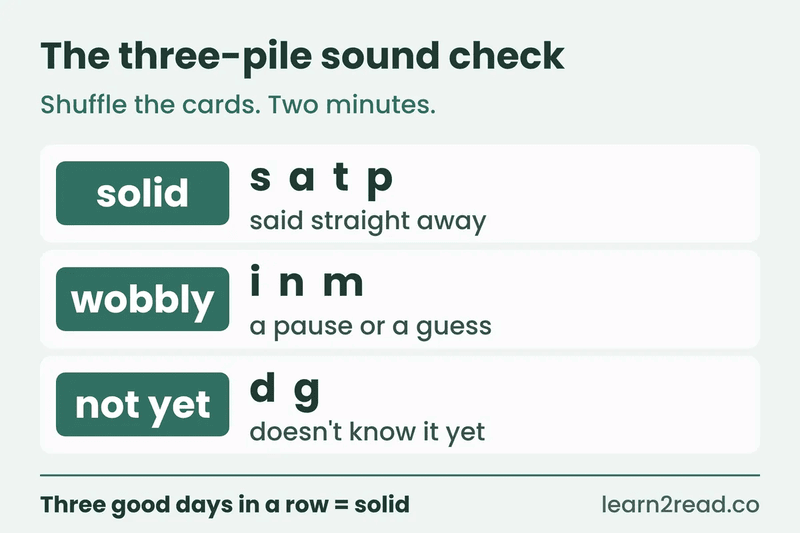
Here's a check that takes two minutes and tells you exactly what to practise.
Shuffle the sound cards your child has been taught.
Hold up each one. If your child says the sound straight away, it goes on the solid pile. If there's a pause, a guess or a self-correction, it goes on the wobbly pile. If your child doesn't know it, it goes on the not yet pile.
Write the wobbly and not-yet letters on a sticky note on the fridge.
A sound moves to solid after three good days in a row. This one check stops you wasting time on sounds your child already knows, and shows you which ones need the most review.
Child Keeps Forgetting Letter Sounds? A 5-Minute Daily Review That Works
If your child keeps forgetting letter sounds, give five minutes a day to review, mostly on old sounds, before adding anything new. Short daily practice beats one long weekend session.
That isn't only a teacher's hunch. In a study that taught science lessons to 5 to 7 year olds, published in Child Development in 2012, Vlach and Sandhofer found that "spacing lessons out in time resulted in higher generalization performance" compared with packing the same lessons together.
A US review of study methods by Dunlosky and colleagues gave distributed practice and practice testing its highest rating. Research on alphabet teaching points the same way: one study taught letters in "brief lessons taught through distributed cycles of review", and children's alphabet knowledge grew.
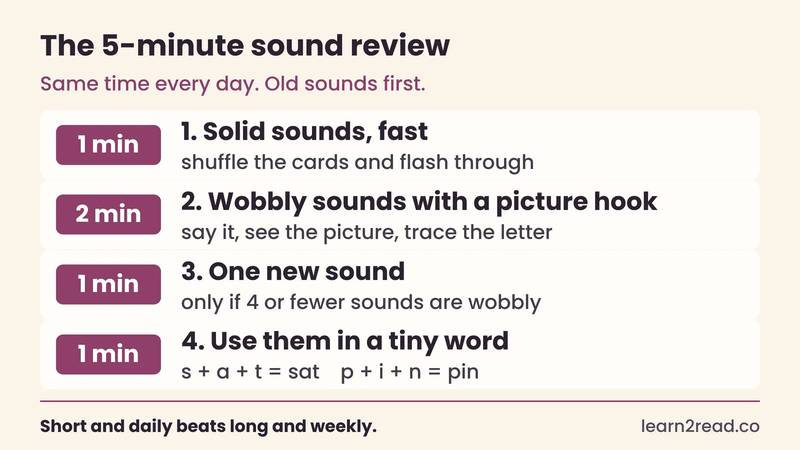
Here's the routine. Do it at the same time each day, after breakfast or after bath time.
Solid sounds, fast (1 minute). Shuffle the solid pile and flash through it. This is the warm-up, and it lets your child feel successful before anything hard.
Wobbly sounds with a hook (2 minutes). Take three or four wobbly sounds. For each one, say the sound, show the picture hook, and have your child say it back and trace the letter with a finger. Then mix them and check again.
One new sound, only if it's earned (1 minute). Add a new sound only when the wobbly pile has four or fewer letters in it. If the wobbly pile is bigger, skip this step today.
Use the sounds in a word (1 minute). Put two or three solid sounds together into a tiny word: s, a, t makes sat. p, i, n makes pin. A sound that gets used in a word has a reason to be remembered. Our guide on how to teach blending shows how to do this step well.
Give every sound a picture hook. Children remember sounds faster when the picture sits inside the letter shape: a snake curled into an s, or a tall tree drawn as a t.
Literacy researcher Timothy Shanahan, summarising studies by Linnea Ehri, writes that embedded mnemonic pictures "can reduce the amount of repetition needed" for children to learn letters and sounds. If your child's school uses a set of actions or pictures, use the same ones at home.
Say the sounds cleanly. The Reading Framework advises that "it helps if teachers pronounce the sounds as purely and clearly as possible". Say /mmm/ and /sss/, held, and keep short sounds like /t/ and /p/ crisp, with no "tuh" or "puh". Our phonics sound chart lists every sound with an example word.
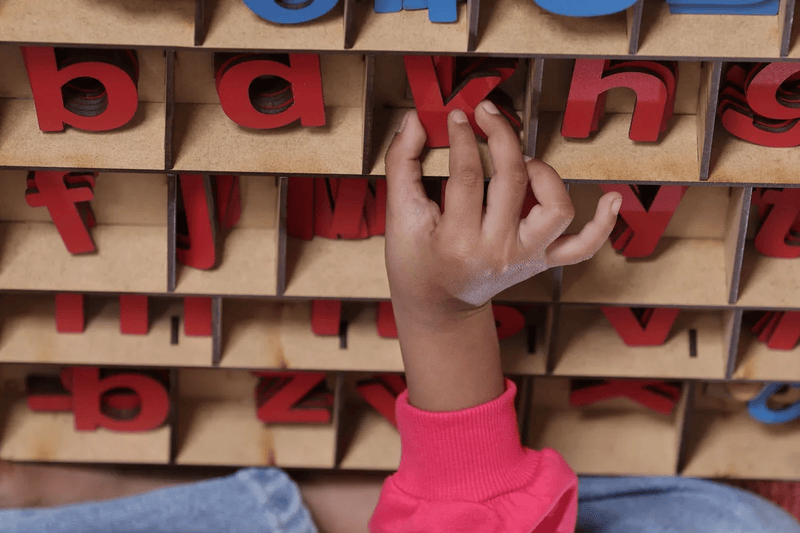
Hunt for sounds away from the table. Two minutes of "I spy something that starts with /m/" in the kitchen, or finding the letter s on a cereal box, is review that doesn't feel like practice. Keep it light, and stop while it's still fun.
Try it tonight. Do the three-pile check with the sounds your child has learned so far, and stick the wobbly list on the fridge. Tomorrow, start the 5-minute review with those letters.
Do's and Don'ts When Letter Sounds Won't Stick
When a child keeps forgetting letter sounds, the biggest change a parent can make is to stop adding new sounds while old ones are still wobbly. Most of us feel pressure to keep up with the class. A smaller set of sounds your child really knows beats a long list that keeps slipping.
Don't | Do this instead | Why |
Add a new sound every day no matter what | Add one only when the wobbly pile is small | New sounds push out shaky old ones |
Practise for 30 minutes on Sunday | Five minutes a day, at the same time | Spaced practice sticks better |
Always show cards in a-z order | Shuffle every time | Order lets children recite, not recognise |
Say the letter name during sound practice | Say only the sound, like /f/ for f | Two labels at once cause mix-ups |
Say "you knew this yesterday!" | Say "let's look at the picture again" | Pressure makes recall harder |
Use capital letters on the cards | Use lowercase letters | Books are printed mostly in lowercase |
When Should You Worry About Forgetting Letter Sounds?
Forgetting letter sounds is worth a closer look when a child in UKG or KG2 still can't hold on to most of the sounds after two or three months of short daily review, or when other signs come along with it. Before that, slow progress is very common. This is a practical guide, not a clinical cut-off.
Talk to the class teacher at the next PTM (parent-teacher meeting), if any of these are true. For any hearing or speech worry, see your paediatrician directly:
After several months of short daily review, your child still remembers only a handful of sounds.
Your child finds it hard to hear the first sound in a word, or to hear that cat and hat rhyme.
Your child's speech is hard for others to understand, or your child often says "what?" and misses things said from across the room.
Your child has had a lot of ear infections or colds with blocked ears. A Kent Community Health NHS Foundation Trust leaflet on glue ear says it "can affect speech development, behaviour and educational progress", and a hearing check is a simple first step.
A close family member had serious trouble learning to read.
None of these is a diagnosis. The International Dyslexia Association lists trouble "learning letters and their sounds" among early signs, and notes that early help makes a big difference. Our guide to the early signs of dyslexia explains what each sign can mean and who to ask.
At Learn2Read, a live online phonics programme for children aged 3 to 12, teachers review earlier sounds in class as new ones are added, so parents can keep home practice short.
FAQs
Why does my child know letter sounds one day and forget them the next?
A letter sound that has been met only a few times is still fragile, so it can be there one day and gone the next. Short reviews spread across several days help it stick. Most children need many brief meetings with a sound, in shuffled order, before they can say it instantly every time.
How long does it take a child to learn letter sounds?
Phonics programmes often teach about one new sound a day, but remembering takes longer than teaching. Many children are still unsure of some sounds weeks after first meeting them. A sound counts as learned when the child says it instantly, with cards shuffled, on three days in a row.
Is forgetting letter sounds a sign of dyslexia?
Not on its own. Forgetting letter sounds is common for children in their first year of phonics. It is worth raising with the class teacher if a child still remembers very few sounds after several months of short daily review, or also struggles to hear rhymes and first sounds. A paediatrician can check hearing and advise on next steps.
How many minutes a day should I practise letter sounds with my child?
About five minutes a day is enough for most children aged 3 to 6, ideally at the same time each day. Spend most of it reviewing sounds the child has already met, add a new sound only when few are wobbly, and finish by blending two or three sounds into a short word.
Should I stop teaching new letter sounds if my child keeps forgetting old ones?
Pausing new sounds for a few days is often the quickest way forward. If more than four taught sounds are still wobbly, spend a few days reviewing those before adding more. A small set of sounds a child knows instantly is more useful for reading than a long list that keeps slipping.
Why does my child know the alphabet in order but not when the letters are mixed up?
Saying letters in a-z order relies on remembering the sequence, the way a child remembers a song. Recognising a single letter on its own is a different skill. Shuffle the cards every time you practise, so the child has to recognise each letter's shape and sound without the help of the order.
Read Next
My Child Knows the Alphabet (ABCD) but Can't Read: Letter Names vs Letter Sounds: if your child knows the names but never had the sounds.
How to Teach Blending: the next step once a handful of sounds are solid.
Phonics Sound Chart: every sound with an example word, for your fridge.
b and d Confusion: Is It Dyslexia? How to Fix It: for the two letters that swap most often.
When Should Phonics Be Taught?: if you're wondering whether your child is ready yet.
If your child keeps forgetting letter sounds, five minutes of review a day usually turns that around. Keep the sessions short, review the old sounds before adding new ones, and give every sound a picture to hang on. If you'd like a teacher to help your child's sounds stick, book a free trial class.

Latest Posts

14 November 2026
How Many Words Per Minute Should a 6 Year Old Read? (2026)
11 November 2026
When Do Kids Stop Sounding Out Words? UKG to Class 2 Guide

7 November 2026
Child Refuses to Read at Home? Check the Book First, Age 4-8

A new chapter from Learn2Read
Read Before They Read
Before you teach your child to read, read this. A calmer, clearer way into your child’s reading journey—with a practical guide written for real Indian homes.