5 September 2026
Decodable Books: A Parent's Complete Guide (Ages 4-7)
Decodable Books: A Parent's Complete Guide (Ages 4-7)
posted on : 5 September 2026
Your child proudly "reads" their favorite book to you — with the book upside down. Or they sail through the class reader at home, then meet the same words in a different book and freeze. If either scene feels familiar, nothing is wrong with your child. They've simply been practicing with books that let them memorize and guess instead of actually read.
Decodable books fix exactly that. This guide explains what decodable books are, how they're different from the levelled books you probably grew up with, the research on why they work, and — the part most guides skip — how to choose the right one and use it at home in ten minutes a day.
What Are Decodable Books?
A decodable book is a beginner's book written so that almost every word can be sounded out using the letter-sound rules your child has already been taught. If your child has learned the sounds s, a, t, p, i, n, their decodable book is built from words like sat, tap, pin and nap — no surprises, no guessing required.
You'll also hear them called decodable readers or decodable texts. Same thing: books that match the child's phonics knowledge, step by step.
That "already been taught" part is the whole trick. English has about 44 sounds, and phonics teaches them in a planned order. A decodable book meets your child exactly where they are in that order — so every page says, quietly: you can do this yourself.
(One small thing you'll notice: early decodable books use lowercase letters almost everywhere. That's deliberate — reading is taught with lowercase first, because that's what fills real books.)
Decodable Books vs Levelled Books: What's the Difference?
Decodable books are matched to the sounds your child knows; levelled books (also spelled "leveled," and sometimes called predictable readers) are matched to a difficulty level and often rely on repeating patterns and picture clues.
Decodable books | Levelled / predictable books | |
Built around | The phonics sounds your child has learned | A difficulty level (repetition, patterns, pictures) |
Child reads by | Sounding out the letters | Recognizing patterns, guessing from pictures |
Typical page | "sam sat on the mat." | "I can see a bus. I can see a bike. I can see a…" |
Habit it builds | Look at the letters, decode | Look at the picture, predict |
Best used for | A child's own first reading practice | An adult reading aloud rich stories TO the child |
Here's the honest version, because levelled books aren't villains: many are lovely, and they're perfect for you to read to your child. The problem starts when a pattern-and-picture book is the child's own first "reading" material. A beginner can score a perfect page without looking at a single letter — which feels like reading, but trains guessing.
That guessing habit is exactly what schools across the world are now moving away from, as reading instruction shifts toward the science of reading — the research consensus on how children actually learn to read.
Why Decodable Books Matter (What the Research Says)
The first books a child reads by themselves set their "reading reflex" — the default move their brain makes when it meets an unknown word. Decodable books set that reflex to look at the letters and sound it out.
The research backs this up. A study by literacy researcher Heidi Anne Mesmer found that children reading decodable books applied their phonics knowledge more, read more accurately, and needed less adult help than children reading other early texts. A 2012 research review by Cheatham and Allor reached a similar conclusion: how decodable a beginner's text is matters — it makes children likelier to use sounding-out as their main strategy.
And the payoff parents actually care about is confidence. The first time a child reads an entire book alone — really reads it, no guessing, no help — something visible changes in how they sit. Success is the fuel. In the UK's National Literacy Trust survey of over 125,000 children published in June 2026, reading enjoyment rose for the first time since 2021 — and enjoyment is built child by child, one finished book at a time.
When Does Your Child Need Decodable Books?
The honest answer is a stage, not an age: decodable books begin the moment your child knows their first five or six letter sounds, and they've done their job when your child can sound out new words without them. For most children that window is roughly ages 4 to 6, but the stage is what matters — here's how it maps:
Your child can... | The decodable stage they need |
Say the sounds for s, a, t, p, i, n | The very first books: short words like sat, pin, tap |
Say all 26 single letter sounds | Full CVC books (consonant-vowel-consonant: cat, bed, mug) with simple sentences |
Read digraphs — two letters, one sound (sh, ch, th) | Books featuring ship, chat, moth |
Read vowel teams (ai, ee, oa) | Longer stories with rain, feet, boat |
Sound out most new words on sight, first try | Time to move beyond decodables (see below) |
If your child isn't sure of any letter sounds yet, decodable books can wait — start with the sounds themselves and keep reading wonderful books to them. Our reading milestones by age guide shows what typically happens when.
How to Choose a Decodable Book: The 5-Check Test
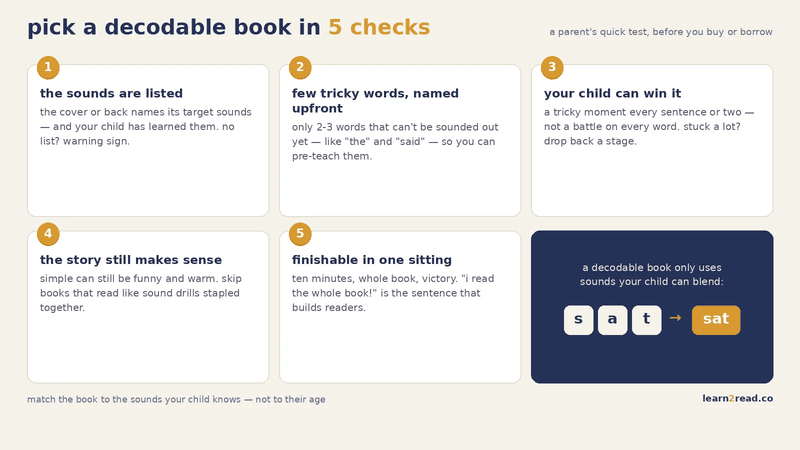
Standing in a bookshop or scrolling online, here's what separates a great decodable book from a dud:
1. The sounds are listed — and your child knows them. Good decodable sets print their target sounds on the cover or back ("this book practices: s, a, t, p, i, n"). If the book doesn't say what it practices, that's a warning sign.
2. Tricky words are few and named upfront. Tricky words (sometimes called common exception words) are everyday words that can't be fully sounded out yet — like the, said, no. A good book uses only two or three and lists them, so you can pre-teach: "This book has two words we just know: 'the' and 'said.'"
3. Your child can win it. A good fit feels like effort your child can succeed at — a tricky moment every sentence or two, not a battle on every word. If they're stuck on word after word, drop back a stage. That's not failure; that's fitting the tool to the child.
4. The story still makes sense. Early decodables are simple, but the best ones are genuinely funny or warm — a cat sitting on someone's hat is a real story to a 4-year-old. Skip books that read like sound drills stapled together.
5. It can be finished in one sitting. Ten minutes, whole book, victory. Finishing is the feature: "I read the WHOLE book" is the sentence that builds readers.
When buying or borrowing, search "decodable" plus the sounds your child is learning — most publishers and library apps now label sets by phonics stage or sound sequence. Your child's teacher can also tell you exactly which sounds have been covered so far — one question that makes every book choice easier.
How to Read a Decodable Book Together (10 Minutes That Work)
Before (1 minute): Warm up the target sounds — "quick, what does sh say?" — and point out the tricky words by name.
During (6-7 minutes): Your child reads; you point and wait. When they get stuck:
Point under the letters and say "sound it out" — then count to three in your head before helping. That pause is where the learning happens.
If one letter is the roadblock, give the sound, never the whole word: "that says mmm" — and let them finish the win.
Never say "look at the picture — what could it be?" When a child gets stuck on a word in a decodable book, the helpful prompt is "sound it out, point under each letter" — picture-guessing trains the exact habit these books exist to prevent.
After (2 minutes): Praise the strategy, not just the result: "You sounded that out all by yourself." Then read the same book again tomorrow — the second read builds speed, the third builds storytelling voice. Rereading isn't cheating; it's how fluency is made.
Then — this matters — close the decodable and pick up a rich, beautiful storybook and read it to them. Decodable books build the skill; read-alouds build the love. A beginning reader needs both every day, and neither replaces the other.
When to Move On From Decodable Books
Decodable books are training wheels: essential at the start, designed to become unnecessary. Most children need them for roughly their first one to two years of reading instruction, and the signals to move on are easy to spot:
They sound out brand-new words in the wild — cereal boxes, shop signs, subtitles — without being asked.
They read a never-seen decodable nearly perfectly on the first try.
They start calling decodables "too easy" and reaching for other books.
When that happens, let go gradually — mix in simple "real" books and keep decodables around for newly introduced sound patterns. The goal was never decodable books forever. The goal is a child who picks up books for joy — and gets there through a hundred small "I read it myself" victories.
One honest caveat: decodable books are the practice, not the teaching. They work when someone is teaching the sounds in a sensible order — at school, at home, or in a structured program. At Learn2Read, a live online phonics program for children aged 3 to 12, our teachers see it weekly across 35+ countries: a child learns six sounds, meets their first decodable book, and reads a whole page alone — often within the first weeks. If your child's school doesn't teach systematic phonics, that structure is the missing piece, and it's very buildable.
FAQ: Decodable Books
What age should my child start decodable books?
Start when your child knows their first five or six letter sounds — for most children that's around age 4 to 5, sometimes late 3s. The stage matters more than the age: no letter sounds yet means it's phonics time, not decodable time.
Are decodable books boring?
The old ones sometimes were; modern sets have real humor and real plots within their sound limits. In classroom research reported by Reading Rockets, children said they enjoyed decodable books and saw them as a source of exciting stories. And the built-in success — finishing a whole book alone — is the opposite of boring to a 5-year-old.
My child's school uses levelled books. Should I still use decodable books at home?
Yes, they can live alongside each other. Keep the school's books for school, and add ten minutes with a decodable matched to the sounds your child knows. You're not contradicting the school — you're adding the letter-by-letter practice a beginner needs. If you're unsure of your child's sound knowledge, ask the teacher which sounds have been taught.
How many decodable books do we need?
Fewer than you think — a small set per stage is plenty, because rereading is part of the method. One book read three times over three days does more for fluency than three books read once. Libraries and printable sets from structured-literacy publishers can cover most stages cheaply.
What's the difference between decodable books and phonics readers?
Usually nothing — "phonics readers," "decodable readers," and "decodable books" mostly describe the same thing. The label matters less than the match: check that the book lists its target sounds and that your child has learned them.
Does my child still need decodable books if they already read well?
No. Once a child sounds out unfamiliar words accurately and automatically, decodables have done their job. Keep one around when a brand-new spelling pattern shows up; otherwise, follow their interests into the wide world of real books.
__________________________________________________
Read Next:
- The Science of Reading, Explained for Parents — why schools everywhere are changing how reading is taught (decodable books are part of this story).
- Phonics Sound Chart for Kids: All 44 Sounds with Examples — the sound order that decodable books follow.
- Reading Milestones by Age — what typically clicks at 3, 4, 5, 6 and 7.
A gentle next step: Decodable books shine when the sounds are taught in the right order first. That's exactly what our live teachers do — book a free trial class with Learn2Read and watch your child read their first words in real time.

Latest Posts
2 September 2026
Homework Battles: 7 Do's & Don'ts for Ages 5-8 (2026)
29 August 2026
Kids' Attention Spans & Short Videos: What Parents Must Know
25 August 2026