
21 October 2026
My Child Knows the Alphabet (ABCD) but Can't Read: Letter Names vs Letter Sounds, Ages 3 to 6
My Child Knows the Alphabet (ABCD) but Can't Read: Letter Names vs Letter Sounds, Ages 3 to 6
posted on : 17 October 2026
By Nitin Jain, Founder, Learn2Read · Published 17 October 2026
Nitin Jain founded Learn2Read, which teaches live online phonics classes to children aged 3 to 12.
Your child sings the ABCD song perfectly and can write all 26 letters. Then you point at the word cat, and nothing happens.
Maybe you heard it at the PTM: "She knows her letters, but she isn't reading yet."
If your child knows the alphabet but can't read, the most common reason is simple: they know what each letter is called, and nobody has yet shown them what each letter says. Letter names and letter sounds are two different things. Reading runs on the sounds.
This guide helps you find your child's stage and gives you a ten-minute daily plan to get from ABCD to real words. It's for ages 3 to 6: nursery, LKG and UKG in India, KG1 and KG2 in the Gulf, Reception in the UK, and pre-K or JK and SK in the US and Canada.
In this guide:
Why does my child know the alphabet but can't read? · Which stage is your child at? · Is "a for apple" enough? Letter names vs letter sounds · How to go from ABCD to reading at home · Do's and don'ts · When should you worry?
Why Does My Child Know the Alphabet but Can't Read?
A child who knows the alphabet but can't read usually knows the letter names but not the letter sounds, so the names don't add up to a word. Say the names of c, a and t out loud: "see", "ay", "tee". Put them together and you get "see-ay-tee", which sounds nothing like cat.
To read cat, a child needs the sounds: /k/ /a/ /t/. (Letters between slashes, like /k/, mean the sound, not the name.) Then they need to push those sounds together into one word, which is called blending.
So if your child knows ABCD but can't read, they have usually finished the first step and are waiting for the second. Nothing is wrong. They just haven't been taught the step that makes reading possible.
If you've felt a flash of panic, or wondered whether the school missed something, that's a normal reaction. The fix is ten minutes a day, not a new school.
Some letters are friendly, because the name gives a clue to the sound. Others give no clue at all, and these are the ones children get stuck on.
Letter | Its name | The sound it makes in a word | Why it trips children up |
c | "see" | /k/ as in cat | The name starts with /s/, the sound is /k/ |
h | "aitch" | /h/ as in hat | The name has no /h/ sound in it at all |
w | "double-u" | /w/ as in wet | The name sounds like /d/ |
y | "why" | /y/ as in yes | The name starts with /w/ |
g | "jee" | /g/ as in goat | The name sounds like /j/ |
a | "ay" | /a/ as in ant | The name is the long sound; early words use the short one |
i | "eye" | /i/ as in pin | The name is the long sound again |
Screenshot this table. If your child reads "h" as "aitch" when sounding out, this is why.
Which Stage Is Your Child At?
Most children learning to read in English go through four stages: they learn the letter names, then the letter sounds, then how to blend sounds into words, and then they start reading short books. A child who "knows ABCD" can be at stage one or stage two, and the two-minute tests below tell you which.
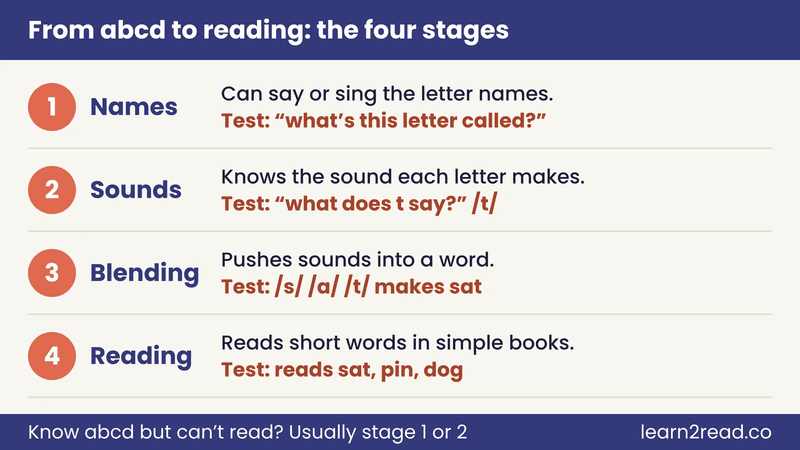
Stage | Your child can | Two-minute test | What to do next |
1. Names | Say or sing the 26 letter names | Point to m, s, t, a. Ask "what's this letter called?" | Start letter sounds this week |
2. Sounds | Say the sound each letter makes | Point to the same letters. Ask "what does this letter say?" | Practise the tricky letters, then start blending |
3. Blending | Push 2 or 3 sounds into a word | Say /s/ /a/ /t/ slowly. Ask "what word is that?" | Read three-letter words from cards |
4. Reading | Read short words in simple books | Give a book with words like sat, pin, dog | Move on to decodable books |
Most children who "know the alphabet but can't read" pass test 1 and stumble on test 2. If your child passes test 2 and stumbles on test 3, the gap is blending, and our guide on how to teach blending picks up exactly there.
Is "a for apple" Enough? Letter Names vs Letter Sounds
Teaching letter names and letter sounds side by side is the approach reading researcher Timothy Shanahan suggests for the first years of school, and the common mistake at home is stopping at the names. Keep the names your child already knows and start the sounds now.
Reading researcher Timothy Shanahan looked at this question for Reading Rockets. For children in kindergarten and grade 1 he writes: "I'd try to teach names and sounds together." He is open that starting with names is his opinion "rather than a data-based, science of reading claim."
His advice also changes with age. For preschoolers he would "focus more on the letter names for a while, and not sweat the sounds." But "if kids come to school knowing a bunch of letter names, at whatever age," he writes, "I would turn my focus to the letter sounds." A child who already knows ABCD is exactly that child.
Names do help. A 2008 study by Rebecca Treiman and colleagues in the journal Cognition found that "typical U.S. children use their knowledge of letters' names to help learn the letters' sounds." The same study found children did better with letters whose sound is at the start of the name, like v, than with letters whose sound isn't in the name at all, like h.
That's the useful takeaway for parents. The letter names your child already knows are a head start for most sounds. The tricky letters from the table above need extra practice, because the name points the wrong way.
The English national curriculum, used in British-curriculum schools in the UK and the Gulf, expects both. Its Year 1 requirements include responding "with the correct sound to graphemes (letters or groups of letters) for all 40+ phonemes" for reading, and "naming the letters of the alphabet in order" for spelling.
How to Go From ABCD to Reading at Home
Ten minutes a day of letter sounds, with blending added after the first six sounds, is the quickest route from ABCD to real words for a child who knows the alphabet but can't read. Here is a four-week plan most families can follow.
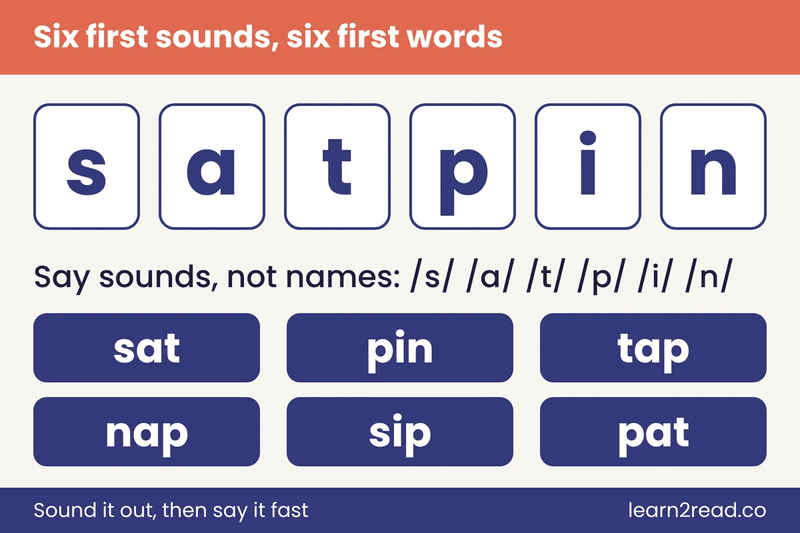
Week 1: switch the question. Every time you would ask "what letter is this?", ask "what does this letter say?" instead. Start with s, a, t, p, i, n, the six letters many phonics programmes teach first, because they make lots of short words. Say each sound short and clean: /s/, not "suh".
Week 2: sound hunts. Pick one sound a day and say, "Today is /m/. Let's find things that start with /m/." Try mango, milk, mat and mop.
Play "I spy something that starts with /m/" out loud too, because hearing sounds without letters (called phonemic awareness) makes blending easier later. Point out the letter m on packets and signs. Keep the alphabet song, but stop using "a for apple" as a reading test.
Week 3: first blends. With six sounds you can make sat, pin, tap, nap, sip and pat. Say the sounds slowly, /s/ /a/ /t/, then faster, until your child hears the word.
Then show them the three letters and let them do it. Expect it to take many tries.
Week 4: the tricky letters and short books. Add the letters from the table above that don't sound like their names: c, h, w, y and g. Then give your child a book made of words they can sound out, called a decodable book. Our guide to decodable books explains how to pick one.
If you want to see every sound in English in one place, our phonics sound chart lists all 44 with examples, in lowercase.
Do's and Don'ts When Your Child Knows the Alphabet but Can't Read
Asking a child what a letter says, instead of what it is called, is the biggest single change parents can make at the names-to-sounds stage. Most of us learned the alphabet as names, so the changes below feel odd at first.
Try it tonight. Put s, a, t and m on the table and say, "This one says /s/. Your turn."
If your child says "ess", smile and ask, "That's its name. What does it say?" Stop after two minutes, even if it's going well.
Don't | Do this instead | Why |
Ask "what letter is this?" | Ask "what does this letter say?" | Reading needs the sound, not the name |
Say "buh", "muh", "tuh" | Say short, clean sounds: /b/, /m/, /t/ | "buh-a-tuh" doesn't blend into bat |
Start with capital letters | Start with lowercase: a, b, c | Almost every word in a book is lowercase |
Teach all 26 sounds before any word | Blend words after the first six sounds | Children need to see sounds turn into words early |
Drop the ABCD song | Keep it, and add sounds alongside | Names still help with sounds and with spelling |
The capital-letter point matters more than it looks. Many charts and preschool books in India and the Gulf start with A, B, C in capitals, but almost every word your child will read is in lowercase letters. Teach lowercase letters first, like a and b, and capitals later.
If your child's school still treats "a for apple" recitation as reading, ask at the next PTM when they start teaching letter sounds.
When Should You Worry?
Knowing the alphabet but not reading at age 3 or 4 is very common and not a concern, and many children pick up letter sounds quickly once they are taught them directly. Talk to your child's teacher and your paediatrician if these are still true after a few months of steady sound practice:
Your child is 5 or older and still can't learn the sounds of a few common letters, even with daily practice.
They can say the sounds but can't blend two sounds together, even with lots of help.
They struggle to tell whether two words rhyme, or to hear the first sound in their own name.
A close family member had real trouble learning to read.
None of these is a diagnosis. Our guide to the early signs of dyslexia explains what each one can mean and who to ask.
At Learn2Read, a live online phonics programme for children aged 3 to 12, we teach letter sounds from the first class, alongside the names children already know. A child who knows ABCD is usually closer to reading than their parents think.
FAQs
Why does my child know the alphabet but can't read?
A child who knows the alphabet but can't read usually knows the letter names, not the letter sounds. The names of c, a and t are "see", "ay" and "tee", which don't blend into cat. Reading needs the sounds, /k/ /a/ /t/, and the skill of pushing them together, so teach the sounds next and then blending.
Should I teach letter names or letter sounds first?
Teach both, side by side. Reading researcher Timothy Shanahan suggests teaching names and sounds together in the first years of school, and research shows letter names help children learn many letter sounds. The mistake is stopping at the names: a child who knows only names can recite the alphabet but cannot read words.
What is the difference between a letter name and a letter sound?
A letter name is what the letter is called, like "aitch" for h. A letter sound is the sound it makes in a word, like /h/ in hat. Children read by saying the sounds and blending them, so the sound is what turns letters into words.
At what age should a child know letter sounds?
Many children learn their first letter sounds between ages 3 and 5. The English national curriculum expects children in Year 1, aged 5 to 6, to respond with the correct sound for all 40+ phonemes. Children vary a lot, so a 4-year-old who knows names but not sounds is very common.
How can I teach letter sounds at home?
Spend ten minutes a day on sounds. Ask "what does this letter say?" instead of "what is this letter?", start with s, a, t, p, i and n, and say each sound short and clean without an "uh" on the end. After a week or two, blend those sounds into words like sat and pin.
Is "a for apple" a good way to teach reading?
The "a for apple" rhyme helps children remember letters, but it is not enough for reading. "a for apple" links a letter to a picture, while reading needs the letter's sound, /a/ as in ant and apple, and practice blending sounds into words. Keep the rhyme and add the sounds.
Read Next
How to Teach Blending: When Your Child Knows the Sounds but Can't Read the Word: the very next stage once the sounds are in.
Phonics Sound Chart for Kids: All 44 Sounds with Examples: every sound your child will learn, in one place.
Phonics vs Sight Words: Which Should You Teach First?: for when you're deciding how much to memorise and how much to sound out.
Why Your Child Guesses at Words: for when they start reading but guess from the first letter or the picture.
Knowing ABCD is a real first step. Ten minutes of sounds a day turns it into reading. If you'd like a teacher to take your child from letters to words, book a free trial class.

Latest Posts
17 October 2026
My Child Knows the Alphabet (ABCD) but Can't Read: Letter Names vs Letter Sounds, Ages 3 to 6
14 October 2026
How to Teach a Child to Write Sentences ?
10 October 2026
b and d Confusion: Is It Dyslexia? How to Fix It (Ages 4-7)

A new chapter from Learn2Read
Read Before They Read
Before you teach your child to read, read this. A calmer, clearer way into your child’s reading journey—with a practical guide written for real Indian homes.

