7 October 2026
What to Ask Your Child's Teacher About Reading (2026)
What to Ask Your Child's Teacher About Reading (2026)
posted on : 26 September 2026
You get ten minutes. Maybe fifteen. You sit in a small chair, the teacher smiles, and somewhere in the first thirty seconds you hear the sentence every parent hears: "She's doing fine."
Then you walk out to the car and realise you still don't know a single concrete thing about your child's reading.
Knowing what to ask your child's teacher about reading is the difference between a polite meeting and a useful one. This guide gives you eight questions that get real answers, shows you what a good answer actually sounds like, and tells you what to do when the answer is vague. You can screenshot the list at the bottom of this section and take it in with you.
One thing worth saying before we start: none of this is about catching the teacher out. Most teachers are managing thirty children and would love a parent who asks specific questions instead of general ones. Specific questions are easier to answer well.
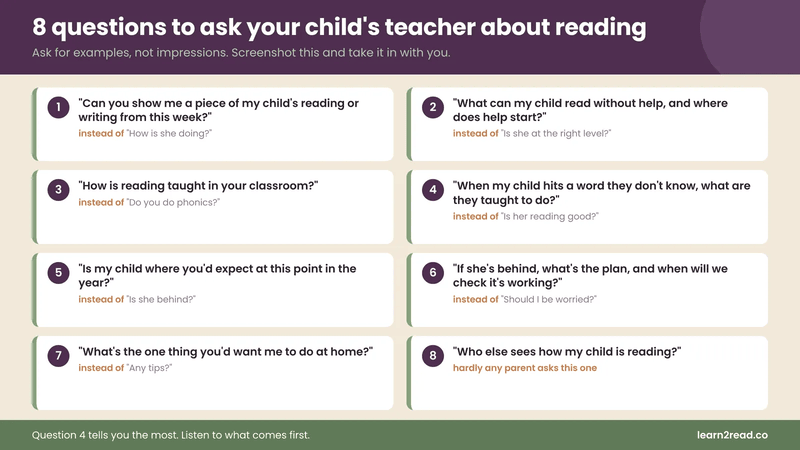
The 8 Questions, in One Table
Take a photo of this. It's the whole meeting on one screen, and it's the short version of what to ask your child's teacher about reading.
# | Ask this | Not this |
1 | "Can you show me a piece of my child's reading or writing from this week?" | "How is she doing?" |
2 | "What can my child read without help, and where does help start?" | "Is she at the right level?" |
3 | "How is reading taught in your classroom?" | "Do you do phonics?" |
4 | "When my child hits a word they don't know, what are they taught to do?" | "Is her reading good?" |
5 | "Is my child where you'd expect at this point in the year?" | "Is she behind?" |
6 | "If she's behind, what's the plan, and when will we check whether it's working?" | "Should I be worried?" |
7 | "What's the one thing you'd want me to do at home?" | "Any tips?" |
8 | "Who else sees how my child is reading?" | hardly any parent asks this one |
Why Doesn't "How Is My Child Doing?" Tell You Anything?
"How is my child doing?" invites a summary, and a summary is where the useful detail goes to die.
Put yourself in the teacher's chair. A parent asks a broad question, the teacher has eleven more meetings that afternoon, and the honest short answer for most children genuinely is "fine." Nothing has gone wrong. The teacher isn't hiding anything. The question simply didn't ask for anything specific enough to be worth a specific reply.
Swap it for a question with a noun in it and everything changes. "Can you show me something she wrote this week?" produces a piece of paper. Paper can't be vague. You'll see letter formation, spelling attempts, whether she's writing the sounds she hears or copying shapes she's memorised. Five seconds of looking at real work beats five minutes of adjectives.
The same trick works across the whole meeting. Ask for examples, not impressions.
What Should I Ask About My Child's Reading Level?
Ask what your child can read without help, and where the help starts. That gap is the single most useful thing a teacher can tell you about reading.
Schools describe reading levels in wildly different systems, and the labels travel badly. A "level 12" in one school means nothing in another. Book bands, letters, colours, numbers: none of it tells you what your child can actually do. So skip the label and ask about the behaviour.
Good questions here:
"What kind of book can she pick up and read on her own?"
"At what point does she start needing you?"
"What does she do when she gets stuck?"
"Has that changed since the start of term?"
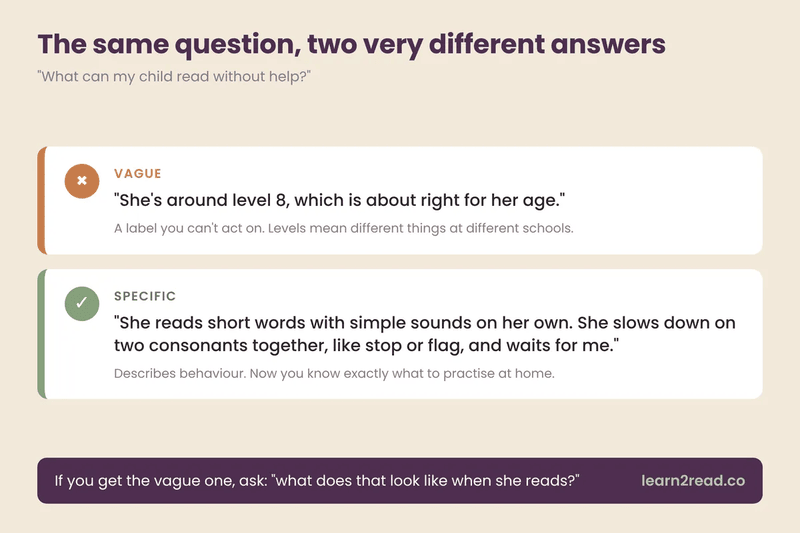
A useful answer sounds like: "She's solid on short words with simple sounds. She reads those without me. She slows down when there are two consonants together at the start, like stop or flag, and she'll usually stop and wait for me rather than try."
That answer tells you exactly what to practise. If your child stalls on consonant blends, how to teach blending walks through the fix in ten minutes a day.
A less useful answer sounds like: "She's around level 8, which is about right." If you get that, ask the follow-up: "What does a level 8 child do that a level 7 child can't?" Teachers who know their readers can answer that instantly.
How Do I Find Out How Reading Is Actually Taught at School?
Ask the open version: "How is reading taught in your classroom?" Don't ask "do you do phonics?", because almost every school will say yes, and the word covers very different practices.
This question matters more than most parents realise. Reading instruction has been through a serious rethink over the past several years, and schools have not all moved at the same speed. Some teach children to work out a word from its letters, in a planned order, sound by sound. Others still encourage children to use the picture and the sentence to guess. Those two approaches produce very different readers by age seven.
A strong answer names a sequence: "We teach the sounds in a set order, we practise them daily, and the books the children take home only use sounds we've already covered." The detail about the books matters. It means the school is thinking about whether a child can actually decode what they're sent home with.
A weaker answer stays general: "Oh, we do lots of reading. We have a lovely book corner and we read every day." Reading a lot is good. It isn't an instruction method.
The National Institute of Child Health and Human Development, reporting on the National Reading Panel's review of the research, put the finding plainly: explicitly and systematically teaching children to manipulate phonemes "significantly improves children's reading and spelling abilities". Systematic is the operative word. Sounds taught in a planned order, revisited, and practised beat sounds mentioned as they come up.
If the answer is vague, that's worth knowing, and it isn't a disaster. It means the daily ten minutes you do at home carries more weight than you thought.
What Should I Ask When My Child Gets Stuck on a Word?
Ask it exactly like this: "When my child hits a word she doesn't know, what is she taught to do?"
Of everything on the list of what to ask your child's teacher about reading, this is the question I'd keep if I could only ask one. The answer reveals the school's whole approach in about eight seconds, and almost no parent asks it.
Listen for what comes first in the answer. If the teacher says "we tell them to look at the letters and sound it out," the school is teaching decoding. If the answer starts with "we tell them to look at the picture" or "we ask what would make sense there," the school is teaching a strategy called three-cueing, where children guess from context.
Guessing works beautifully in picture books for five-year-olds and collapses around age six or seven, when the pictures shrink and the words get harder. Reporting on schools moving away from the method, Education Week noted that sending a child to check the picture on a tricky word "can take their focus away from the word itself". Nell Duke, a literacy professor at the University of Michigan, told the same publication that the approach "has led to a lot of misconceptions."
If your child already guesses at words, you'll recognise this immediately. Why your child guesses at words explains where the habit comes from and the four-week routine that replaces it.
What Should I Ask If My Child Is Behind?
Ask for a plan with a date on it. "If she's behind, what's being done, and when will we check whether it's working?"
Plenty of parents get told their child is behind and leave with nothing but the word "behind." A plan has parts you can repeat back: what will change, who will do it, how often, and when someone looks again.
A real plan sounds like: "She'll work in a group of four with Mrs Okafor for twenty minutes, four mornings a week, on the sounds she's missing. We'll reassess at half term and I'll email you either way."
Something that isn't a plan: "We'll keep an eye on her."
And if you hear "she'll catch up," push once, politely. Some children do catch up. Many don't, and the ones who don't tend to fall further behind each year, because every year of school asks them to read more in order to learn everything else. Waiting is a decision, and it's usually the expensive one. You're allowed to say: "I'd rather not wait. What can we start now?"
What Should I Ask About Helping at Home?
Ask for one thing, not a list. "If I could only do one thing at home for ten minutes a day, what should it be?"
Parents who ask "any tips?" get handed a photocopied sheet of twenty activities that stays in the bag. Asking for one thing forces a priority, and a priority is something you'll actually do on a Tuesday night when everyone is tired.
Then ask the follow-up that makes it stick: "How will I know it's working?" A teacher who says "she'll start sounding out instead of waiting for you" has given you something observable. You'll spot it or you won't, and either way you'll know where you stand in three weeks.
Worth knowing: ten focused minutes most days beats an hour on Sunday. Our teachers see this pattern constantly across the countries we work in. Short and frequent wins, because reading is a skill built by repetition, and a tired child at the end of a long session isn't learning much.
What Should I Ask That Nobody Asks?
Ask who else sees your child read. "Besides you, who else has heard my child read this term?"
In many schools a reading specialist, a support teacher, or a teaching assistant hears children read regularly, and they often notice things the class teacher doesn't have time to catch. Sometimes nobody else has heard your child read at all, which is also useful to know, because it tells you how much of the picture rests on one person's impression.
This question does something else. It quietly signals that you're paying attention, and it opens a door to the person who may become your most useful contact if your child does need extra help.
What Should I Do After the Meeting?
Send a short email the same day, summarising what you agreed. Knowing what to ask your child's teacher about reading only pays off if the answers survive the walk to the car.
Not a formal letter. Four lines: what you discussed, what the plan is, what you're doing at home, and when you'll check in. Something like: "Thanks for today. To make sure I've got it right: Zara will join the morning group four times a week, I'll do ten minutes of sound practice at home, and we'll compare notes at half term. Do correct me if I've misremembered anything."
The main thing it does is create a record. Verbal plans evaporate, especially in a busy term. It also gives the teacher a chance to correct anything you misheard, before a misunderstanding has a month to grow.
Put a date in your phone for when the check-in should happen. If it passes quietly, you're the one who follows up.
FAQ
What are the best questions to ask a teacher about my child's reading?
The most useful questions ask for specifics rather than summaries. Ask to see a piece of recent work, ask what your child can read without help, ask how reading is taught in the classroom, and ask what your child is told to do when they meet an unfamiliar word. Each of those produces a concrete answer you can act on, while "how is she doing?" usually produces "fine."
How do I know if my child is behind in reading?
Ask the teacher directly whether your child is where they'd expect at this point in the school year, and ask what the gap looks like in practice. A specific answer describes behaviour: which sounds your child knows, what kind of word stops them, whether they attempt unfamiliar words or wait for an adult. Reading levels and book bands vary between schools, so the behaviour tells you more than the label does.
What does it mean if the school teaches children to guess words from pictures?
It means the school is using a context-based approach, sometimes called three-cueing, where children are encouraged to work out a word from the picture or the sense of the sentence rather than from its letters. This strategy tends to work in early picture books and to break down around ages six and seven, when illustrations carry less of the story. If you hear it described in your child's classroom, it's worth building decoding practice at home, where your child sounds words out from the letters.
Should I tell the teacher I'm worried, or wait and see?
Say it. Teachers generally prefer a parent who raises a concern early over one who arrives frustrated two terms later, and a concern raised in September can be acted on in September. Frame it as a question rather than a complaint: "I've noticed she avoids reading at home, is that something you see in class?" You'll get a more honest answer, and you'll find out quickly whether what you're seeing at home shows up at school too.
How often should I meet my child's teacher about reading?
Most schools schedule a formal meeting once or twice a year, and that's rarely enough if your child is struggling. Knowing what to ask your child's teacher about reading matters most when those slots are few. If there's a plan in place, agree a check-in point when you make it, usually four to six weeks out, and ask whether a short email update is possible in between. Most teachers will say yes to a brief email exchange, which is far less work for them than a meeting.
My child reads fluently but doesn't understand the story. What do I ask?
Ask the teacher whether they've checked comprehension separately from decoding, because the two skills come apart more often than parents expect. A child can read every word on the page correctly and still lose the thread, usually because all of their attention is going into the words themselves or because the vocabulary is unfamiliar. Ask what your child does when asked to retell what happened, and whether the same gap shows up when someone reads the story aloud to them.
Read Next
Why Your Child Guesses at Words (and How to Stop It). If the teacher's answer to question 4 mentioned pictures or context, start here.
How to Teach Blending: When Your Child Knows the Sounds but Can't Read the Word. The practice ladder for a child who stalls on longer words.
Homework Battles: 7 Do's and Don'ts for Ages 5-8. For when ten minutes of practice turns into an argument.
__________________________________________________
You don't need to be a teacher to ask a good question about reading. You just need the right eight, and a notebook.
If the meeting left you wanting a clearer picture of where your child actually is, a Learn2Read teacher can sit with your child for one session and tell you plainly what they can and can't do yet. Learn2Read is a live online phonics programme for children aged 3 to 12, taught by trained teachers over video.

Latest Posts
3 October 2026
Early Signs of Dyslexia in Children: Ages 4 to 7, and 5 Things That Look Like It
30 September 2026
My Child Can Read But Doesn't Understand: Why It Happens and How to Fix It (Ages 5 to 8)
26 September 2026