
5 September 2026
Homework Battles: 7 Do's & Don'ts for Ages 5-8 (2026)
Homework Battles: 7 Do's & Don'ts for Ages 5-8 (2026)
posted on : 2 September 2026
It's 6:30 pm. The worksheet has been on the table for forty minutes. Your child has sharpened three pencils, needed two glasses of water, and is now crying because the letter "b" looks wrong. You're somewhere between negotiating and shouting.
If this is your house on school nights, you're not doing anything wrong — and your child isn't lazy. Homework battles at ages 5-8 are one of the most common struggles parents tell us about, and they have more to do with timing, energy, and how young brains work than with attitude.
This guide gives you the research-backed answer to "how long should homework actually take," then walks through 7 do's and don'ts that turn most homework battles around within a couple of weeks — including the exact words to use.
How Long Should Homework Take at Ages 5-8?
Most education researchers recommend about 10 minutes of homework per grade level per night — so 10 minutes in Grade 1 (around age 6), and no more than 20-30 minutes by Grade 2-3. This guideline, often called the "10-minute rule," is supported by Duke University psychologist Harris Cooper, who reviewed more than 60 homework studies and found that for young children, more homework time does not mean better results.
Here's what that looks like across the early years:
Age (typical) | Class/Grade | Reasonable homework time | What it should feel like |
5 | Kindergarten (the year before Grade 1) | 0-10 minutes | Play-like: sounds, counting, being read to |
6 | Grade 1 / Year 1-2 | ~10 minutes | One short task, done with support nearby |
7 | Grade 2 / Year 2-3 | ~20 minutes | Two short bursts beat one long sit |
8 | Grade 3 / Year 3-4 | ~30 minutes max | Growing independence, parent checks at the end |
Cooper's review found something else worth pinning to your fridge: the link between homework and achievement is much weaker in primary school than in secondary school. In his words, homework for young children should be "short, lead to success without much struggle, and occasionally involve parents."
So if homework regularly takes your 6-year-old an hour, the answer is not pushing harder. Something in the routine — timing, energy, difficulty, or emotion — needs adjusting. That's what the do's and don'ts below fix. (If the load itself is genuinely heavy night after night, that table is also a kind, factual starting point for a chat with the teacher.)
Why Homework Ends in Tears (It's Not Laziness)
By the time your child sits down to homework, they have already spent a full day holding it together at school — following rules, sitting still, managing big feelings. Many children then release all of it at home. This after-school flood even has a name: restraint collapse, and we've written a full guide on it: After-School Meltdowns: Why Your Sweet Child Falls Apart at 3:30.
Add two more facts about young brains. First, attention: as Cooper notes, "younger children are less able than older children to tune out distractions in their environment" — the TV, a sibling, a toy on the table. Second, stamina: at 5-8, focused attention comes in short bursts, then genuinely runs out. As Cooper puts it: "kids burn out."
None of that is laziness. It's development. The fix is to work with those limits, not against them.
The 7 Do's and Don'ts at a Glance
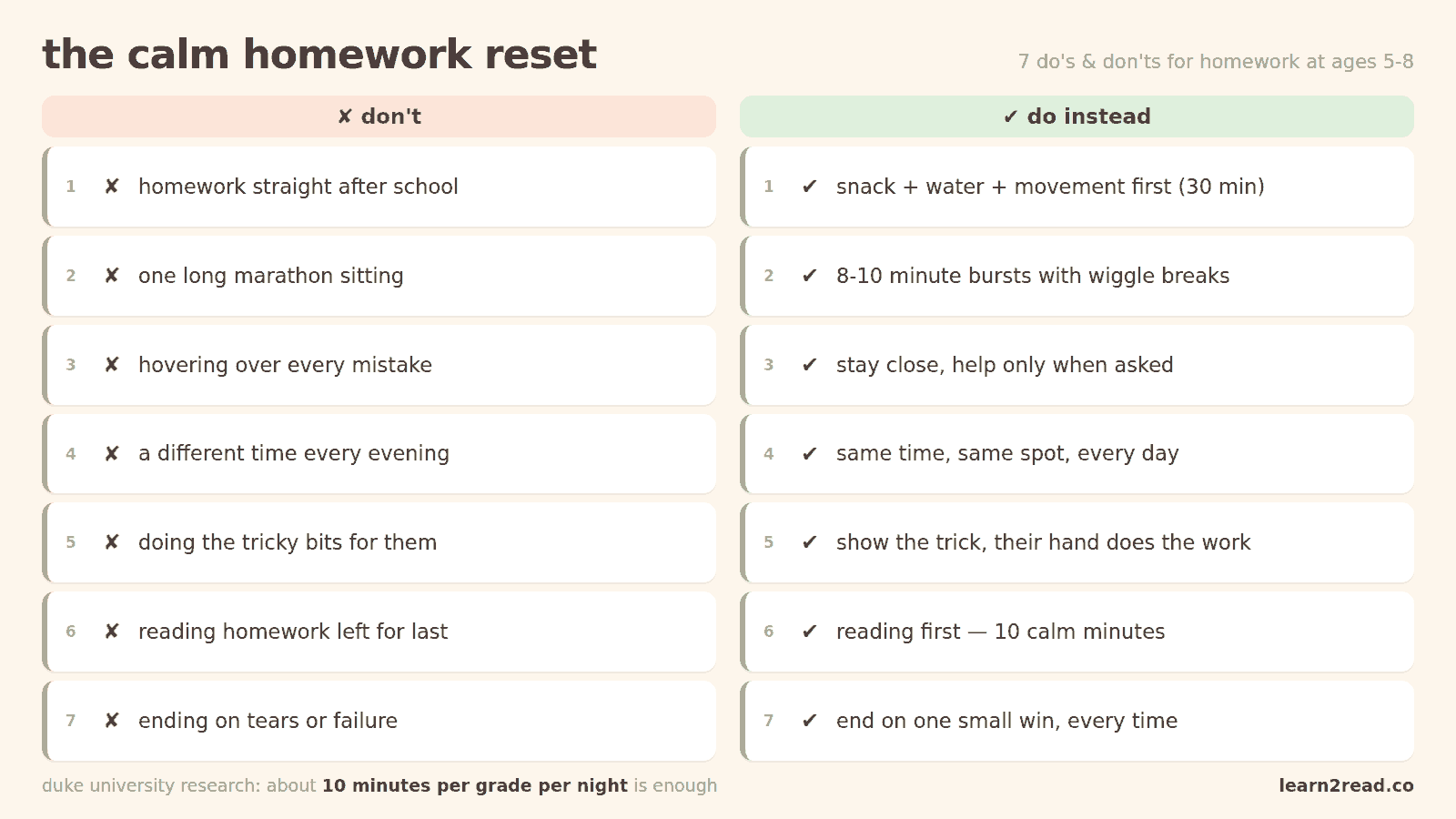
Screenshot this table — it's the whole system in one view:
# | Don't | Do instead |
1 | Start homework straight after school | Give a 30-minute reset first: snack, water, movement |
2 | Push through one long marathon sitting | Work in short bursts with wiggle breaks |
3 | Hover and pounce on every mistake | Stay close, help only when asked |
4 | Let homework float around the evening | Anchor it: same time, same spot, every day |
5 | Do the tricky bits for them | Narrate the strategy, let them do the work |
6 | Leave reading homework for last | Make reading the 10-minute warm-up |
7 | Stop at the point of tears or failure | Always end on one small win |
Now let's unpack each pair — including what to actually say.
1. Don't start homework straight after school → Do give a 30-minute reset first
Most of us have tried "let's just get it done" the minute they walk in. It backfires because you're asking a tired brain to do its hardest work at its emptiest moment.
Instead, build a short reset before any homework: something to eat, something to drink, and at least a few minutes of movement — run, dance, hang upside down off the sofa. Food and movement refill exactly what school drained.
Say this: "Snack and play first. Homework starts when the big hand reaches the 6."
2. Don't push through marathons → Do use short bursts with wiggle breaks
Twenty minutes of focused work will not happen in one sitting at age 6 — and forcing it produces the slumping, sliding-off-the-chair theatre every parent knows.
Use a timer: 8-10 minutes of work, then a 2-minute "wiggle break" (jumping jacks, a lap of the room), then back. Two bursts finish most early-years homework — and the timer becomes the "bad guy" instead of you.
Say this: "Let's race the timer, not each other. When it beeps, you get your wiggle break."
3. Don't hover and pounce on mistakes → Do stay close, help on request
Sitting right beside a child and correcting every wobble ("that's not how you write g...") teaches them one thing: I can't do this without you. It also doubles the tension at the table.
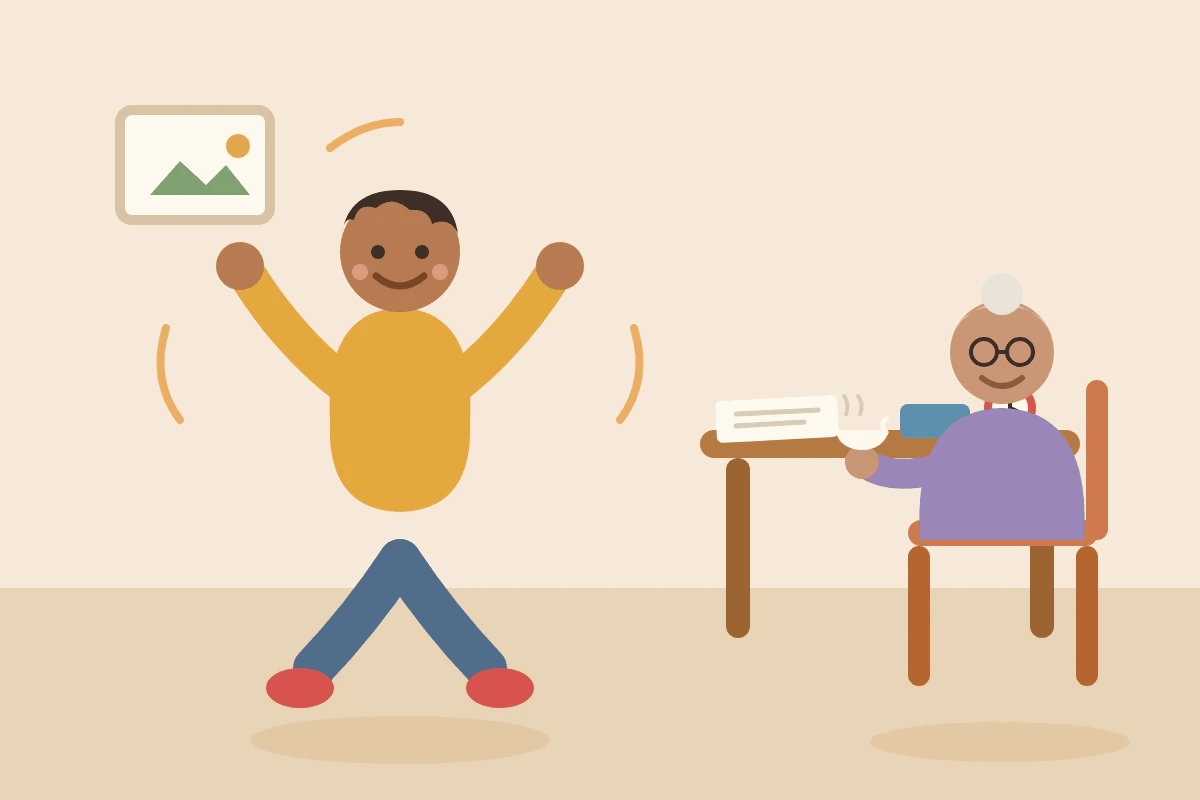
Stay nearby — folding laundry, making tea — and let them bring problems to you. When they do, help with the smallest possible nudge, then hand it back. Remember Cooper's standard: homework at this age should lead to success without much struggle — if every question needs you, flag it to the teacher; that's information, not failure.
Say this: "You start, I'm right here. Bring it to me if a bit feels stuck."
4. Don't let homework float → Do anchor it to the same time and place
When homework happens "sometime before bed," every single evening becomes a negotiation — and your child will negotiate like a tiny lawyer.
Pick one time (after the reset) and one spot (kitchen table works better than bedrooms for this age), and keep both boringly consistent. Routines remove the argument because there's nothing left to argue about: it's just what happens at that time, like brushing teeth.
Say this: "Homework lives at the kitchen table after snack. That's its home."
5. Don't do it for them → Do narrate the strategy, let their hand do the work
When it's 7 pm and everyone's done, writing the answer yourself is tempting — most of us have done it. But the teacher then sees skills your child doesn't have, and your child learns that melting down long enough makes homework disappear.
Instead, narrate how to attack the problem and keep the pencil in their hand. For reading words, that means sounding out, not guessing: "Cover the word. Now say each sound: c... a... t. Blend them." (Our free Phonics Sound Chart shows all 44 sounds with examples — it's a handy cheat sheet for exactly these moments.)
Say this: "I'll show you the trick, your hand does the work."
6. Don't leave reading for last → Do make reading the 10-minute warm-up
Reading homework saved for the end of the evening meets a child who has nothing left — so reading itself becomes the thing they cry about. Do that nightly and you teach a dangerous lesson: reading = exhaustion.
The National Literacy Trust's 2026 survey of over 125,000 children found that only 36.1% of 8-18 year olds enjoy reading in their free time — close to historic lows. Enjoyment is fragile, and the homework table is exactly where many children lose it.
So flip the order: reading first, while the tank is fullest — ten calm minutes, sitting together, before the worksheets. If your child is 5-7, that might be a phonics book they sound out to you, or you reading to them with them chiming in.
Say this: "Book first, worksheet second. Pick tonight's book."
7. Don't end on failure → Do end on one small win
Never let the last moment of homework be tears, a crossed-out answer, or "fine, just leave it." That final feeling is what the brain files away — and what it expects tomorrow.
End every session by naming one real, specific win: "You read 'ship' all by yourself — yesterday that word beat you." If the session collapsed, salvage the smallest true thing and end there. Confidence built at the homework table shows up everywhere else.
Say this: "Tell me one thing you did today that felt hard yesterday."
When It's More Than a Homework Battle
Most homework battles respond to the routine fixes above within a couple of weeks. But sometimes nightly tears are a signal, not a phase. Talk to the teacher — and consider a professional evaluation — if you notice:
Tears specifically around reading or writing tasks, every time, even short ones
Your child avoids, guesses at, or memorises words rather than sounding them out
Letters are consistently reversed or written bottom-to-top well past age 7
The teacher reports the same struggles at school that you see at home
These can be early flags for learning difficulties like dyslexia, which respond best to early, structured support. If reading is the sticking point, a structured phonics approach — the same method behind the science of reading — is where evidence points. Learn2Read, a live online phonics program for children aged 3-12, teaches exactly this way, one sound at a time, with a teacher who makes it feel like a game rather than a battle.
FAQ: Homework Battles at Ages 5-8
How long should homework take a 6-year-old?
About 10 minutes a night, based on the widely used "10-minute per grade" rule supported by Duke University research. If your 6-year-old regularly needs 30-60 minutes, adjust the routine first (rest, short bursts) — and if it's still long, speak with the teacher about trimming the load.
My child cries the moment homework appears. What do I do?
Move homework away from arrival time — give a 30-minute snack-and-movement reset first — and shrink the visible task ("just these three questions"). Tears at the sight of homework usually mean the routine is asking for effort at the worst possible moment, not that the child can't do the work.
Should I sit with my child during homework?
Stay near, not on top of them. At ages 5-8, children work best with a parent in sight for security, but hovering and correcting every stroke builds dependence. Be available "on request," then check the finished work together at the end.
What if my child simply refuses homework?
Keep the routine boring and predictable: same time, same place, timer on, no lectures. Refusal feeds on negotiation — so remove the negotiation, shrink the first task ("write your name, then the timer starts"), and end on a win so tomorrow starts easier. If refusal continues for weeks, loop in the teacher.
Is homework even worth it at age 5?
Research says formal homework adds little to achievement in the early primary years — Harris Cooper's review of 60+ studies found the homework-achievement link is much weaker for young children than teenagers. What does pay off at 5: being read to daily, playing with letter sounds, and short, playful practice. Treat worksheets as habit-building, not achievement-building.
What's the best time of day for homework?
After a food-and-movement break following school — for most families, that's 30-60 minutes after arriving home, and well before the bedtime wind-down. Homework right before bed pits your child's hardest task against their emptiest tank, which is how battles start.
Read Next
After-School Meltdowns: Why Your Sweet Child Falls Apart at 3:30 — if the battle starts before the homework even comes out
Kids' Attention Spans & Short Videos — why focus feels harder than it used to, and how to rebuild it
Reading Milestones by Age — check what's typical at 5, 6, 7 and 8 before you worry
__________________________________________________
If reading homework is the nightly flashpoint, that's the one battle worth outsourcing. Learn2Read's live phonics classes turn sounding-out into a game your child actually asks for — taught by real teachers, in small groups, from home. Book a free trial class and make reading the easy part of the evening.

Latest Posts

2 September 2026
Homework Battles: 7 Do's & Don'ts for Ages 5-8 (2026)

29 August 2026
Kids' Attention Spans & Short Videos: What Parents Must Know
25 August 2026