
10 October 2026
b and d Confusion: Is It Dyslexia? How to Fix It (Ages 4-7)
b and d Confusion: Is It Dyslexia? How to Fix It (Ages 4-7)
posted on : 10 October 2026
Your child writes "dall" for ball. Reads "dig" as big. Flips the b in their own name.
You have shown them the difference a dozen times. They nod, they get it, and the next day it is back.
Here is the short answer. b and d confusion happens because they are the same shape facing opposite ways, and nothing else your child has ever learned changes its name when you flip it. A cup is a cup from either side. A chair is a chair. Letters are the first things in life that break that rule.
So this is not carelessness and it is usually not dyslexia. It is your child applying a rule about objects that has worked perfectly for five years.
Most children sort it out somewhere between 6 and 7 with no help at all. Some need teaching, and the teaching that works is narrower than the internet suggests. Most of the tricks going around treat the symptom.
This guide covers what is normal at each age, the method that fixes it, the five things that keep it going, and the point at which it is worth asking the school.
In this guide:
Why does my child mix up b and d? · Is it normal to reverse b and d at 5, 6 and 7? · What actually fixes b and d confusion? · Why the bed trick works for some children and not others · Five things that keep the confusion going · What to do this week · When are b and d reversals a sign of something more? · FAQs about b and d confusion
Why Does My Child Mix Up b and d?
Children mix up b and d because the two letters are the same shape in opposite directions, and young children's brains are built to recognise an object as the same object no matter which way it faces. That ability helps with everything else in the world and works against them with letters.
This is worth sitting with for a second, because it changes how you respond.
Everything your child has learned about objects says direction does not matter. Their shoe is their shoe whichever way it points. Their cup is their cup. The brain treats a flipped object as the same object, and that is a useful shortcut.
Then letters arrive and they are the first things that need direction to mean anything. b and d are one shape and one stick, arranged two ways. p and q are the same trick upside down.
Your child is not forgetting. They are applying a rule that has never failed them before.
Why b and d are harder than every other pair
Two other things stack the odds.
The two sounds are easy to mix up by ear. Both are made by blocking the air and releasing it with the voice on, so listening alone won't separate them. What does separate them is where the block happens, and your child can feel that.
And they both turn up in the most common early words. bat, ball, big, bed, dog, dad, did. A child cannot avoid these the way they can avoid a rare letter.
Is It Normal to Reverse b and d at 5, 6 and 7?
Reversing b and d is typical until about age 7, and most children who do it never turn out to have dyslexia. Understood.org puts it plainly: reversals are "typical and fairly common up until second grade," and "most kids who reverse letters before age 7 end up not having dyslexia."
Here is the pattern most children follow. School years differ around the world, so ages come first.
|
Age |
School year (UK / US and Canada / India / Gulf) |
What is typical |
|
4 |
Nursery / Pre-K or Junior Kindergarten / LKG / KG1 |
Reverses lots of letters, writes some back to front, may mirror whole words. Expected. |
|
5 |
Reception / Kindergarten or Senior Kindergarten / UKG / KG2 |
Still mixes b and d often. Knows they are different, cannot always tell which is which. |
|
6 |
Year 1 / Grade 1 / Class 1 |
Mixes them some of the time, more in writing than in reading, more when tired or rushing. |
|
7 |
Year 2 / Grade 2 / Class 2 |
Occasional slips. Catches and fixes them when reading back. |
|
8 |
Year 3 / Grade 3 / Class 3 |
Mostly gone. Frequent confusion at this age is worth raising with the teacher. |
End of Year 2, Grade 2 or Class 2 means roughly May in the US and Canada, July in the UK and the Gulf, and March or April in India, where the school year runs April to March.
Screenshot this table. It is the one to re-read at each birthday, and it settles most of the worry on its own.
Understood.org gives a clear marker for when to speak up: "If your child is still reversing letters a lot by the end of second grade, you may want to reach out to your child's teacher."
One more thing worth knowing. Reversals in writing hang around longer than reversals in reading, because writing asks your child to produce the letter from memory while reading only asks them to recognise it. Production is the harder task. A child who reads b and d correctly and still writes them the wrong way round is making normal progress.
What Actually Fixes b and d Confusion?
The method that fixes b and d confusion is to teach one letter to mastery before touching the other, tie the letter to the mouth movement that makes its sound, and practise writing it with the starting point marked. Teaching both letters together is what creates the confusion in the first place.
Four steps. Ten minutes a day, four days a week.
|
Step |
What you do |
Why it works |
|
1. Pick one letter and leave the other alone |
Work on d only, for a week or two. Do not mention b at all. |
The brain cannot confuse two things if only one is in play |
|
2. Tie it to the mouth |
Say the sound. Your child feels where their tongue goes for d: tip up behind the top teeth. For b the lips press together. |
Gives them a check they carry everywhere |
|
3. Mark where the pencil starts |
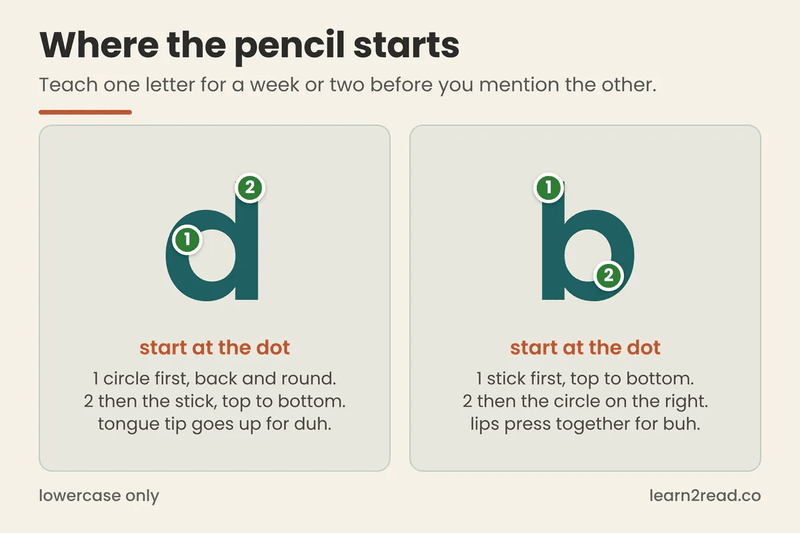
For d, start with the circle on the left, then the stick up on the right. Put a green dot where the pencil starts. |
Direction gets stored in the hand, not the eye |
|
4. Only then bring in the second letter |
Once the first is automatic in reading and writing, introduce the other and compare them openly. |
Contrast teaches once there is something solid to contrast with |
This is the four step method in full.
Step 2 is the one most home routines skip, and it is the one that travels. A visual trick needs a wall chart or a hand gesture. A mouth check is available in an exam hall, in the car, anywhere, which is why specialist programmes lean on it and most home routines never mention it. Ask your child to say the sound and notice whether their lips pressed together or their tongue went up. Lips means b. Tongue means d.
Step 3 matters more than it looks. Letter reversals live partly in the hand. A child who has written d a hundred times starting from the circle on the left has stored the direction as a movement, and movement memory is sturdier than looking at a chart.
Write lowercase throughout. Reading is built from lowercase letters, and children meet them first. Switching to uppercase only hides the problem, because those two capital forms aren't confusable.
Why the bed Trick Works for Some Children and Not Others
The "bed" trick, where a child pictures the word bed as a headboard and footboard to work out which letter is which, helps children who already know both letters and need a quick check. It does little for a child who has not yet learned either letter properly, because it adds a step instead of removing one.
You have probably met several of these tricks. Two fists making b and d. The bed picture. The thumbs-up hands.
They are not bad. They are just aimed at the wrong moment.
A trick is a lookup tool. Lookup tools help once the knowledge is there and the child needs to check. They get in the way when the knowledge is missing, because now your child is remembering a picture, then working out which side of the picture, then choosing the letter. That is three steps where there should be one.
The order that works: build one letter solidly, build the second, then hand your child a trick as a backup for the moments when they are tired or rushing.
If your child is already using a trick and it works, keep it. If they are using one and still getting it wrong, that is a sign to go back and build the letters properly.
Five Things That Keep the Confusion Going
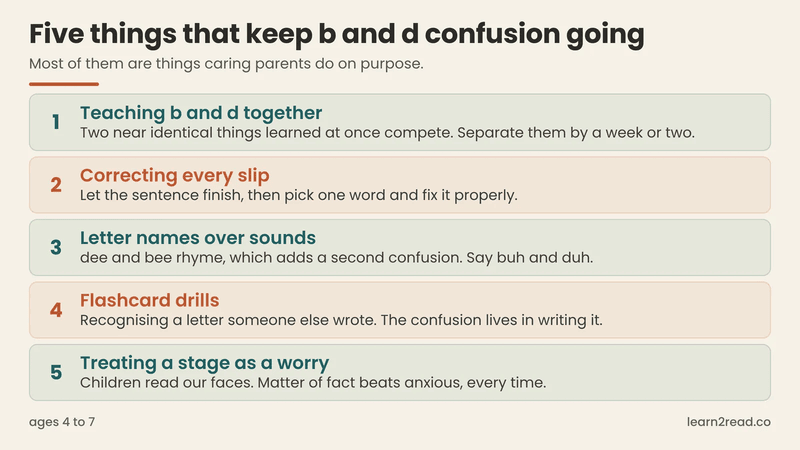
Five habits keep b and d confusion alive longer than it needs to be: teaching the two letters together, correcting every slip, using letter names in place of sounds, drilling flashcards, and treating a normal stage as a worry. Most of them are things caring parents do on purpose.
1. Teaching b and d together
The most common one. It feels logical to show the difference side by side, and it is the fastest way to tangle them. Two nearly identical things learned at the same time compete in memory. Separate them by a week or two.
2. Correcting every single slip
A child writing a sentence has a lot going on. Stopping them at each reversal breaks the writing and makes the letter a source of dread. Let the sentence finish, then pick one word to fix properly.
Say it like this. "Read me this word." Then: "Say the sound. Did your lips press, or did your tongue go up?" Then: "Write it again, starting at the green dot." Nothing else.
3. Reaching for letter names when sounds would do
"That's a dee, not a bee" gives your child nothing to work with, and the two names rhyme, which adds a second confusion on top of the first. Say the sounds. buh and duh are easy to tell apart.
4. Drilling with flashcards
Flashcards ask your child to recognise a letter someone else has written. The confusion lives mostly in production, so the practice that counts is your child writing the letter themselves, with the starting point marked.
5. Treating a stage as a worry
Children read our faces. A child who senses that b and d are a problem starts avoiding words with them, writing smaller, and guessing to get past the moment. That costs far more than the reversals do. A child who has started guessing needs that habit addressed too, and our guide on why your child guesses at words covers it.
|
Keeps it going |
Fixes it |
|
Both letters taught together |
One letter to mastery, then the other |
|
Letter names: "dee, not bee" |
Letter sounds and the mouth check |
|
Flashcard recognition drills |
Writing the letter, starting point marked |
|
Correcting mid-sentence |
One word fixed after the writing is done |
|
Anxious tone |
Matter of fact, it is a stage |
📌 Screenshot this one. It fits a phone screen and answers most of it.
What to Do This Week
The fastest way to start on b and d is to pick the letter your child already gets right more often and work only on that one for two weeks. The goal is one letter your child never has to think about.
Four days this week, ten minutes:
Day 1. Say the sound. Your child says it back and notices their mouth. Write the letter five times with a green dot where the pencil starts.
Day 2. Hunt for the letter. Find it ten times in a book, a food packet, a sign on the way to school. Your child points and says the sound, not the name.
Day 3. Write three short words that start with it. For d: dog, dad, dip. Your child says each sound as they write it.
Day 4. Your child writes the letter with their eyes shut. It sounds odd and it works, because it forces the hand to remember the direction without the eyes checking.
Then wait two more weeks before you introduce the other letter. The waiting is part of the method.
A note on the pencil. If forming letters is slow and effortful, some of what looks like confusion is the hand struggling. Watch whether your child writes the letter correctly when they go slowly and wrongly when they rush. If so, the letter is known and the problem is speed, and that eases with practice alone.
b, d, p and q: Which to Fix First
Fix b and d first, because they appear in far more early words than p and q, and a child who sorts out one mirror pair usually sorts out the second much faster. The idea that letters have a direction is the real lesson, and it transfers.
|
Pair |
How common in early reading |
When to tackle it |
|
b and d |
Very common: ball, big, bed, dog, dad, did |
First, from about age 5 |
|
p and q |
q is rare in early words and almost always with u |
After b and d are solid |
|
n and u |
Less common, usually resolves on its own |
Only if it persists past 6 |
|
m and w |
Occasional, usually brief |
Only if it persists past 6 |
The sound work pays off here too. p and q sound nothing alike, so a child who has learned to check the sound rather than the shape has an easy route in. Our guide on how to teach blending builds the same sound-first habit for whole words.
When Are b and d Reversals a Sign of Something More?
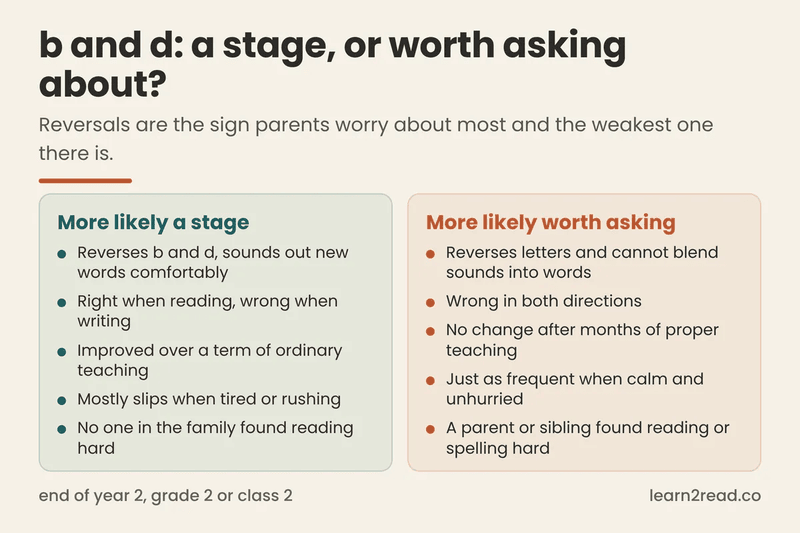
Reversing b and d is worth a closer look when it is still frequent at the end of Year 2, Grade 2 or Class 2, and when it comes with trouble hearing the separate sounds in a spoken word, letter sounds that will not stay learned, or a family history of reading difficulty.
On its own, at any age below 7, it means very little.
That distinction matters, because reversals are the sign parents worry about most and the weakest one there is. Our guide to the early signs of dyslexia in children sets out the signs that do carry weight, and the five ordinary situations that look the same.
|
More likely to be a stage |
More likely to be worth asking about |
|
Reverses b and d, sounds out new words comfortably |
Reverses letters and cannot blend sounds into words |
|
Gets it right when reading, wrong when writing |
Gets it wrong in both directions |
|
Improved over a term of ordinary teaching |
No change after months of proper teaching |
|
Mostly slips when tired or rushing |
Just as frequent when calm and unhurried |
|
No one in the family found reading hard |
A parent or sibling found reading or spelling hard |
Two practical steps if the second column sounds more like your child.
Book a hearing and vision check. It is quick and it clears the two most fixable explanations off the list.
Bring specifics to the teacher. At a parent-teacher meeting (PTM), "he still writes dall for ball most days, and he cannot tell me the first sound in dog" gets a real answer. "I am worried about his letters" usually gets "he is doing fine". Our guide on what to ask your child's teacher about reading has more questions worth that slot.
Nothing here is a diagnosis, and no checklist online is. If several things in the right-hand column sound like your child and six months of teaching has not moved it, take your notes to the teacher and to your paediatrician and ask about the assessment route where you live.
The National Reading Panel review found that explicitly and systematically teaching children to manipulate phonemes significantly improves reading and spelling. Systematic is the word that matters: a planned order, taught the same way each time. That is the evidence-backed core of early reading, and the same planned order is what settles mirror letters in practice.
At Learn2Read, a live online phonics programme where trained teachers work with children aged 3 to 12 across 35+ countries, b and d come up in almost every beginner class. Teachers expect it, and they teach the two letters weeks apart on purpose.
FAQs About b and d Confusion
At what age should a child stop confusing b and d?
Most children stop confusing b and d between ages 6 and 7, and occasional slips when tired or rushing are normal well into age 7. Understood.org describes letter reversals as typical and fairly common up until second grade. Frequent confusion that is still there at the end of Year 2, Grade 2 or Class 2 is the point at which it is worth raising with your child's teacher, particularly if it comes alongside trouble hearing the sounds inside spoken words.
Does mixing up b and d mean my child has dyslexia?
On its own, no. Most children who reverse letters before age 7 do not turn out to have dyslexia, and reversals are the weakest of the early signs. What matters is whether they arrive alongside difficulty hearing the separate sounds in a spoken word, letter sounds that will not stay learned, and a family history of reading difficulty. If several of those fit, talk to your child's teacher.
How do I teach the difference between b and d?
Teach one of them properly before you mention the other. Work on a single letter for a week or two: say its sound, have your child notice what their mouth does to make it, and write the letter with a dot marking where the pencil starts. Only when that letter is automatic in both reading and writing should you introduce the second one and compare them. Teaching both at once is the most common reason the confusion lasts.
Does the bed trick actually work?
It works as a backup check for a child who already knows both letters and needs a way to confirm which is which. It does little for a child who has not yet learned either letter properly, because it adds steps instead of removing them: picture the bed, work out which end, then choose the letter. Build the letters first, then offer a trick for tired moments.
Why does my child read b and d correctly but write them wrong?
Because writing a letter asks your child to produce it from memory while reading only asks them to recognise it, and producing is harder. Writing reversals commonly persist after reading reversals have resolved, because production is the harder task. A child who reads both letters correctly has the knowledge, and what remains is a motor habit, which is fixed by writing the letter with the starting point marked rather than by more reading.
Should I correct my child every time they reverse a letter?
No. Stopping a child at every slip interrupts their writing and turns two letters into something they dread, which usually leads to shorter sentences and easier words. Let them finish, then pick one word and fix it properly: say the sound, notice the mouth, rewrite the letter from the marked starting point. One word fixed well does more than ten words corrected in passing.
Is it a problem if my child writes letters back to front at 4?
No. At 4 reversing letters is expected, and some children mirror whole words or write a line of text from right to left. It reflects how young children handle shapes, and says nothing about their reading future. The useful work at this age is sounds, well before letter shapes: rhyming games, spotting the first sound in a word, and plenty of being read to.
Read Next
-
Why Your Child Can Read But Can't Spell because reversals in writing and shaky spelling usually come from the same place.
-
Early Signs of Dyslexia in Children for the signs that do carry weight, and the five ordinary things mistaken for them.
-
Reading Milestones by Age for what is typical at 3 to 7 when nothing is wrong.
If b and d have been going round in circles for months, the quickest way forward is usually one session where a trained teacher watches your child read and write, works out whether the gap is in the ear, the eye or the hand, and shows you which one to practise.
Written by Nitin Jain, Founder, Learn2Read. Reviewed by the Learn2Read teaching team, October 2026. Learn2Read teaches phonics and early literacy to children aged 3 to 12 through live online classes in 35+ countries.

Latest Posts
7 October 2026
Why Your Child Can Read But Can't Spell, and How to Fix It
3 October 2026
Early Signs of Dyslexia in Children: Ages 4 to 7, and 5 Things That Look Like It
30 September 2026