7 November 2026
Capital or Small Letters First? ABCD vs abc for LKG Kids
Capital or Small Letters First? ABCD vs abc for LKG Kids
posted on : 4 November 2026
By Nitin Jain, Founder, Learn2Read · Published 4 November 2026
Nitin Jain founded Learn2Read, which teaches live online phonics classes to children aged 3 to 12. Sources checked against peer-reviewed letter-knowledge research, the UK Department for Education's Reading Framework and the handwriting guidance of two UK phonics programmes. Last reviewed: 4 November 2026.
Your child can sing the ABCD song, point to a big A on the wall chart and write a wobbly CAT in capital letters. Then you open a storybook and almost every letter on the page looks different.
So, capital or small letters first? It's a question parents ask again and again on forums, often typed just as one mum put it: "What do you start with - lower case or upper case?"
For reading, start with small letters (lowercase). Almost all the print your child will read is small letters, and phonics programmes teach letter sounds with small letters first.
If your child already knows capital ABCD, that isn't wasted. Children who know a capital letter are far more likely to know its small partner too, so you build from what they know.
Below you'll find why so many homes start with capitals, a 4-week plan for a child who only knows capitals, and what to do about writing. It's written for parents of children in playgroup, nursery, LKG and UKG in India, KG1 and KG2 in the Gulf, and preschool or Reception elsewhere.
In this guide:
The short answer · Why capitals come first in many homes · Why small letters matter more for reading · My child only knows capitals: what now? · Capital or small letters for writing? · Do's and don'ts · When to look closer
Capital or Small Letters First (Uppercase or Lowercase)? The Short Answer
Teach small letters first for reading, and add capitals as their partners. About 95 in every 100 letters in picture books are small, and phonics programmes teach sounds with small letters. Keep capitals for your child's name and the first word of a sentence, and link each one to a small letter they already know.
Whichever you chose, capital or small letters first, capitals still matter. They just don't need to come first, and they don't need as much practice time.
Here's the rule we'd give any parent of a 3 to 6 year old: read and sound out in small letters, write names with one capital, and treat every capital as the "big partner" of a small letter your child already knows.
Capital ABCD or Small abcd First? Why Many Indian Homes Start With Capitals
Capitals usually come first because they're easier to see and easier to write. Most capital letters are built from straight lines, and many alphabet charts, puzzles and first workbooks in India use them.
There's real logic to this. Literacy author Anna Geiger, summing up occupational therapist Laura Sowdon's view, writes that "uppercase letters are generally straighter and simpler to form than lowercase letters." Some US schools teach capitals first for this reason. The Aaron School in New York says, "Developmentally, capitals are easier so we teach them first."
Children also tend to learn capitals sooner. In one US study of preschoolers, children knew on average 17.6 capital letters but 14.87 small letters by spring of their preschool year. A 2023 study by Vinter and colleagues sums up earlier research the same way: higher naming scores "have been reported for uppercase letters than for lowercase letters".
The good news for any parent who started with capitals: that knowledge carries over. A study in the Journal of Speech, Language, and Hearing Research found children were "more than 16 times more likely to know a lowercase letter if they knew the corresponding uppercase letter."
So you haven't done anything wrong. Capitals are a fine first step. They're a poor place to stay.
For more letter games, see our tips to build letter knowledge.
Why Do Small Letters Matter More for Reading?
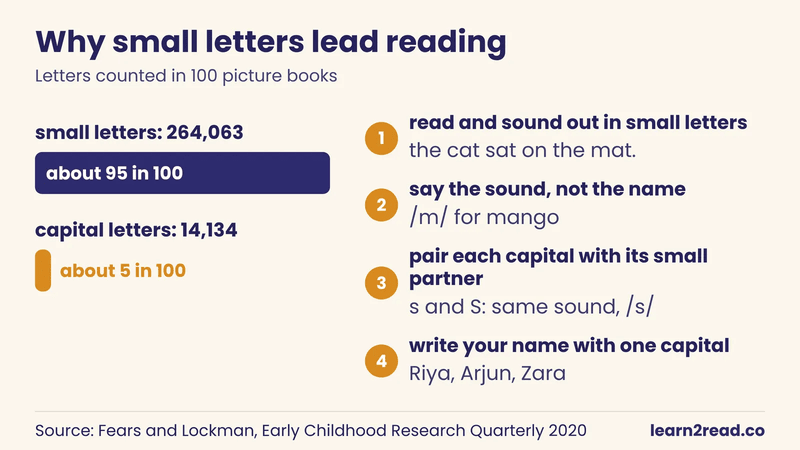
Small letters matter more because they make up almost everything a child reads. When researchers counted the letters in 100 picture books, they found 264,063 small letters and only 14,134 capitals. That's about 95 out of every 100 letters.
Picture a page from a typical early reader:
the cat sat on the mat.
Every letter there is small except, in a real book, the first t. A child who only knows CAT in capitals has to work out the shapes of c, a and t all over again before reading can begin.
That's why the main phonics programmes start with small letters. The Read Write Inc. programme says in its guidance: "We teach phonics using lower case letters in the Speed Sounds Lessons." In Little Wandle, children learn small-letter formation in Units 2 to 5 of Reception, and these are "then practised in Unit 6, when capital letters are introduced".
What the research says, in one table:
Study | Finding | Number |
Fears and Lockman (2020), 100 picture books | Small letters dominate children's books | about 95 in 100 letters are small |
Piasta, Petscher and Justice (2012), US preschoolers | Capitals are usually learned first | 17.6 capitals vs 14.87 small letters known |
Turnbull and colleagues (2010), US preschoolers | Knowing a capital goes with knowing its small partner | more than 16 times more likely |
Small letters are harder in one way: several look alike. b, d, p and q are the same shape turned around.
Occasional reversals like these are perfectly normal between three and seven, and Jolly Phonics notes that "the letters b and d are introduced in different groups to avoid confusion." If your child mixes them up, our b and d confusion guide has the fix.
My Child Only Knows Capital Letters. What Now?
Build a bridge from each capital to its small partner, starting with the pairs that look the same. You don't need to stop using capitals or start again.
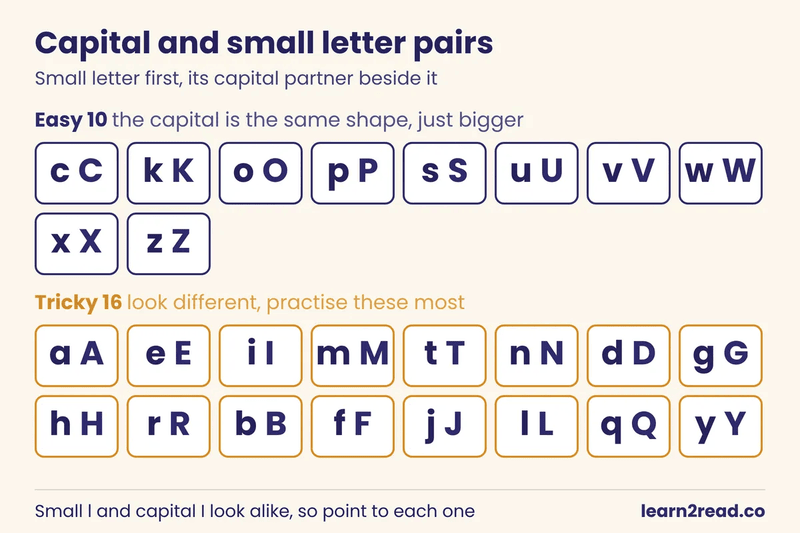
About ten letters look nearly identical in both forms, just bigger or smaller: c, k, o, p, s, u, v, w, x and z. Your child already "knows" these in small form, even if nobody has told them. The other sixteen look different (a, b, d, e, f, g, h, i, j, l, m, n, q, r, t, y), and those are where the practice goes.
A four-week plan that works at home (stretch it to eight weeks for a 3-year-old):
Week 1: the easy ten. Show the small letter and its capital side by side and say, "This is the big s, and this is the little s. Same sound: /s/." Then hide the capitals and play only with the small ones.
Week 2: tricky pairs, five a week. Start with a, e, i, m and t, because they turn up in so many first words. Say the sound, not the letter name.
Week 3: five more tricky pairs. Add n, d, g, h and r. Keep b and d at least a few days apart.
Week 4: the last six, then read. Add b, f, j, l, q and y, and read tiny words in small letters every day: sat, pin, hop, red.
If your child's LKG workbook is all capitals, don't fight the school. At the next PTM, ask: "Can we practise the small letter next to each capital at home?" Whether you're in Jaipur, Dubai, London or Toronto, most teachers will be glad you asked.
Five minutes a day is plenty. If letters keep slipping, our guide to a child who keeps forgetting letter sounds has a simple review routine.
One switch makes a big difference: use letter sounds, not letter names. "A for apple" teaches the name ay, while "/a/ for apple" teaches the sound your child needs to read.
If that's new to you, read our post on letter names vs letter sounds.
Should My Child Write Capital or Small Letters First?
For writing, teach small letters first too, with the correct starting point for each one. Capitals come in for names and the first letter of a sentence.
If your 3-year-old's grip is still shaky, it's fine to let them draw straight-line capitals for a few months. Just move reading practice to small letters now.
The UK Department for Education's Reading Framework says children should "be taught the correct start and exit points for each letter". It also notes that programmes teach that each small letter has a capital partner which shares the letter name and represents the same sound.
Don't worry if your child writes a mix like "dAD" or "bAll" for a while.
Researchers Rebecca Treiman and Brett Kessler found that "the younger children, especially, often wrote with capital letters." Mixing is a normal stage. It fades as small letters become automatic.
Two habits help most at home:
Name writing: teach "Riya" or "Arjun" with one capital and the rest small. Children write their own name more than any other word, so this one habit does a lot.
One letter, one start: for small letters, show where the pencil starts, then let your child trace in the air, on your palm and on paper.
Capital and Small Letters: Do's and Don'ts
The simplest rule at home: small letters do the reading work, and capitals only ever appear beside their small partner.
Do | Don't |
Use small letters on flashcards, fridge magnets and labels at home | Buy a capital-only alphabet set as the main teaching tool |
Say the sound: "/m/ for mango" | Drill "M for mango" as the only way of naming letters |
Pair each capital with its small partner, side by side | Start a new capitals-only workbook once your child knows ABCD |
Teach the child's own name with one capital, rest small | Insist on perfect capitals before moving on to small letters |
Practise the tricky sixteen most | Spend equal time on c, o and s, which already look the same |
Keep b and d a few days apart when introducing them | Teach b, d, p and q together in one sitting |
When Is Mixing Up Capital and Small Letters a Worry?
Mixing capitals and small letters is normal up to about age 6 or 7, especially in writing. It's worth a word with the class teacher if a child still knows very few small letters after several months of short daily practice, or also struggles to hear rhymes and first sounds in words.
The International Dyslexia Association lists early difficulty "learning letters and their sounds" as one sign worth watching, but one sign on its own isn't a diagnosis.
If you're worried, start with the class teacher at the next PTM, and ask your paediatrician to check hearing and eyesight. Our guide to the early signs of dyslexia explains what to look for between 4 and 7.
FAQs
Should I teach capital or small letters first?
For reading, small letters first. About 95% of the letters in children's picture books are small, and phonics programmes teach letter sounds with small letters. Capitals can be added as the "big partner" of each small letter, and are needed for a child's name and the start of a sentence.
My child learned capital ABCD first. Is that a problem?
No. One 2010 study found children were more than 16 times more likely to know a small letter if they knew its capital, so capital ABCD is a useful head start. The next step is to pair each capital with its small partner and move daily reading practice to small letters, starting with letters that look the same in both forms.
Should I teach uppercase or lowercase letters first?
Lowercase first for reading. Uppercase and lowercase are the same as capital and small letters. About 95 in 100 letters in picture books are lowercase, so most reading practice should use them, with each uppercase letter paired with its lowercase partner.
Which capital and small letters look the same?
About ten letters look nearly the same in both forms, just a different size: c, k, o, p, s, u, v, w, x and z. The other sixteen look different, including a, b, d, e, g, h, q and r. Those different-looking pairs are the ones that need the most practice at home.
My child's school teaches capital ABCD in LKG. Should I teach small letters at home?
Yes, gently. Keep the school's capitals and pair each one with its small partner at home, using letter sounds. Five minutes a day on small letters gives a child the shapes found in every storybook, without clashing with class work. Ask the teacher at the next PTM which order the class follows.
At what age should a child learn small letters?
There's no single right age. Many phonics programmes start in LKG, UKG or Reception, the year a child turns 4 or 5, and some children begin earlier in nursery. A child who can listen to stories, enjoys rhymes and can hear the first sound in a word is usually ready for a few minutes of small-letter practice a day.
Should my child write in capital or small letters?
UK phonics programmes such as Little Wandle and Read Write Inc. teach small letters first (some US handwriting programmes start with capitals), with a correct starting point for each one, then add capitals for names and the first letter of a sentence. Young children often mix the two, writing words like "bAll". Researchers Treiman and Kessler found younger children often write in capitals, and the mixing usually fades as small letters become automatic.
Is it wrong to teach capital letters first?
No. Capital letters are easier to write, so they make a gentle start, and some programmes begin with them. Research has not settled which order is best, but because almost all printed text is small letters, small letters should get most of the reading practice.
Read Next
My Child Knows the Alphabet (ABCD) but Can't Read: Letter Names vs Letter Sounds: the next step once the small letters are in place.
Child Keeps Forgetting Letter Sounds? How to Make Them Stick: a 5-minute daily review for letters that won't stay put.
b and d Confusion: Is It Dyslexia? How to Fix It: for the two small letters that swap most often.
Phonics Sound Chart: every sound with an example word, in small letters, for your fridge.
So, capital or small letters first? Capital ABCD is a fine start, and small abc is where reading happens. Start tonight with one tricky pair, two minutes, small letter first. If you'd like a teacher to guide your child from letters to their first words, book a free trial class.

Latest Posts
4 November 2026
Capital or Small Letters First? ABCD vs abc for LKG Kids
31 October 2026
How Many Minutes Should a Child Read a Day? Guide by Age
28 October 2026
Child Keeps Forgetting Letter Sounds? How to Make Them Stick

A new chapter from Learn2Read
Read Before They Read
Before you teach your child to read, read this. A calmer, clearer way into your child’s reading journey—with a practical guide written for real Indian homes.