
24 October 2026
Child Can Read Words but Not Sentences? Fix Choppy Reading
Child Can Read Words but Not Sentences? Fix Choppy Reading
posted on : 24 October 2026
By Nitin Jain, Founder, Learn2Read · Published 24 October 2026
Nitin Jain founded Learn2Read, which teaches live online phonics classes to children aged 3 to 12. Sources checked against the Education Endowment Foundation, the National Reading Panel and the Hasbrouck and Tindal fluency norms. Last reviewed: 24 October 2026.
Your child reads every word card you hold up. Then you open a book and hear: "the... dog... ran... to... the... park." Every word is its own little stop.
The voice is flat, like a robot reading a list, and by the end neither of you is sure what the dog did.
Two different problems hide behind this search. If the reading sounds choppy, read on. If it sounds smooth but your child can't tell you what happened, start with why a child can read but doesn't understand.
Maybe the report card said it for you: "Needs to work on reading fluency" or "Should read with expression."
If your child can read words but not sentences smoothly, the words are not automatic yet. Each one still takes effort, so there is nothing left over for joining words into phrases. If the words come out right, just slowly, your child has already done the hard part.
This word-by-word stage is a normal step between sounding out and fluent reading, and it moves with one kind of practice: hearing a sentence read well, then reading it again.
This guide explains why reading sounds choppy, what fluency actually means, a 10-minute routine that works at home, and when slow reading is worth a closer look. It's written for children in UKG, class 1, class 2 and class 3 in India, KG2 to Grade 3 or Year 3 in the Gulf, and Reception to Year 3 or kindergarten to Grade 3 elsewhere.
In this guide:
Why can my child read words but not sentences? · What is reading fluency? · How fast should a child read? · A 10-minute routine to fix it · Do's and don'ts · When should you worry?
Why Can My Child Read Words but Not Sentences?
If your child can read words but not sentences, they are usually still decoding each word on its own, so every word costs effort and the sentence comes out in pieces. Smooth reading needs most words to be recognised instantly. Until then, a child reads like someone crossing a river on stepping stones, one careful jump at a time.
These are the usual reasons, and what each looks like at home.
|
Reason |
What you'll notice |
What helps |
|
Reads a word on a card but not in a book |
Gets "dog" right alone, stalls on it mid-sentence |
Read the sentence's hard words alone first, then the whole line |
|
Words still need sounding out |
Lips move on each word, long pauses before longer words |
Re-read the same page two or three times |
|
Small words aren't instant yet |
Stops on the, was, said, of, even though the story is easy |
Two minutes a day on the small, frequent words |
|
No feel for phrases |
Every word gets the same weight and the same pause |
Hear it first: you read the sentence, then your child copies |
|
Full stops and commas ignored |
Runs past the end of a sentence, or stops in the middle |
Make a game of "stop at the dot" |
|
Book is too hard |
Choppy on every page, tired quickly |
An easier decodable book for practice, a harder one for reading together |
Children learning to read in English as a second language often go through this stage for longer, because the rhythm of English phrases is less familiar to the ear. That's a reason for more listening, and no reason to worry.
Most children pass through four stages on the way to smooth reading. Knowing which one your child is in tells you what to practise next.
|
Stage |
What it sounds like |
Next step |
|
Sound by sound |
"c-a-t... cat" |
Blending practice |
|
Word by word |
"the... dog... ran" |
Echo reading and re-reading |
|
Phrase by phrase |
"the little dog / ran to the park" |
Phrase scoops |
|
Smooth |
sounds like talking |
Harder books, and keep reading aloud to them |
If your child is still blending most short words sound by sound, start one step earlier with our guide on how to teach blending. For choosing practice books, our guide to decodable books explains which ones a beginning reader can read without guessing.
What Is Reading Fluency?
Reading fluency is the ability to read text accurately, at a comfortable pace and with natural expression. The UK's Education Endowment Foundation defines it as "the ability to read with accuracy, automaticity, and expression (prosody)".
Automaticity means reading words without having to work them out. Prosody means reading with the rise, fall and pauses of normal speech.
A choppy reader usually has the accuracy and is missing the other two. That's good news: smoothness is built on accuracy, and your child already has it.
Fluency matters for understanding. A child who spends all their effort getting from one word to the next has little left for the meaning. Smooth reading frees that attention for meaning, which is why the routine below starts with your voice.
How Fast Should a Child Read? Words per Minute in Class 2 and 3
How many words per minute should a class 2 child read? A typical US second grader reads about 100 words correctly per minute by the end of the year, but smooth phrasing matters more than the number. In US reading norms compiled by Jan Hasbrouck and Gerald Tindal in 2017, a 50th-percentile second grader reads about 50 words correctly per minute at the start of the year and about 100 by the end. Teachers shorten this to WCPM, from a quick oral reading fluency (ORF) check.
|
US grade (roughly class 2 and class 3) |
Start of year |
Middle of year |
End of year |
|
Grade 2 |
50 |
84 |
100 |
|
Grade 3 |
83 |
97 |
112 |
Words read correctly per minute, 50th percentile, grade-level passages. Source: Hasbrouck and Tindal (2017), via Reading Rockets.
The same source suggests that children scoring 10 or more words below the 50th percentile, averaged over two unpracticed readings of grade-level text, need a fluency-building program. That is a school-level judgement, so leave the timing to your child's teacher.
Use this table to understand the stage, and skip timing your child every night. These are US figures for children reading grade-level US texts, and school years in India and the Gulf don't line up exactly.
A child reading fast and flat is not fluent either. Listen for smooth phrases and a voice that sounds like talking.
Child Can Read Words but Not Sentences? A 10-Minute Routine to Fix It
When a child can read words but not sentences, the most reliable fix is to read a sentence aloud first, then have your child read the same text several times. The National Reading Panel, a US government review of reading research, found that repeated oral reading with guidance from teachers, peers or parents had a positive impact on word recognition, fluency and comprehension. Silent reading on its own was not shown to build fluency.
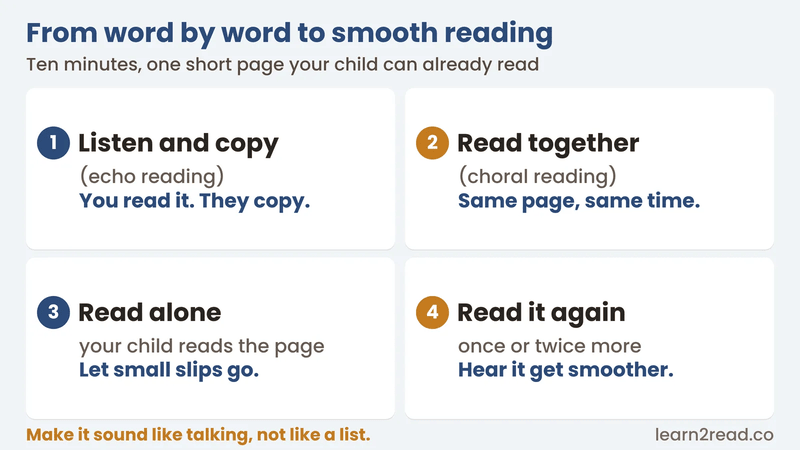
If you're wondering how to improve reading fluency at home, start with one short page your child can read with no more than about one mistake in every 20 words. Anything harder is a read-together book. Then work through four steps.
-
Listen and copy (echo reading). Read one sentence aloud with natural expression while your child slides a finger smoothly under the whole line. Then your child reads the same sentence straight after you, copying your voice. Go sentence by sentence through the page.
-
Read together (choral reading). Read the whole page together, at the same time, at a gentle pace. Let your voice drop a little quieter as your child's gets stronger.
-
Read alone. Your child reads the page alone. Don't correct small slips unless the meaning changes.
-
Read it again. Your child reads the same page once or twice more. Each read sounds smoother, and your child can hear the difference, which is the best motivation there is.
If your child groans "we already read this!" Change the listener and keep the page. Read it to Dadi or Nani on a video call, to a teddy, or in a lion voice. A new audience makes the third read feel new.
The Education Endowment Foundation describes the same order for classrooms: a gradual release "from teacher modelling, to choral reading", then on to paired and independent reading.
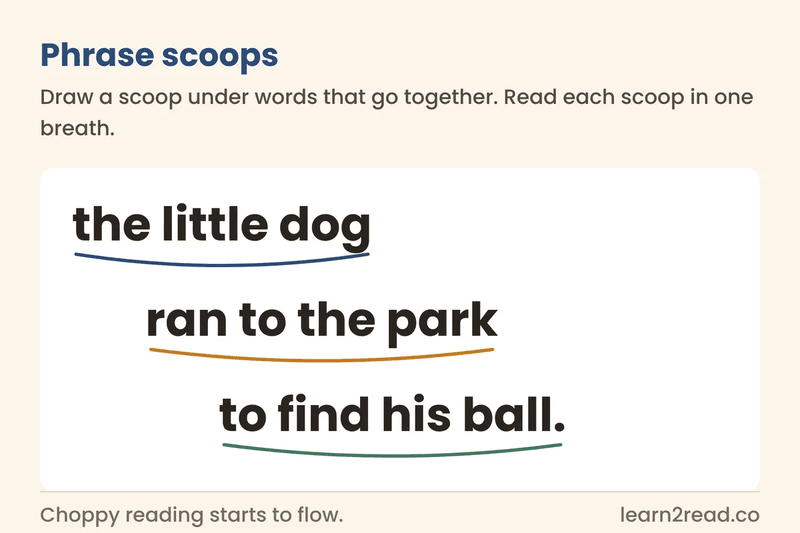
Add phrase scoops. Teachers call this phrase-cued text. With a pencil, draw a curved line under each group of words that belong together: "the little dog / ran to the park / to find his ball." Your child reads each scoop as one breath.
This is often the moment choppy reading starts to flow.
Make the dots talk. Read "the dog ran." and let your voice drop at the dot. Then read "did the dog run?" and let it go up. Ask your child to copy both, because full stops and question marks are instructions for the voice.
Practise the small words. Words like the, was, said, of and you appear on almost every page.
Most of them can be partly sounded out, so point to the part that follows the sounds, flag the tricky letter, then spend two minutes a day until they're instant. Our guide to sight words shows how.
Try it tonight. Pick a page your child has already read.
Read the first sentence the way you'd say it to a friend, and ask your child to "make it sound like me". That's it.
Do's and Don'ts When Your Child Reads Word by Word
The biggest change parents can make for a word-by-word reader is to read the sentence aloud first, so the child knows what smooth reading sounds like. Most of us were taught to listen and correct. With a choppy reader, showing works better than correcting.
|
Don't |
Do this instead |
Why |
|
Say "read faster!" |
Say "make it sound like talking" |
Rushing adds mistakes and stays flat |
|
Time them every night |
Notice when a page sounds smoother on the second read |
Timing makes children anxious and choppier |
|
Move to a new book every night |
Re-read the same page or book across a few days |
Repeated reading builds fluency |
|
Correct every small slip mid-sentence |
Let it go if the meaning holds, then re-read the sentence |
Stopping breaks the phrase you're trying to build |
|
Only listen to your child read |
Read aloud to them too, every day |
Children copy the reading voice they hear |
Reading aloud to your child doesn't stop once they can read. Hearing you read is how they learn what a sentence should sound like. Our guide to reading aloud to your child covers how long and how often.
When Should You Worry?
Word-by-word reading needs a closer look when a child in class 2 or above still sounds out most short, common words, or stays laboured after six to eight weeks of daily re-reading on easy books (a practical guide, not a clinical cut-off). Before that, it is very common in the first year or two of learning to read.
If you keep asking "why does my child read so slowly?" even on easy books, check the list below. Talk to the class teacher at the next PTM (parent-teacher meeting), and to your paediatrician if they suggest it, if any of these are true:
-
By class 2 or Grade 2, your child still has to sound out most short, common words letter by letter.
-
Reading stays slow and laboured after six to eight weeks of the routine above, even on easy books.
-
Your child can't tell you what a page was about, even after reading it smoothly.
-
Your child gets upset or avoids reading aloud, or a close family member had serious reading difficulties.
None of these is a diagnosis. Our guide to the early signs of dyslexia explains what each one can mean and who to ask.
At Learn2Read, a live online phonics programme for children aged 3 to 12, children read aloud to a teacher in live classes, and re-reading the same text until it flows is part of the lesson.
FAQs
Is reading word by word a sign of dyslexia?
Not on its own. Most children read word by word for a while after they learn to blend. It is worth checking if, by class 2, a child still sounds out most short words, or reading stays laboured after weeks of daily re-reading on easy books. Talk to the class teacher first, and to a paediatrician if they suggest it.
Is it normal for a child to read word by word?
Word-by-word reading is a normal stage for children in their first year or two of learning to read. It usually means the child can decode words but cannot yet read them automatically. Most children move past it with repeated reading of easy texts and plenty of listening to fluent reading.
What is reading fluency in simple words?
Reading fluency is reading accurately, at a comfortable pace and with natural expression. The Education Endowment Foundation defines it as the ability to read with accuracy, automaticity and prosody. A fluent reader sounds like someone talking, with pauses at full stops and commas.
How many words per minute should a child read in class 2?
In US norms by Hasbrouck and Tindal (2017), a typical second grader reads about 50 words correctly per minute at the start of the year and about 100 by the end. These are US grade-level figures, so use them as a rough guide only. Smooth phrasing and understanding matter more than speed.
How can I improve my child's reading fluency at home?
Use echo reading: read a sentence aloud with expression and have the child repeat it. Then read the page together, let the child read it alone, and finish with one or two more re-reads. Ten minutes a day on an easy page, plus daily reading aloud to the child, builds fluency.
Should I make my child read faster?
Pushing a child to read faster usually adds mistakes and keeps the reading flat. Fluency grows from accuracy and repeated practice, and speed follows on its own. Ask the child to make the reading sound like talking, and praise smoothness and expression over speed.
Read Next
-
How to Teach Blending: When Your Child Knows the Sounds but Can't Read the Word: for a child who is still sounding out most short words.
-
My Child Can Read But Doesn't Understand: the next question once reading sounds smooth.
-
Reading Aloud to Kids: How Long, How Often, When to Stop: why your voice is still your child's best reading model.
-
Sight Words for Kids: How Many and How to Teach Them: the small words that make sentences flow.
-
Decodable Books: A Parent's Complete Guide: books your child can re-read without guessing.
-
Why Your Child Guesses at Words: for a child who invents words to keep the sentence moving.
If your child can read words but not sentences, they've done the hardest part: they can read the words. Ten minutes of listening and re-reading a day joins them up. If you'd like a teacher to help your child read smoothly, book a free trial class.

Latest Posts
21 October 2026
Child Skips Words When Reading? Causes and Fixes for Class 1
17 October 2026
My Child Knows the Alphabet (ABCD) but Can't Read: Letter Names vs Letter Sounds, Ages 3 to 6

14 October 2026
How to Teach a Child to Write Sentences ?

A new chapter from Learn2Read
Read Before They Read
Before you teach your child to read, read this. A calmer, clearer way into your child’s reading journey—with a practical guide written for real Indian homes.

