18 November 2026
Child Refuses to Read at Home? Check the Book First, Age 4-8
Child Refuses to Read at Home? Check the Book First, Age 4-8
posted on : 7 November 2026
By Nitin Jain, Founder, Learn2Read · Published 7 November 2026
Nitin Jain founded Learn2Read, which teaches live online phonics classes to children aged 3 to 12. Sources checked against the UK Department for Education's Reading Framework, the National Literacy Trust's 2025 reading survey, Scholastic's Kids and Family Reading Report and the NHS. Last reviewed: 7 November 2026.
The teacher says your child reads nicely in class. At home, the reading book comes out of the bag and the shutters come down. Tears, wriggling, "I'm tired", or reading so badly it sounds deliberate.
If your child refuses to read at home but reads at school, the cause is usually the book or the moment, not laziness. The home book is often too hard to read alone, reading at home has started to feel like a test, or it arrives at the most tired hour of the day. Fix those, and many children start reading at home again.
You're not alone in this. One mother on Mumsnet wrote that her son "gets shouty/distressed or just stays in silence" at home, and that at school "they don't see the way he is at home."
This guide covers the six most common reasons, a one-page check to see if the book is too hard, what to say in the moment, a 10-minute routine, and when refusing to read is worth a closer look. It's written for parents of children in UKG, class 1 and class 2 in India, KG2 to grade 2 in the Gulf, and Reception to Year 3 elsewhere.
In this guide:
Why does my child read at school but refuse at home? · Is the reading book too hard? · What to say · A calm 10-minute routine · Do's and don'ts · Keep reading aloud · When to worry
Why Does My Child Read at School but Refuse at Home?
A child who refuses to read at home but reads at school is usually reacting to something about home reading itself. These are six common reasons, with the easiest to check first.
1. The book is too hard to read alone. At school a teacher helps with tricky words, but at home your child faces a whole page on their own. If more than 1 word in 10 is a struggle, reading feels like failing.
2. The book doesn't match the phonics they've been taught. The UK Department for Education's Reading Framework says early readers should be "reading books matched closely to their phonic knowledge". Some home readers are full of spelling patterns the class hasn't reached yet.
3. Reading to you feels like a test. At school, reading is part of the day, but at home a parent sits close, stops at every mistake and waits. Even a loving "no, look again" ten times in five minutes adds up.
4. It's the wrong hour. A 5 year old refusing to read at 6 pm has often held it together all day at school, and has nothing left. Our post on after-school meltdowns explains why.
5. They didn't choose the book. In Scholastic's 2019 Kids and Family Reading Report, 89% of children agreed that their favourite books are the ones they picked themselves. The school reader is rarely one they'd pick.
6. Reading has become the only time you sit together, and it's work. If the reading book is the main one-to-one time a child gets with a busy parent, and that time is always a correction session, refusing it makes sense.
Many children have more than one of these at once, and a reluctant reader at home is often a confident one at school. Check number 1 first, because it's the easiest to fix.
Reason | Quick check | Fix tonight |
Book too hard | More than 2 slips on a page of 20 words | Read it to your child, ask the teacher for an easier book |
Book doesn't match their phonics | Lots of words with sounds they haven't learned | Ask for a decodable book at the PTM |
Feels like a test | You correct every slip | Help only after a three-second wait |
Wrong hour | Reading starts the minute they're home | Snack and a break first |
No choice | You always pick the book | Offer a choice of two |
Only time together | Reading is your main one-to-one time | Add five minutes a day that has nothing to do with the reading book |
Is the UKG or Class 1 Reading Book Too Hard? The 1-in-10 Check
When a child refuses to read at home, check the book before anything else.
A book is too hard for reading alone when your child stumbles on more than 1 word in every 10. At 1 word in 20 or fewer, it's an easy, confidence-building book. In between, it's a book to read together.
Teachers call these the independent reading level, the instructional level and the frustration level. We've adapted the cut-offs below from McGraw Hill's reading-level guidance for its Corrective Reading programme.
Words read correctly | What it means | What to do |
95% or more (1 slip in 20 words or fewer) | Easy. Your child can read it alone | Use it for home reading and re-reading |
90% to 94% (about 2 slips in 20 words) | Just right with help | Read it together, taking turns |
Below 90% (more than 1 slip in 10) | Too hard to read alone | Read it to your child, or swap it |
If you've heard of the five-finger rule, this is the same idea, counted on a shorter stretch of about 20 words so it works for UKG and class 1 books.
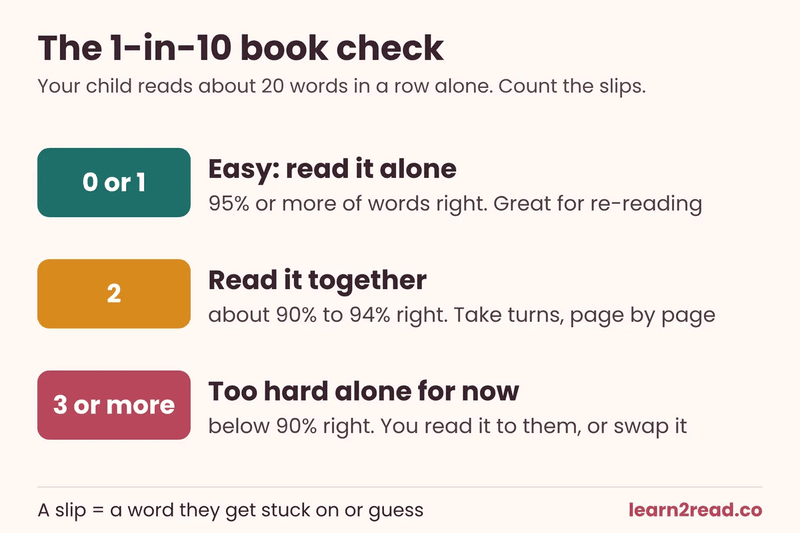
How to do it in two minutes: pick about 20 words in a row. In a UKG book that may mean two or three pages. Let your child read without help and count the words they get stuck on or guess.
Zero or one slip is easy. Two slips means read it together. Three or more means the book is too hard for now.
If the school book fails the check every week, tell the teacher at the next PTM and ask for a book that uses only the sounds your child has learned, often called a decodable book.
You could say:
"At home she can't read about 3 words in every 20 of this book. Could she have one that uses only the sounds she's learned?"
Meanwhile, read the hard book aloud to your child and let them read a single sentence, or one easier book.
What If the Book Passes the Check and They Still Refuse?
Then it's usually the moment or the audience. Let them read to a teddy, a grandparent on a video call or a younger sibling, and stay in the room without watching closely.
What Should You Say When Your Child Refuses to Read?
When your child won't read to you, or won't do the reading book at all, say less and offer a small choice between two ways of reading. A choice gives your child some control back, which is often what the refusal is about.
Phrases that help:
"Do you want to read the first page, or shall I?"
"This book or that one?"
"Read me just one page and then I'll read you a story."
"You read the short words, I'll read the long ones."
"Point to a word you know on this page."
Phrases that make it worse (most of us have said at least one of these on a tired evening):
"Your teacher says you read fine at school."
"You knew that word yesterday."
"We're not getting up until you finish."
"Your cousin is already reading chapter books."
When your child gets stuck on a word, wait three seconds, then help them sound it out: "What's the first sound?" If they still can't get it, just tell them the word and move on. Guessing from the picture is a habit worth gently stopping, and our post on why children guess at words shows how.
A Calm 10-Minute Home Reading Routine for Reluctant Readers
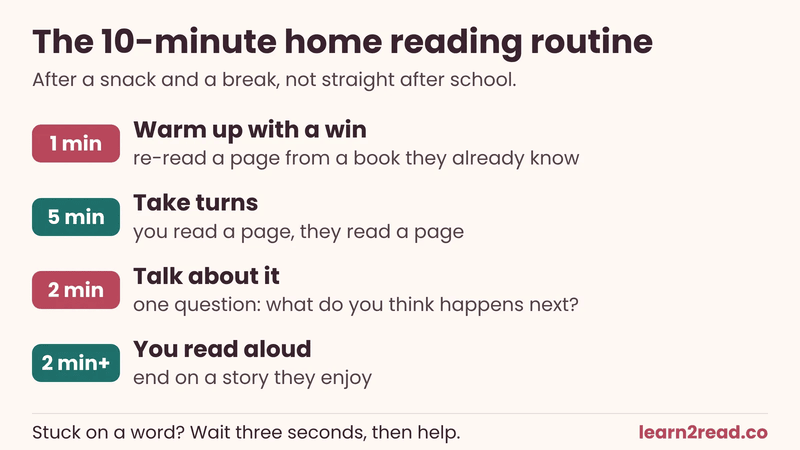
Keep home reading short, at a fixed calm time, and make it shared. For a reluctant reader aged 4 to 8, ten minutes of shared reading is a good place to start.
Pick the time. After a snack and a short break, or in the morning before school. Not straight after school, and not when they're already exhausted. Bedtime is still a good time for you to read to them.
Warm up (1 minute). Re-read a page from a book they already know well. Starting with a win matters.
Take turns (5 minutes). You read a page, they read a page. Or they read only the short sentences. Keep your corrections to the words they're stuck on.
Talk (2 minutes). One question about the story: "What do you think happens next?" No quizzing.
Your turn to read aloud (2 minutes or more). Finish by reading to them, so reading time ends on something they enjoy.
If English isn't your home language, you can still help. Whether you're in Jaipur, Dubai, London or Toronto, tell the story in your own language first, then let your child read the English words they know.
Choice helps too. Reading Rockets summarises motivation research by John Guthrie and Allan Wigfield: "providing genuine student choices increases effort and commitment to reading". Let your child pick one book in two, even if it's a comic or a book they've read twenty times.
Child Refuses to Read at Home: Do's and Don'ts
The biggest do is to check the book before blaming the child. The biggest don't is to correct every slip as it happens.
Do | Don't |
Check the book with the 1-in-10 check | Assume refusing means laziness |
Read the hard school book aloud to your child | Make them struggle through every word alone |
Offer a choice of two books | Use reading as a punishment or a condition for screen time |
Read at a fixed calm time, after a snack | Start reading the minute they walk in from school |
Help with a stuck word after three seconds | Correct every slip as it happens |
Keep reading aloud to them every day | Stop reading aloud because they "can read now" |
Tell the teacher what you see at home | Compare them with siblings or cousins |
Should You Still Read Aloud to a Child Who Can Read?
Yes. Reading aloud to your child keeps books feeling like a treat while their own reading is still hard work.
Many parents stop just when it matters. Scholastic found that reading aloud peaks at age five, and when parents were asked why they stopped, the most common answer was that their child could now read alone. The UK's Reading Framework says children "benefit hugely from listening to family members reading aloud to them".
It also helps to know that fewer young children read every day than you might think. The National Literacy Trust's 2025 survey found that among 5 to 8 year olds, daily reading dropped to 44.5%. Our guide to reading aloud to your child covers how long and how often by age.
When to Worry About Reading: Is Refusing a Sign of Something More?
Refusing to read is usually about the book or the routine. It's worth looking closer if your child still avoids all reading after a few weeks of easier books and calm routines, or if they also struggle to link letters to sounds or to blend sounds into words.
The NHS lists signs such as "reading at a level below what's expected" for their age and being slow and hesitant when reading aloud. These are reasons to talk to the class teacher, not reasons to panic.
If your child refuses to read at home for weeks, ask your paediatrician to check eyesight and hearing too, because a child who can't see the page clearly will avoid it. Our guide to the early signs of dyslexia explains what to watch for between 4 and 7.
FAQs
Why does my child read at school but not at home?
If your child reads at school but not at home, they are usually reacting to the book or the hour, not to reading itself. The home book may be too hard to read alone, reading with a parent can feel like a test, and after a full school day many young children are too tired. Easier books, a calm fixed time and taking turns often help.
How do I know if my child's reading book is too hard?
Ask your child to read about 20 words in a row without help and count the words they get stuck on. One slip or fewer means the book is easy enough to read alone, two slips means read it together, and three or more slips means the book is too hard for independent reading for now.
Should I force my child to read every day?
Forcing a child to read usually makes refusal worse. A short daily routine works better: about ten minutes at a calm time, a choice of two books, taking turns page by page, and ending with the parent reading aloud. The aim is to keep daily contact with books without a fight.
What should I do if my child refuses to read their school reading book?
Check whether the school reading book is too hard by counting slips on one page. If it is, read it aloud to your child and let them read one sentence or page. Tell the class teacher and ask for a book that matches the phonics sounds your child has already learned.
Should I keep reading aloud to my child once they can read?
Yes. Reading aloud to a child who is learning to read keeps stories enjoyable while their own reading is still slow. Scholastic found that reading aloud at home peaks at age five, and many parents stop once a child can read alone, which is often just when they need it most.
My child is not interested in reading at home. What should I do?
Start by checking the book with the 1-in-10 check, because a book that is too hard is the easiest cause to check and fix. Then offer a choice of two books, read at a calm time after a snack, and take turns page by page. Comics and favourite re-reads count too.
When should I worry that my child refuses to read?
It is worth talking to the class teacher if a child still avoids all reading after a few weeks of easier books and calm routines, or also struggles to match letters to sounds and blend them into words. A paediatrician can check eyesight and hearing, which can make reading uncomfortable.
Read Next
What to Ask Your Child's Teacher About Reading: what to say at the next PTM if the book keeps failing the check.
How to Make Your Child Love Reading: the long game, once the daily fight has stopped.
Decodable Books: A Parent's Complete Guide: the kind of book a reluctant early reader can actually read alone.
Why Your Child Guesses at Words: if your child reads but makes up words along the way.
Homework Battles: 7 Do's and Don'ts for Ages 5 to 8: when worksheets and spellings cause the fight too, not just the reading book.
If your child refuses to read at home, start with the book and the hour, not with willpower. Many children come round once reading feels possible again. If you'd like a teacher to rebuild your child's confidence with books at the right level, book a free trial class.

Latest Posts
14 November 2026
How Many Words Per Minute Should a 6 Year Old Read? (2026)
11 November 2026
When Do Kids Stop Sounding Out Words? UKG to Class 2 Guide
7 November 2026
Child Refuses to Read at Home? Check the Book First, Age 4-8

A new chapter from Learn2Read
Read Before They Read
Before you teach your child to read, read this. A calmer, clearer way into your child’s reading journey—with a practical guide written for real Indian homes.