
21 October 2026
Child Skips Words When Reading? Causes and Fixes for Class 1
Child Skips Words When Reading? Causes and Fixes for Class 1
posted on : 21 October 2026
By Nitin Jain, Founder, Learn2Read · Published 21 October 2026
Nitin Jain founded Learn2Read, which teaches live online phonics classes to children aged 3 to 12. Sources checked against the American Academy of Ophthalmology, the American Academy of Pediatrics and the National Reading Panel. Last reviewed: 21 October 2026.
The page says "we went to the park." Your child reads "we went to park."
A line later, the "a" vanishes. Then a whole line goes missing, the story jumps ahead, and your child doesn't notice at all.
Maybe the class teacher wrote it in the report card: "Reads well but skips words. Needs to be more careful."
If you're thinking "my child skips words when reading, what am I doing wrong?", the answer is probably nothing.
In children aged 5 to 8 skipping usually comes from one of five things: small words that carry little meaning, eyes that run ahead of the voice, a book that is too hard, losing their place on the line, or being pushed to read fast. Each cause has its own fix, and most take ten minutes a day.
This guide shows you how to tell which cause you're dealing with, what to say in the moment, and when it's worth an eye test or a word with the teacher. It's written for children in UKG to class 3 in India, KG2 to Grade 3 or Year 3 in the Gulf, and Reception to Year 3 or kindergarten to Grade 3 in the UK, US and Canada.
In this guide:
Why does my child skip words? · Which kind of skipping is it? · Is skipping words a sign of dyslexia? · How to stop a child skipping words · What to say when your child skips a word · When should you worry?
Why Does My Child Skip Words When Reading?
A child who skips words is usually following the meaning of the story and letting the small words slip, or their eyes are moving faster than their reading skill. That's why the words that vanish are so often short ones like the, a, of, was and to. They're easy to miss, and the sentence still makes sense without them. Eye-tracking research with skilled readers by Keith Rayner and colleagues (2011) found that word length and predictability both have strong effects on which words get skipped.
Here are the five common causes and how each one shows up at home.
| Cause | What you'll notice | Quick fix |
| Small words feel unimportant | Drops the, a, of and is, but reads long words fine | Practise the small words as a set, then re-read the sentence |
| Eyes run ahead of the voice | Reads fast, skips and adds words, the story still makes sense | Slow down with a finger or a card under the line |
| The book is too hard | Skips words it can't read, stops often, gets tired | Swap to an easier book for practice |
| Loses place on the line | Misses a whole line or reads one line twice | Card under the line, and an eye test if it keeps happening |
| Rushed for speed | Skips more when timed, or when praised for being fast | Praise careful reading |
A mix is common. A child might drop small words in an easy book and skip the long words in a hard one.
Skipping small words often shows up just as a child stops reading word by word and starts reading for meaning. Their eyes have got ahead of their voice. The fix is to bring the eyes back to the print.
Skipping is different from guessing, though the two often travel together. A child who guesses looks at the first letter or the picture and says a word that fits. If that sounds more like your child, our guide on why children guess at words covers that habit.
Which Kind of Skipping Is It? A Five-Minute Listening Test
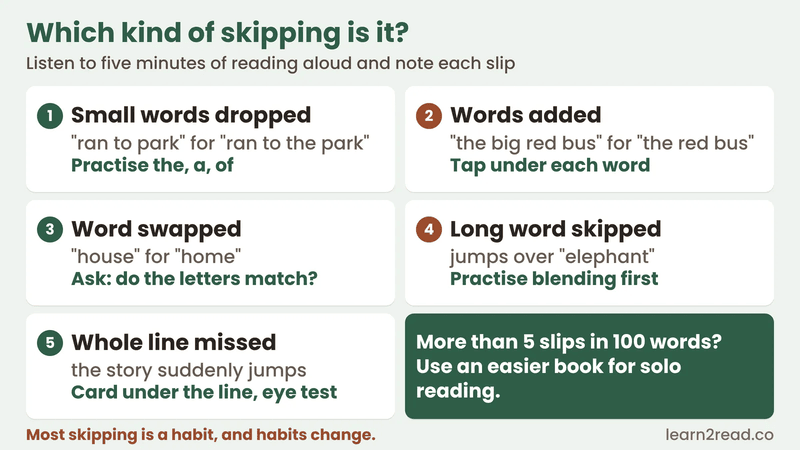
Most skipping falls into five patterns you can hear: dropped small words, added words, swapped words, skipped long words and missed lines. To find your child's pattern, sit beside them for five minutes while they read aloud from a book at their school level, and quietly note each slip on a piece of paper.
Teachers use a version of this called a running record (a written note of every slip a child makes while reading aloud). Don't correct anything during the test. You are only listening. Mark a small pencil dot above each slip, then count the dots in the first 100 words.
| What you hear | Example | What it usually means |
| Small words dropped | "the dog ran to park" for "the dog ran to the park" | Reading for meaning; small words not automatic yet |
| Words added | "the big red bus" for "the red bus" | Eyes ahead of the voice, or telling the story from memory |
| A word swapped for one that means the same | "house" for "home" | Reading the meaning more than the print (see guessing, below) |
| A long word skipped | Jumps straight over "elephant" | Your child can't yet blend that many sounds |
| A whole line missed | The story suddenly jumps | Losing place; check eyesight if it happens often |
If long words are the ones vanishing, our guide on how to teach blending shows how to build up from three sounds to longer words.
Now count the slips in about 100 words. As a practical home guide, a child who misses more than about 5 words in every 100 when reading alone needs an easier book for solo practice.
That matches the old 95 to 98 percent accuracy rule. Timothy Shanahan, professor emeritus at the University of Illinois Chicago, notes the rule was never validated by research, and that children can learn from harder books when they get support while reading. So keep the harder books for reading together.
Is Skipping Words a Sign of Dyslexia?
On its own, skipping words when reading is usually not a sign of dyslexia, so if you have searched "my child skips words when reading, is it dyslexia?", the short answer is usually no. Dyslexia mostly shows up as real trouble with sounds: linking letters to sounds, blending sounds into words, and remembering how words are spelled. A child who reads "elephant" well and drops "the" has a different problem.
Eyesight is a separate question. The American Academy of Ophthalmology lists "losing their place when reading" as one of four hidden signs of a vision problem in children, along with a short attention span, avoiding close-up activities and turning the head to the side.
If your child loses place when reading, keeps skipping lines while reading, holds the book very close or squints, book an eye test with an eye doctor. It's quick, and it settles the question.
Be wary of anyone selling eye exercises as a cure for reading problems. A 2009 joint statement from the American Academy of Pediatrics and children's eye specialists, summarised by Reading Rockets, says "vision problems are not the cause of primary dyslexia or learning disabilities", and that eye exercises, vision therapy and tinted lenses are not supported by scientific evidence.
If your child also struggles to sound out short words, read our guide to the early signs of dyslexia and speak to the class teacher and your paediatrician.
How to Stop a Child Skipping Words: A 10-Minute Routine
The quickest way to stop a child skipping words when reading is to slow their eyes down to the print: a book they can read, a finger or card under the line, and a second read of each page. Do it for ten minutes a day, four or five days a week.
Step 1: Pick the right book. For reading alone, choose a book where your child slips on fewer than 5 words in 100. For a child in UKG or class 1 who is still learning sounds, that usually means a decodable book, which is built only from sounds they have already learned. Our guide to decodable books explains how to choose one.
Step 2: Tap each word, or use a card (finger tracking). Ask your child to tap under each word as they say it, or hold a plain card or bookmark under the line. The finger and the voice have to move together, which makes skipping hard. Drop the finger once the skipping stops, because it slows down a confident reader.
Step 3: Read each page twice. After each page, ask your child to read it again. The second read is usually smoother and more accurate. The National Reading Panel, a US government review of reading research, found that repeated oral reading with guidance from teachers, peers or parents had a positive impact on word recognition, fluency and comprehension.
Step 4: Teach the small words as a set. Words like the, a, of, was, to, said and you turn up on almost every page, and when a child skips small words when reading, it's usually because they don't know them instantly yet. Spend two minutes a day on them: sound out the parts that follow the rules, point out the tricky letter (the "o" in of), then read each word from a card until it comes instantly. Our guide to sight words shows the quickest way to do this.
Step 5: Record one page. Record your child reading one page on your phone, then play it back while they follow the print with a finger. Ask, "Did you hear a word go missing?" Children often catch their own skips by ear far faster than they accept being told.
Step 6: Praise care. Say "You read every word on that page." Skip "Wow, you're so fast!" Children aim at whatever we praise.
If your child also reads Arabic or Urdu, which run right to left, a finger at the left edge of each English line is a handy reminder of where to start. Practise before dinner, when your child is fresh, rather than at bedtime.
What to Say When Your Child Skips a Word
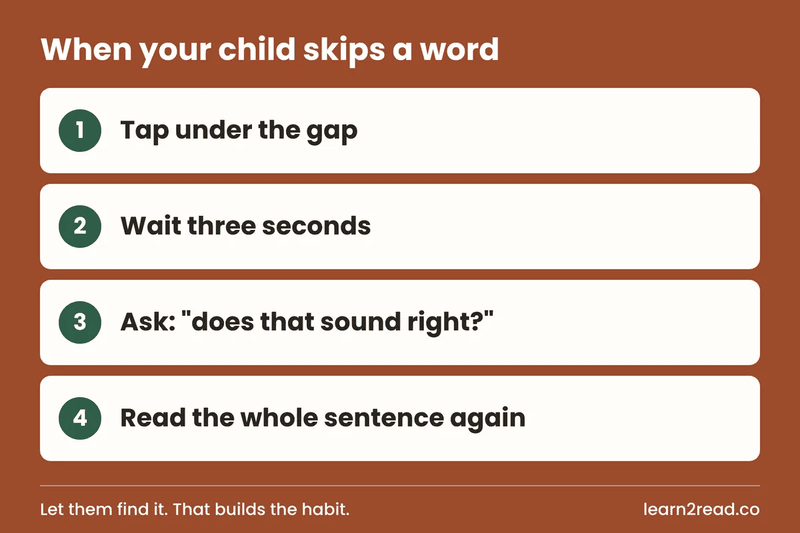
When your child skips a word, tap under the spot and wait three seconds before saying anything. Many children spot the gap themselves, and finding it on their own is what builds the habit of checking. If they don't find it, ask "Does that sound right?" and have them read the whole sentence again.
| Don't | Do this instead | Why |
| Say "No, you missed 'the'!" | Tap under the missed word and wait | Finding it themselves sticks better |
Read the word for them straight away | Ask "Does that sound right? Look again." | Turns their attention back to the print |
| Stop them after every slip | Let a small slip go if the meaning is right, then re-read the sentence at the end | Constant stopping kills the story |
| Call it careless or lazy | Say "Your eyes went faster than your voice. Let's slow them down." | Names the cause without shame |
| Time them with a stopwatch | Notice the words read correctly | Speed pressure makes skipping worse |
Most of us have said "you're being careless" at least once. It's a natural reaction, and it doesn't help much.
A child who skips words isn't choosing to. Their eyes are doing what eyes do when the brain already knows where the sentence is going.
Try this tonight. Pick one page your child has read before. Put a card under the first line and say, "Let's see if your finger and your voice can stay together all the way down." Then stop. One page is enough.
My Child Skips Words When Reading: When Should You Worry?
If my child skips words when reading at six or seven, is that a problem? Usually not: skipping a few small words is very common between ages 5 and 7 and fades as reading becomes automatic. Worry only when it continues after six to eight weeks of easier books and finger tracking, or comes with lost lines or squinting. For what's typical at each age, see our reading milestones by age.
Talk to the class teacher at the next PTM (parent-teacher meeting), using our list of questions to ask your child's teacher about reading, and see a doctor where noted, if any of these are true:
Your child still skips many words after six to eight weeks of easier books, finger tracking and re-reading.
They often lose their place, hold the book very close, squint, or turn their head to one side. Book an eye test.
They skip words because they can't sound them out, even short ones like pet or mud.
Reading aloud makes them anxious, or they now avoid books they used to enjoy.
None of these is a diagnosis. They are reasons to look more closely.
At Learn2Read, a live online phonics programme for children aged 3 to 12, children read aloud to a teacher in live classes. If the words your child skips are ones they can't sound out, the real fix is phonics: knowing the sounds and blending them, which is what our classes teach.
FAQs
Why does my child skip small words like "the" when reading?
Children skip small words like the, a and of because those words carry little meaning, so the sentence still makes sense without them. A child who is focused on the story, or whose eyes run ahead of their voice, lets them slip. Practising small words until they are instant, and re-reading each page, usually fixes it.
Is skipping words when reading a sign of dyslexia?
Not usually. A child with dyslexia tends to struggle to sound out words, so they skip words they cannot decode, even short ones like pet or mud. A child who reads long words well but drops the and a is showing an attention habit. If both happen, talk to the class teacher and a paediatrician.
How do I stop my child skipping lines when reading?
Hold a plain card or bookmark under the line being read and slide it down one line at a time. If a child often loses their place, holds books very close or squints, book an eye test, because the American Academy of Ophthalmology lists losing place while reading as a hidden sign of a vision problem.
Should my child use a finger to follow the words?
Tapping under each word helps a beginning reader keep the eyes and the voice together, which cuts skipping. It is a good habit for children aged 5 to 7 who skip or lose their place. Once a child reads accurately, the finger can go, because it slows a confident reader down.
Is it normal for a 6-year-old to skip words when reading?
Yes. Many children aged 5 to 7 drop small words while their reading is still slow and effortful, and it usually fades as words become instant. If a 6-year-old skips words they can't sound out, or skips whole lines, talk to the class teacher and book an eye test.
Why does my child add words that aren't on the page?
When a child adds words when reading, they are usually telling the story from memory or from the meaning, and their eyes run ahead of the print. Adding "big" to "the red bus" shows good understanding but loose attention to the words. Pointing under each word and re-reading the sentence brings attention back to the print.
At what age should a child stop skipping words when reading?
There is no fixed age. Skipping usually fades as word reading becomes automatic, which for many children happens during the first two or three years of school. A child who still skips many words after several weeks of daily practice should have an eye test and a chat with the class teacher.
Read Next
- Why Your Child Guesses at Words (and How to Stop It): for when your child says a word that fits instead of the word on the page.
- Sight Words for Kids: How Many and How to Teach Them: the small, frequent words that get skipped most.
- Decodable Books: A Parent's Complete Guide: how to find books your child can read without skipping.
- Early Signs of Dyslexia in Children: for when the skipping comes with trouble sounding words out.
If you've been thinking "my child skips words when reading" for months, ten calm minutes a day c
an change it. If you'd like a teacher to listen to your child read and help them slow down, book a free trial class.

Latest Posts
17 October 2026
My Child Knows the Alphabet (ABCD) but Can't Read: Letter Names vs Letter Sounds, Ages 3 to 6

14 October 2026
How to Teach a Child to Write Sentences ?
10 October 2026
b and d Confusion: Is It Dyslexia? How to Fix It (Ages 4-7)

A new chapter from Learn2Read
Read Before They Read
Before you teach your child to read, read this. A calmer, clearer way into your child’s reading journey—with a practical guide written for real Indian homes.

