

14 October 2026
How to Teach a Child to Write Sentences ?
How to Teach a Child to Write Sentences ?
posted on : 14 October 2026
By Nitin Jain, Founder, Learn2Read · Published 14 October 2026
Your child reads a whole storybook to you at bedtime. The next afternoon the homework says "Write three sentences about your weekend." Forty minutes later the page holds "I went" and a hole where the eraser went through.
If your child can read but can't write a sentence, nothing is wrong with their brain or their effort. Writing a sentence asks a five or six-year-old to do four separate jobs at the same moment, and reading only asks for one of them.
This guide shows you how to teach a child to write sentences by pulling those four jobs apart, practising them one at a time, and joining them back up. It takes about ten minutes a day, and you can start tonight.
In this guide:
Why can my child read but not write a sentence? · What should a class 1 child be able to write? · How to teach a child to write sentences at home: say it, build it, write it, stretch it · Sentence making for class 1: frames to start with · What to stop doing at the homework table · What about spelling mistakes? · When is it more than practice?
Why Can My Child Read but Not Write a Sentence?
A child who can read but can't write a sentence is usually stuck on one of four jobs writing demands at once: thinking of the idea, holding the words in order, getting each word onto paper, and marking where the sentence starts and stops. Reading uses the letters someone else already chose. Writing makes your child choose every one.
Picture what happens when a six-year-old, say Aarav, tries to write "We went to the park and I saw a dog." He has to hold all ten words in his head.
Then he has to work out how to spell "went", remember which way round a "d" goes, form each letter, leave a space, and come back to the sentence. By the time "park" is on the page, the rest of the sentence has gone.
The US Institute of Education Sciences reviewed the research on young writers for its What Works Clearinghouse practice guide, Teaching Elementary School Students to Be Effective Writers (2012). One of its four recommendations is to teach children to become fluent with handwriting, spelling, sentence construction, typing and word processing. Reading Rockets' summary of that guide gives the reason in one line: when basic writing skills become relatively effortless, children can focus "more on developing and communicating their ideas."
|
The job |
What you see when it's the stuck one |
A 30-second test |
|
Thinking of the idea |
Blank page, "I don't know what to write" |
Ask "What was the best bit of Sunday?" Can they tell you? |
|
Holding the words in order |
Starts well, sentence falls apart halfway |
Ask them to say the sentence twice, the same way both times |
|
Getting words onto paper |
Slow, painful letters; avoids words they can't spell |
Dictate four easy words. Watch the pencil, not the spelling |
|
Starts and stops |
One long line joined with "and then and then" |
Ask "Where does your first sentence end?" |
In our classes, the idea is usually there. It gets lost on the way down the pencil.
Screenshot this table and run the four tests before tonight's homework.
My 6-Year-Old Can't Write a Sentence: What Should a Class 1 Child Be Able to Write?
By around age 6 to 7 (class 1 in India, Grade 1 in the US, Canada and many Gulf schools, Year 1 to Year 2 in the UK), most children can say a sentence out loud and then write it, and many are starting to use a capital letter and a full stop. Progress varies, so treat these as typical ranges.
The English national curriculum puts it plainly. Its Year 1 writing requirements, for children aged 5 to 6, include "composing a sentence orally before writing it", "joining words and joining clauses using 'and'" and "beginning to punctuate sentences using a capital letter and a full stop, question mark or exclamation mark".
Notice the word "beginning". Nobody expects perfect punctuation at six.
|
Age and class |
What most children can typically write |
What's still normal |
|
5 (UKG in India, KG2 in the Gulf, Reception or Year 1 in the UK, Kindergarten in the US) |
Their name, single words, a short phrase with sounded-out spelling |
Missing spaces, letters reversed, no full stops |
|
6 (class 1 in India, Grade 1 in the US and Canada, Year 1 to 2 in the UK) |
One or two simple sentences they said out loud first |
Spelling by sound ("becos", "frend"), one long sentence joined with "and" |
|
7 (class 2 in India, Grade 2, Year 2 to 3 in the UK) |
Three to five connected sentences on one topic, joined with "and", "but", "because" |
Capital letters in the middle of words, the odd missing full stop |
If your child is five and writes "i lik my dog", that is a good sentence for five. Three letter-sound spellings in a row show their phonics is working.
How to Teach a Child to Write Sentences at Home: Say It, Build It, Write It, Stretch It
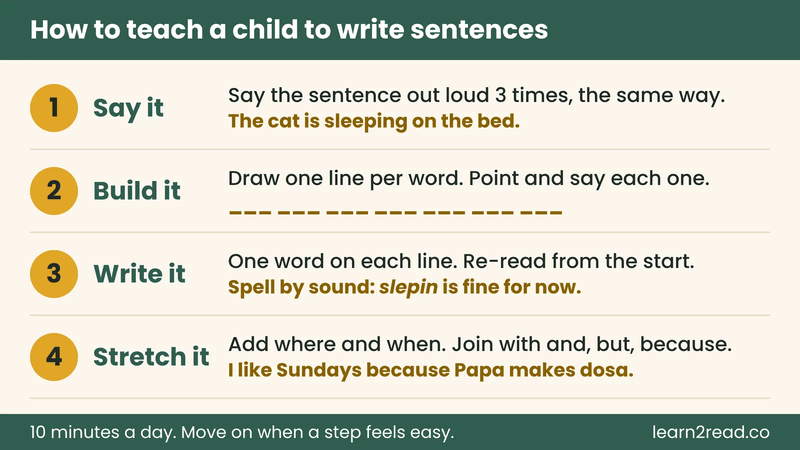
The fastest way to teach a child to write sentences is to separate saying the sentence from writing it, so your child's memory handles one job at a time. Practise four steps for about ten minutes, four or five days a week:
-
Say it: your child says the sentence out loud three times, the same way.
-
Build it: draw one line per word.
-
Write it: one word per line, re-reading from the start each time.
-
Stretch it: add where and when, then join with and, but, because.
Some children are ready to move on in a few days and others need a few weeks. Move to the next step when the current one feels easy.
Before you start, show it once yourself: write one sentence of your own while your child watches, and think out loud: "I'll say it first. Capital letter. Now the full stop. Let me re-read it."
One minute is enough.
Step 1: Say it (oral sentences, no pencil)
Every sentence is spoken before it is written. Ask one small question with a picture or a real thing in front of you: "What is the cat doing?" Your child answers in a full sentence: "The cat is sleeping on the bed."
Repeating the sentence is the step that matters most. Ask them to say it again, exactly the same way, and once more while counting each word on a finger.
If they can say it the same way three times, they own it, and the sentence won't leave them halfway through writing it.
Do this at dinner or in the car. No paper at all for the first week. If English isn't the main language at home, play this game in English for five minutes and let everything else at dinner happen in your own language.
Step 2: Build it (one line per word)
Draw one short line on the page for each word in the spoken sentence. "The cat is sleeping on the bed" gets seven lines. Your child points to each line and says the word that goes there.
This turns a cloud of words into seven small jobs. It also teaches spaces between words without you ever saying "leave a space", because each word now has its own place to go.
Step 3: Write it (one word at a time)
Now your child writes one word on each line. They say the word, write it, then re-read the sentence from the start before writing the next word. That re-read is what stops the sentence falling apart.
For a word they can't spell, say "Write the sounds you hear" and move on. Teachers call this invented spelling, and slepin on the line is a win at this stage. You fix spelling later, and only one word (more on that below).
When the last word is down, they put the full stop at the end and check the first letter is a capital. Then they read the whole thing back to you.
Step 4: Stretch it (write longer sentences)
Once one sentence is easy, teach them to grow it with two question words: where and when.
"The cat is sleeping." Where? "The cat is sleeping on my bed." When? "This morning, the cat is sleeping on my bed."
Then add joining words, one per week: "and", then "but", then "because". "Because" is the one that turns a list into thinking: "I like Sundays because Papa makes dosa."
Sentence Making for Class 1: Frames to Start With
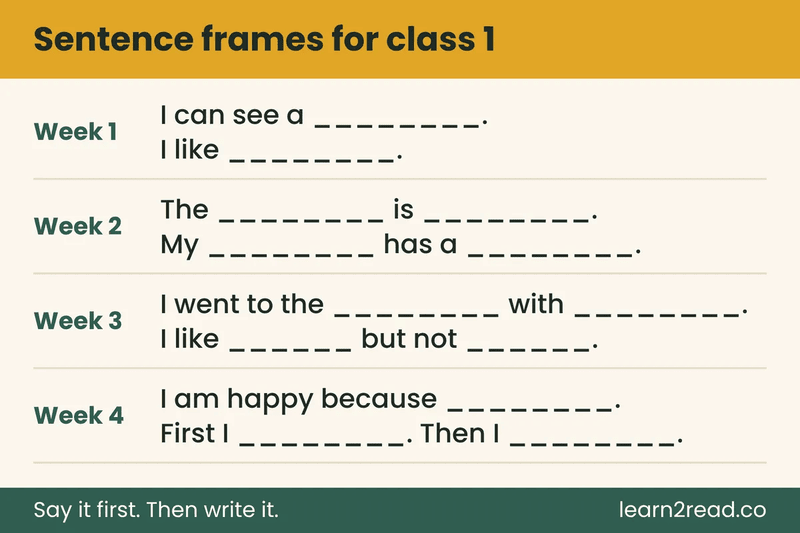
Sentence frames for kids are sentences with a gap your child fills in, so they practise the full shape of a sentence before they have to invent it. Frames are the honest version of a sentence making worksheet for class 1 or UKG: the structure is given, the thinking is theirs.
|
Week |
Frame |
Your child might write |
|
1 |
I can see a ____. |
I can see a red bus. |
|
1 |
I like ____. |
I like mangoes. |
|
2 |
The _ is _. |
The sky is grey. |
|
2 |
My _ has a _. |
My dadi has a green bag. |
|
3 |
I went to the _ with _. |
I went to the park with Zara. |
|
3 |
I like _ but not _. |
I like rice but not bitter gourd. |
|
4 |
I am happy because ____. |
I am happy because it is Saturday. |
|
4 |
First I _. Then I _. |
First I woke up. Then I brushed my teeth. |
Use each frame out loud first (Step 1), then on lines (Step 2). After a fortnight, take the frame away and ask for "a sentence like that one, about something else". That's the moment you see the shape stick, and it's the heart of how to teach a child to write sentences.
A note on capitals: in this post the example sentences start with a capital letter and end with a full stop, because that is the skill being taught. For letter sounds and spelling practice, we keep to lowercase.
What to Stop Doing at the Homework Table
Four homework habits make sentence writing harder: giving a topic that's too big, correcting spelling mid-sentence, dictating sentences to copy, and asking for three sentences on day one. Each one is easy to swap.
|
Don't |
Why it backfires |
Do this instead |
|
"Write about your holiday." |
The topic is too big, so your child can't pick a first sentence |
"Tell me one thing you saw at Nani's house." |
|
Correct spelling while they write |
They lose the sentence every time you interrupt |
Let them finish, then fix one word together |
|
Dictate the sentence for them to copy |
Copying is handwriting practice, not writing |
They say it, you draw the lines, they write it |
|
Ask for three sentences on day one |
Three new sentences is three times the load |
One sentence done well, then stop |
Copying from the board has its place. A child can copy beautifully for a year and still freeze at a blank line. If homework has become a nightly fight, our guide to homework battles covers the bigger picture.
What About Spelling Mistakes?
Let your child spell words the way they sound while they write, then correct one word afterwards. Stopping a sentence to fix spelling teaches a child that writing means getting words wrong, and they start choosing only words they can spell.
Reading Rockets' summary of the IES guide makes the same point: spelling "can affect the words students choose because they may be less likely to use words they cannot spell." A child who writes "the dog was enormous" as "the dog was inormus" has taken a risk worth rewarding.
After the sentence is finished, pick one word, praise the sounds they got right ("You heard every sound in inormus!"), and show the bit that's tricky. If the same words keep coming out wrong week after week, read why your child can read but can't spell, which covers the spelling routine in detail.
Phonics helps here more than anything else. A child who can hear every sound in a word and knows the letters for those sounds can write almost any word well enough to be read, and that frees their attention for the sentence. If your child is still slow at sounding out, start with how to teach blending before pushing longer sentences.
When Is It More Than Practice?
Ask your child's teacher or paediatrician for a view if, after a term of steady practice, any of these signs is still there. Most class 1 children improve within a few weeks, and pencil pain is often a question for an occupational therapist, who your paediatrician can refer you to.
The signs to look for:
-
Your child can't say a simple sentence out loud in any language, or their spoken sentences are much shorter than other children their age.
-
Holding a pencil is painful, letters are very hard to form, or their hand tires after a line.
-
They can say the sentence well and still cannot get any of it onto paper.
-
Letter-sound knowledge hasn't moved in months (our guide to the early signs of dyslexia explains what to look for).
None of these is a diagnosis. They are reasons to ask a professional, and asking early is always fine. If you're unsure how to teach a child to write sentences when one of these is true, start with the teacher.
At Learn2Read, a live online phonics programme for children aged 3 to 12, our teachers start every writing task with the sentence said out loud. Children who can hear every sound in a word and say their sentence first are the ones who stop freezing at the page.
Sentence Writing FAQs for UKG and Class 1 Parents
How do I teach my 5-year-old to write a sentence?
Start with spoken sentences and no pencil for a week. Ask your five-year-old a small question about something in front of them, such as "What is the dog doing?", and have them answer in a full sentence and say it three times the same way. Then draw one line per word and let them write each word using the sounds they hear. One short sentence a day is plenty at five.
My child can read but can't write sentences. Is that normal?
Yes, it is very common between ages 5 and 7. Reading uses words someone else has chosen, while writing asks a child to hold a sentence in memory, spell each word, form each letter and punctuate, all at once. Separating those jobs (say the sentence first, then build it on lines, then write it) usually helps within a few weeks.
What is sentence making for class 1?
Sentence making for class 1 means writing short, complete sentences of four to eight words with a capital letter and a full stop. Most class 1 children (around age 6) can write one or two simple sentences they have said out loud first. Sentence frames like "I can see a ____." are a good way to practise the shape before writing freely.
Should I correct my child's spelling when they write sentences?
Not while they are writing. Interrupting a sentence to fix spelling makes a young child lose the sentence and start avoiding words they can't spell. Let them write the sounds they hear, then praise what they got right and correct one word together after the sentence is finished.
How many sentences should a 6-year-old write?
For practice at home, one or two well-made sentences a day is enough for most six-year-olds. By around age 7, many children can write three to five connected sentences on one topic. Quality first: one sentence your child said, wrote and re-read correctly teaches more than a page copied from a book.
How can I help my child write longer sentences?
Teach your child to stretch a short sentence with question words. Ask "where?" and "when?" to add detail ("I played cricket" becomes "I played cricket in the park after school"), then introduce one joining word per week: "and", then "but", then "because". Practise the longer sentence out loud before it is written.
The homework says "write 3 sentences". How do I help without writing it for them?
Ask one small question for each sentence, such as "What did you eat?", and let your child say the answer three times. Draw one line per word and let them write it in their own spelling. Re-read each sentence together before moving on. Three sentences your child said and then wrote are worth more than three you dictated.
Read Next
-
Why Your Child Can Read But Can't Spell, and How to Fix It: the spelling half of writing, with a four-step routine.
-
Homework Battles: 7 Do's and Don'ts for Ages 5 to 8: for when the sentence is the least of the fight.
-
What to Ask Your Child's Teacher About Reading: what to raise at the next PTM if sentences still won't come.
Ten minutes, one sentence, said before it's written. That's how to teach a child to write sentences, and it's enough to start. If you'd like a teacher to build the phonics underneath it with your child, book a free trial class.

Latest Posts
10 October 2026
b and d Confusion: Is It Dyslexia? How to Fix It (Ages 4-7)
7 October 2026
Why Your Child Can Read But Can't Spell, and How to Fix It
3 October 2026

