
21 October 2026
Kids' Attention Spans & Short Videos: What Parents Must Know
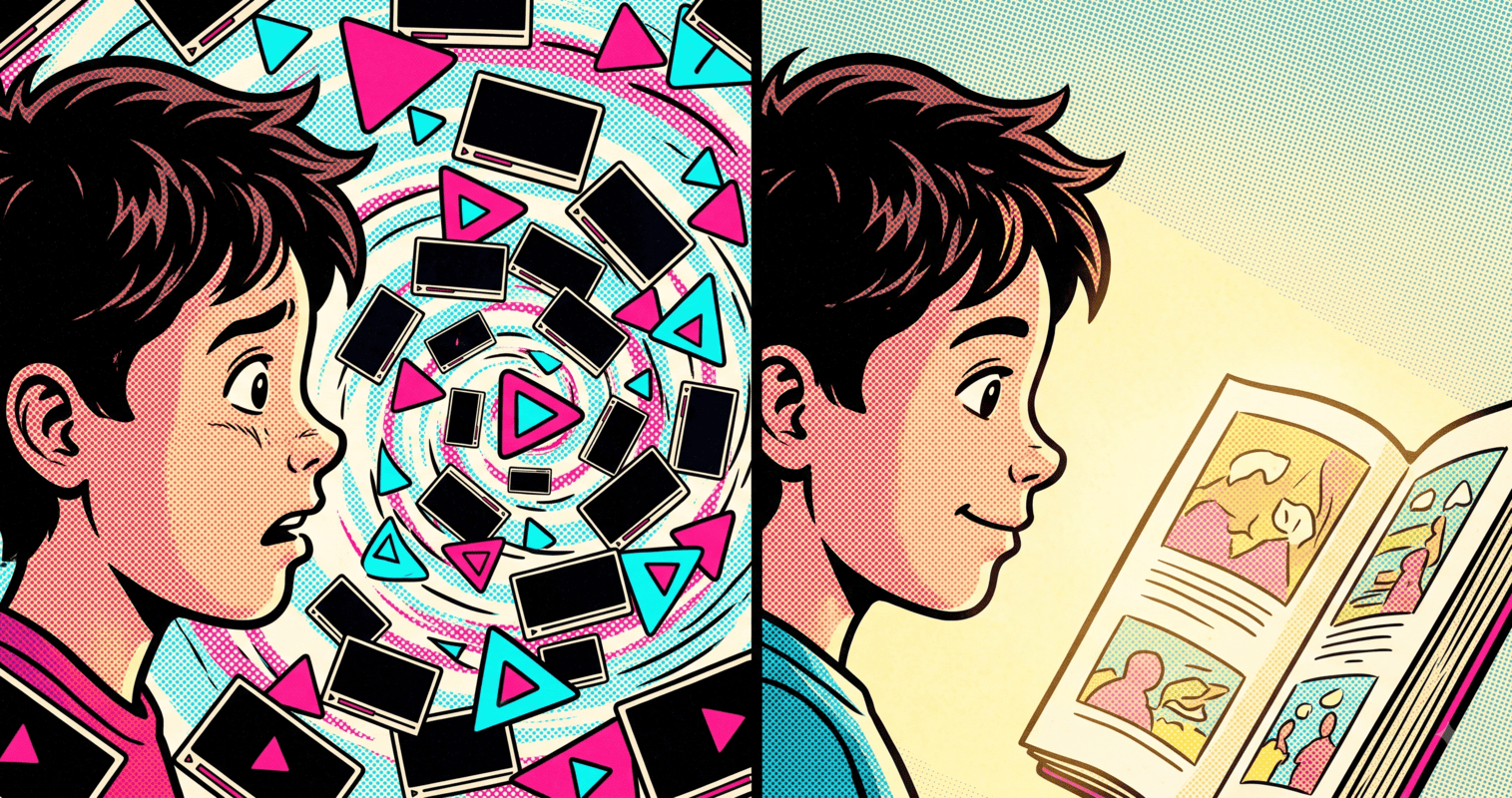
Kids' Attention Spans & Short Videos: What Parents Must Know
posted on : 29 August 2026
Is Short-Form Video Shrinking Your Child's Attention Span? What Parents of 3-8s Need to Know
Your child used to sit through a whole picture book. Now they're swiping mid-page, bored in seconds, asking "what next?" before anything begins. And somewhere online you've met the phrase everyone's suddenly using: brain rot.
Here's the two-sentence truth. Short-form video doesn't damage a young brain like a toxin — but heavy use trains it to expect a new reward every few seconds, which is the opposite of the slow, stretchy attention reading and school demand. The good news: attention is a muscle, and at ages 3-8 it responds to training remarkably fast.
This guide covers what the new research actually shows, what a typical attention span looks like at each age, the 7 signs your child's focus needs help, and the "attention diet" that rebuilds it.
In this guide:
What the new research says
Typical attention spans at 3-8
Why short videos hit young brains hardest
7 signs your child's focus needs help
The attention diet: 5 swaps
Reading: the original attention training
FAQs
Is "Brain Rot" Real? What the New Research Says
The honest answer: "brain rot" is a nickname, not a diagnosis — but the pattern behind it is showing up in real studies of real children. A 2025 study in the journal PLOS ONE followed 1,052 elementary school students and found that the more time children spent on short-video platforms, the weaker their attention on schoolwork — and through that weakened attention, the lower their academic results (summary of the study here).
Two details from that study deserve a spot on the fridge. First, the link ran through attention — short video didn't make children less clever; it made sustained focus harder, and grades followed. Second, children whose parents used short video heavily showed stronger negative effects. The house's scrolling habits, not just the child's, set the weather.
One honest caveat: this research shows correlation, not proven cause-and-effect, and scientists are still mapping the details. But with children under 8 now averaging about 2.5 hours of screen media a day (Common Sense Media, 2025) — and short-form the fastest-growing slice — "wait for perfect proof" is not a plan.
What a Typical Attention Span Looks Like at 3-8
Before worrying, calibrate. Young children are supposed to have short attention spans — a rough rule of thumb many child specialists use is a few minutes of focused attention per year of age for a task an adult chose. For an activity the child loves, it stretches far longer.
Age | On a task someone else chose | On something they love |
|---|---|---|
3 | Around 5-10 minutes, with support | Can surprise you — 15+ minutes deep in play |
4-5 | Roughly 10-15 minutes | 20-30 minutes (dinosaurs, LEGO, one more story) |
6-8 | Around 15-25 minutes, growing each year | 30+ minutes once absorbed in a book or build |
📌 Screenshot this table. A 4-year-old abandoning a worksheet after 12 minutes is developmentally right on time. The worry sign isn't a short span — it's a shrinking one.
Why Short Videos Hit Young Brains Hardest
Attention at ages 3-8 is under construction — which makes the training data matter. A 30-minute story asks a child to hold characters, wait through the slow middle, and earn the ending. A short-video feed asks for none of that: every 20-40 seconds, a fresh burst of novelty arrives, chosen by an algorithm that never lets boredom happen.
Practise anything for two hours a day and you get better at it. Heavy short-form viewing is, in effect, practising switching — and a child who becomes excellent at switching finds sustaining harder everywhere: at the dinner table, in the classroom, on page four of a picture book.
None of this makes you a bad parent for ever handing over the phone. Nearly every family is running the same experiment at the same time — 40% of children now have their own tablet by age two (Common Sense Media, 2025). The point isn't guilt. It's that the training can be redirected.
7 Signs Your Child's Focus Needs Help
One sign alone means nothing; several together, growing over months, mean it's time for the attention diet below.
Books they used to love now get abandoned after a page or two.
Play flits — toy to toy every couple of minutes, nothing goes deep.
"I'm bored" arrives within a minute of a screen switching off.
Meals only happen in front of a screen.
Waiting — in queues, for a turn, for you to finish a sentence — triggers instant protest.
Puzzles, LEGO and drawing get started and left, started and left.
They ask to skip to "the good part" of stories, shows, even games.
Sound familiar at 4pm specifically? Some of what looks like broken focus is just an empty tank — our guide to after-school meltdowns covers that separate (and very fixable) problem.
The Attention Diet: 5 Swaps That Rebuild Focus
Attention recovers the way it eroded: through daily practice. Swap, don't snatch — removal alone creates a vacuum and a war.
Shorts → full episodes. Same screen time, longer arcs. A 20-minute story episode with a beginning, middle and end is attention practice; a feed of clips is switching practice. (Autoplay off — our screen-time do's and don'ts shows how.)
Twenty screen minutes → one long story. The daily read-aloud is the gold-standard attention stretcher: a plot held across 15 quiet minutes, no dopamine fireworks, ending earned.
Background noise → one-thing time. Ten minutes a day of a single absorbing hands-on thing — puzzle, LEGO, helping cook — with the TV off. Depth is the workout.
Instant rescue → a little boredom. Boredom is where children practise generating their own focus. Count slowly to 90 before rescuing a "bored" child; most find something before you reach 60.
Your feed → your book. The study above found parents' short-video habits amplified children's attention costs. Ten visible minutes of you reading anything on paper is the strongest attention lesson you own.

Reading: The Original Attention Training
Every swap above points the same direction, so let's say it plainly: a story is the oldest attention-training technology we have. Following one thread for many minutes, holding what happened, wanting what's next — that is sustained attention, being built in the most enjoyable packaging ever invented.
It's also what we watch happen in class every week. At Learn2Read — a live online phonics program for children aged 3-12 across 35+ countries — teachers regularly see a child who could barely sit for five minutes in week one holding focus for a full session by mid-course. Not because the child changed, but because live human teaching holds attention the way no feed can: a real person saying your name, waiting for your answer, cheering your win.
Where should that rebuilt focus go first? Check our reading milestones by age guide — and if the love of books has dimmed, here's how to bring it back.
FAQs: Kids' Attention Spans and Short Videos
Is "brain rot" a real medical condition? No — it's a popular nickname, not a diagnosis. But research is finding real patterns behind it: a 2025 PLOS ONE study of 1,052 schoolchildren linked heavier short-video use to weaker sustained attention and lower academic performance. Treat the phrase as a warning label, not a disease.
How much attention should my 4-year-old have? A rough rule of thumb many specialists use is a few minutes per year of age on an adult-chosen task — so roughly 10-15 minutes at 4, with much longer stretches on things they love. Short attention at this age is typical; the sign worth acting on is attention that is shrinking, not just short.
Has short-form video been proven to cause attention problems in kids? Proven cause? Not yet — current studies, including the 2025 PLOS ONE research, show strong links but are correlational. Proven enough to act on? Most child-development experts think so, because the mechanism is visible at home: constant novelty trains switching, while school and reading demand sustaining.
Can a shrunken attention span recover? Yes — at ages 3-8, quickly. Attention behaves like a muscle: daily read-alouds, longer-form shows instead of clip feeds, one-thing play sessions and a little tolerated boredom typically show visible change within a few weeks. Young brains adapt in both directions; that's the hopeful half of the same plasticity.
Are slow shows like Bluey okay? Long-form, story-driven shows are a meaningfully better attention diet than short-video feeds — an episode has an arc your child must hold. Screen time rules still apply (see our do's and don'ts), but if screens are happening, episodes beat shorts every time.
Does my own phone use really affect my child's attention? The research says yes — in the 2025 study, children's attention costs were amplified in families where parents were heavy short-video users. Children copy the attention habits they can see. A parent visibly reading a paper book is quietly teaching the exact skill the feed untrains.
Read Next
After-School Meltdowns: Why Your Child Falls Apart at Home — when it's an empty tank, not broken focus.
Screen Time for Kids: 7 Do's and Don'ts That Actually Work — the house rules that make the swaps stick.
How to Make Your Child Love Reading (and Why So Many Kids Quit by Age 8) — the best attention training ever disguised as fun.
Want to watch your child's focus stretch, week by week, with a live teacher who holds it? Book a Free Trial Class →
— The Learn2Read Team

Latest Posts
17 October 2026
My Child Knows the Alphabet (ABCD) but Can't Read: Letter Names vs Letter Sounds, Ages 3 to 6

14 October 2026
How to Teach a Child to Write Sentences ?
10 October 2026
b and d Confusion: Is It Dyslexia? How to Fix It (Ages 4-7)

A new chapter from Learn2Read
Read Before They Read
Before you teach your child to read, read this. A calmer, clearer way into your child’s reading journey—with a practical guide written for real Indian homes.